Two magnetos, one key
Each magneto fires one of the two spark plugs in every cylinder. The 172S engine has four cylinders and two plugs in each, so eight plugs in all (POH Section 7, p. 7-28, ENGINE). The right magneto has its four plugs and the left magneto has the other four.
The diagrams on this page are AI-generated teaching images. If you see an issue, please tell us through the contact form.
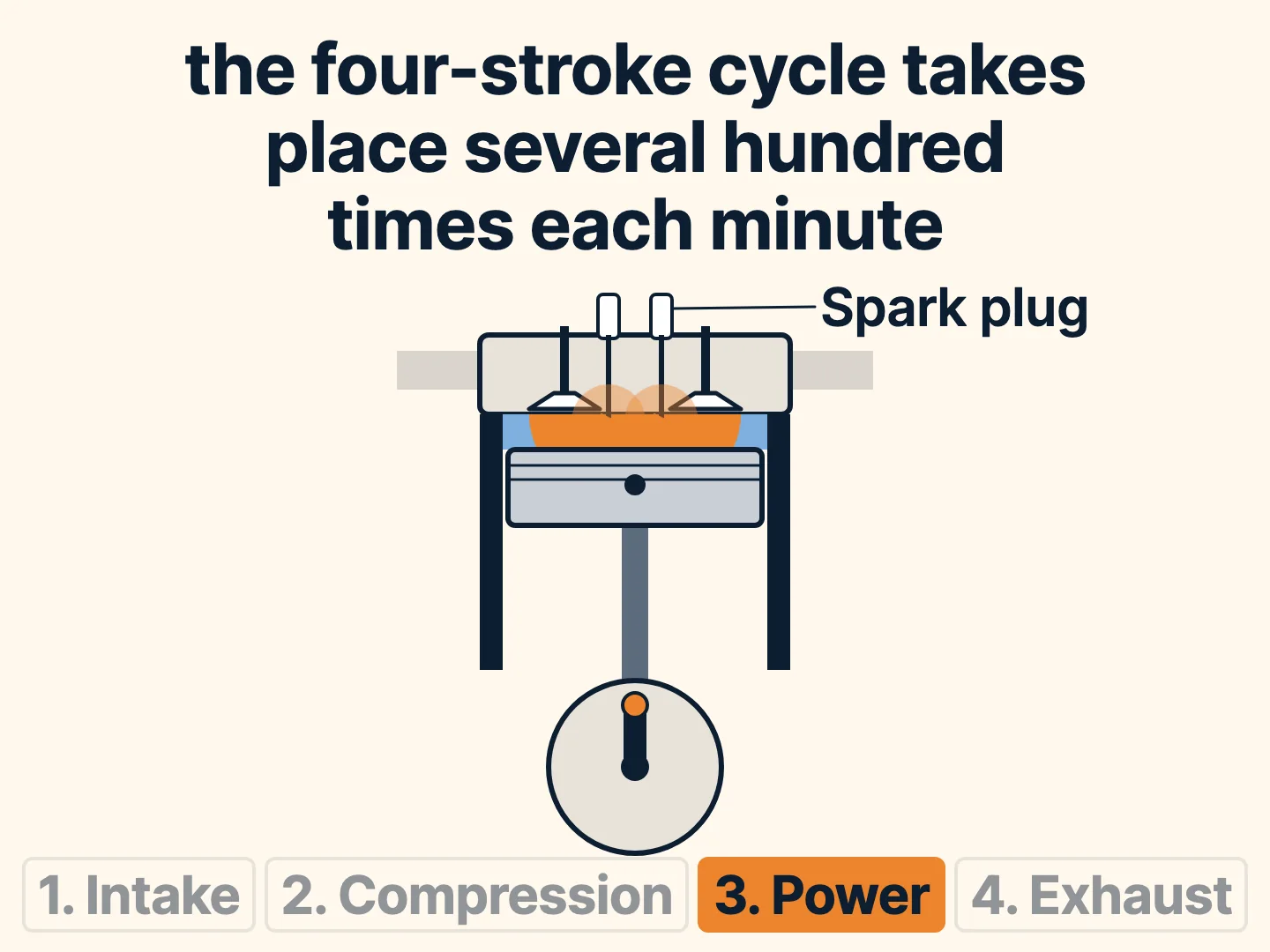
Verbatim, Cessna Model 172S NAV III Pilot's Operating Handbook (172SPHAUS), Section 7, p. 7-34, IGNITION AND STARTER SYSTEM:
Engine ignition is provided by two engine-driven magnetos, and two spark plugs in each cylinder. The right magneto fires the lower right and upper left spark plugs, and the left magneto fires the lower left and upper right spark plugs. Normal operation is conducted with both magnetos due to the more complete burning of the fuel/air mixture with dual ignition.
The key is the magnetos switch. Verbatim, POH Section 7, p. 7-35:
Ignition and starter operation is controlled by a rotary-type switch located on the left switch and control panel. The MAGNETOS switch is labeled clockwise, OFF, R, L, BOTH, and START. The engine should be operated on both magnetos (BOTH position) except for magneto checks. The R and L positions are for checking purposes and emergency use only. When the MAGNETOS switch is rotated to the spring loaded START position, (with the master switch in the ON position), the starter contactor is closed and the starter, now energized, will crank the engine. When the switch is released, it will automatically return to the BOTH position.
What happens in each key position?
| Key | Right magneto | Left magneto | What it is for |
|---|---|---|---|
| OFF | Grounded, no spark | Grounded, no spark | Shutdown and parking |
| R | Fires its 4 plugs | Grounded | Magneto check, emergencies |
| L | Grounded | Fires its 4 plugs | Magneto check, emergencies |
| BOTH | Fires its 4 plugs | Fires its 4 plugs | Every normal phase of flight |
| START | Fires as the engine turns | Fires as the engine turns | Cranking the engine; springs back to BOTH |
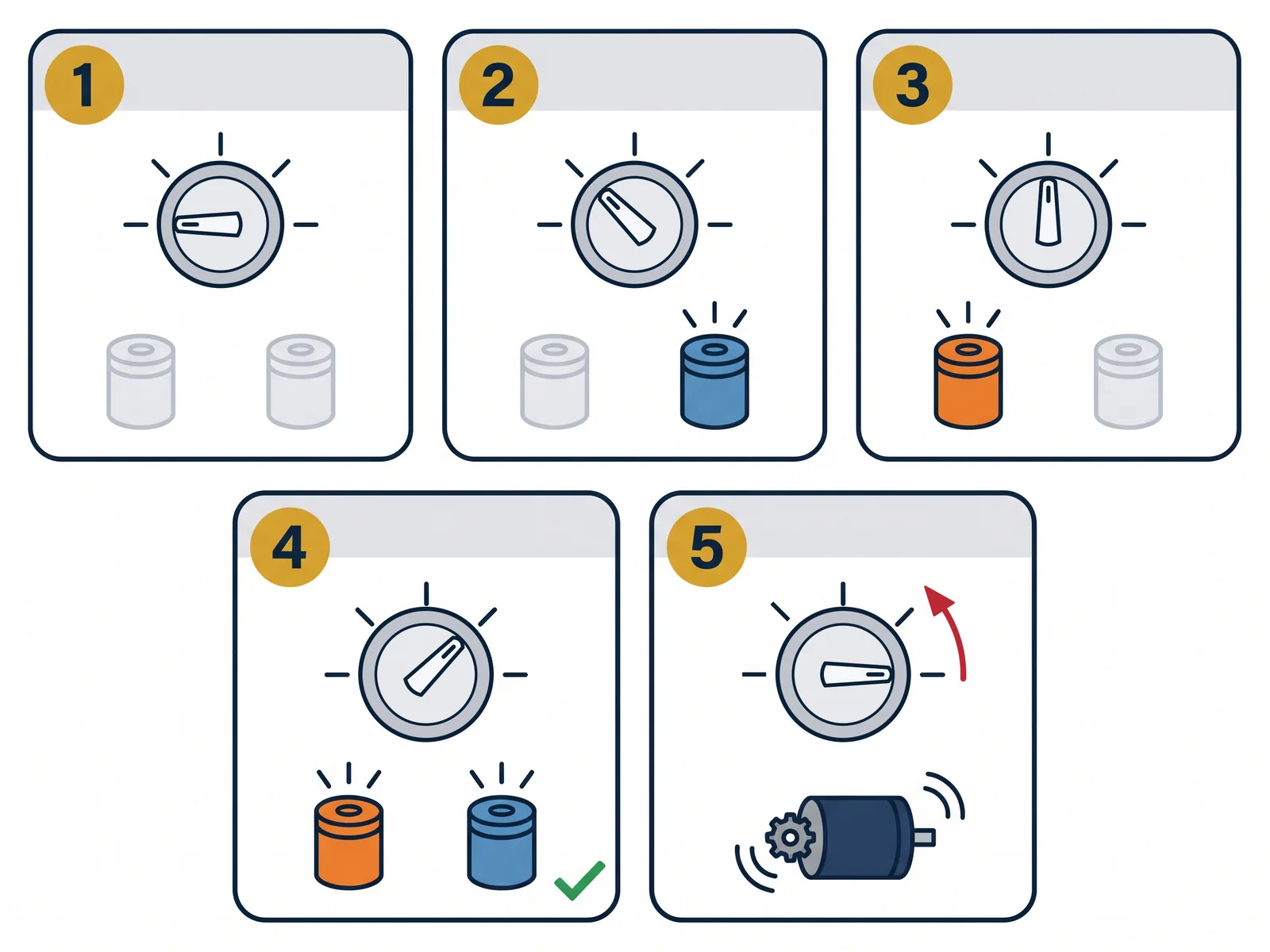
OFF
Neither magneto can fire, so the engine stops. The switch stops each magneto by connecting it to ground through a wire. That is also the weak point: if that wire breaks, the magneto stays "hot" even with the key at OFF.
Verbatim, FAA Pilot's Handbook of Aeronautical Knowledge (FAA-H-8083-25), Chapter 7, p. 7-16:
Even with the ignition switch in the OFF position, if the ground wire between the magneto and the ignition switch becomes disconnected or broken, the engine could accidentally start if the propeller is moved with residual fuel in the cylinder.
So OFF is where the key goes after every shutdown, and every propeller is still treated as live. Verbatim, POH Section 4, p. 4-7, PREFLIGHT INSPECTION, WARNING:
WHEN THE MASTER SWITCH IS ON, USING AN EXTERNAL POWER SOURCE, OR MANUALLY ROTATING THE PROPELLER, TREAT THE PROPELLER AS IF THE MAGNETOS SWITCH WERE ON. DO NOT STAND, NOR ALLOW ANYONE ELSE TO STAND, WITHIN THE ARC OF THE PROPELLER SINCE A LOOSE OR BROKEN WIRE, OR A COMPONENT MALFUNCTION, COULD CAUSE THE ENGINE TO START.
R and L
Only one magneto fires, so each cylinder gets one spark instead of two. On R, the right magneto fires the lower right and upper left plugs and the left magneto is grounded. On L it is the other way around. The engine runs, with slightly less power, because the mixture is lit at one point instead of two. The POH keeps these positions for the magneto check and for emergencies.
BOTH
Both magnetos fire, so every cylinder gets two sparks. BOTH is the normal position for every phase of flight, for two reasons:
- A better burn. Two flames lit at two points burn the mixture more completely, which is why the POH runs the engine on BOTH.
- Redundancy. If one magneto quits, the other keeps every cylinder firing.
Verbatim, Pilot's Handbook of Aeronautical Knowledge, Chapter 7, p. 7-15:
If one of the magnetos fails, the other is unaffected. The engine continues to operate normally, although a slight decrease in engine power can be expected. The same is true if one of the two spark plugs in a cylinder fails.
START
START works the starter motor, not the spark. With the master switch on, turning the key to START closes the starter contactor, and the starter motor cranks the engine. As soon as the crankshaft turns, the magnetos turn with it and begin to fire. When the engine runs, you let go and the key springs back to BOTH.
In the start checklist the step reads, verbatim from POH Section 4, p. 4-13:
15. MAGNETOS Switch - START (release when engine starts)
Just before you turn the key, call "clear" out of the side window and wait for any reply, as the FAA Airplane Flying Handbook asks (Chapter 2, p. 2-16).
How does a magneto make its own spark?
A magneto is a small generator turned by the engine. It spins a permanent magnet to make its own current and steps it up to a voltage high enough to jump the spark plug gap. Nothing in it comes from the battery or the alternator.
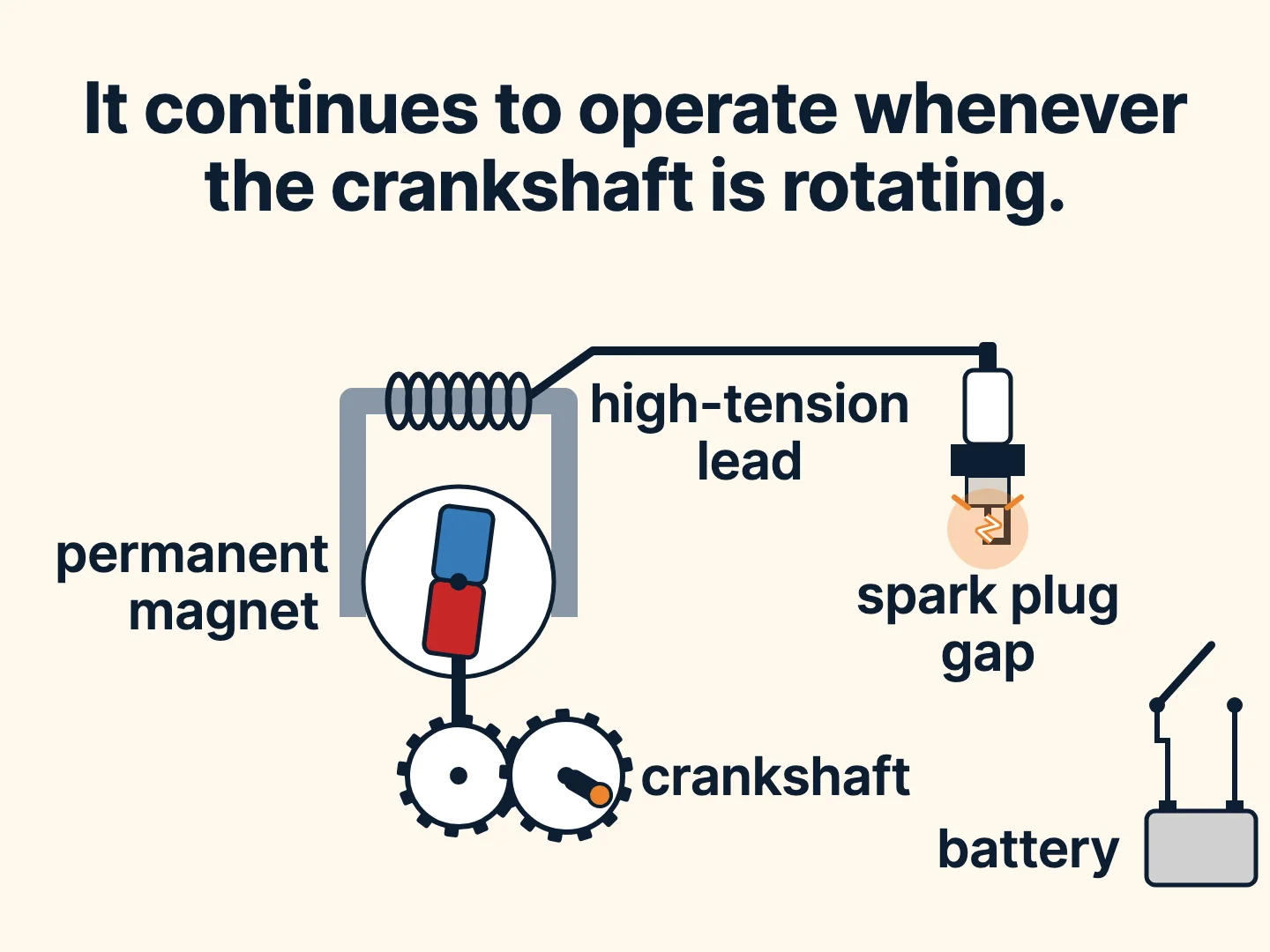
Verbatim, Pilot's Handbook of Aeronautical Knowledge, Chapter 7, p. 7-15:
A magneto uses a permanent magnet to generate an electrical current completely independent of the aircraft’s electrical system. The magneto generates sufficiently high voltage to jump a spark across the spark plug gap in each cylinder. The system begins to fire when the starter is engaged and the crankshaft begins to turn. It continues to operate whenever the crankshaft is rotating.
That has two sides. In flight it is good news: lose all electrical power and the engine keeps running. On the ground it is a hazard: a magneto needs no battery, so moving the propeller with the key left on can start the engine even with the master switch off (Pilot's Handbook of Aeronautical Knowledge, Chapter 7, p. 7-16).
How does the starter work?
The starter is the only part of starting that uses the battery. It is an electric motor that turns the engine fast enough to start, and the key's START position switches it on through a solenoid, called the starter contactor in the POH.
Verbatim, Pilot's Handbook of Aeronautical Knowledge, Chapter 7, p. 7-19, Starting System:
The starter engages the aircraft flywheel, rotating the engine at a speed that allows the engine to start and maintain operation.
When the starter switch is released from the “start” position, the solenoid removes power from the starter motor.
The starter cannot run for long. Its duty cycle, and why the battery limits your attempts too, are in our checklist guide.
How does the magneto check work at the run-up?
The magneto check proves each magneto can run the engine on its own before you take off. It uses the R and L positions, one at a time.
Verbatim, POH Section 4, p. 4-17, BEFORE TAKEOFF:
16. Throttle Control - 1800 RPM a. MAGNETOS Switch - CHECK (RPM drop should not exceed 150 RPM on either magneto or 50 RPM differential between magnetos)
The POH's amplified procedure (Section 4, p. 4-29) sets the order:
- Throttle to 1,800 RPM.
- Key from BOTH to R. Note the RPM.
- Back to BOTH, to clear the spark plugs.
- Key from BOTH to L. Note the RPM.
- Back to BOTH.
A small drop is normal, because one magneto lights the mixture at one point instead of two. A drop of more than 150 RPM on either side, or a difference of more than 50 RPM between them, fails the check. If the engine quits on one magneto, the check fails too, and the airplane does not fly until the problem is fixed. The FAA lists fouled plugs, broken or shorted wires, and improper timing as possible causes (Pilot's Handbook of Aeronautical Knowledge, Chapter 7, pp. 7-15 to 7-16).
No drop at all is a warning, not a pass. It can mean a magneto is not grounding, the "hot" magneto described under OFF. Verbatim, Pilot's Handbook of Aeronautical Knowledge, Chapter 7, p. 7-16:
It should be noted that “no drop” in rpm is not normal, and in that instance, the aircraft should not be flown.
The POH adds that no RPM drop may indicate a faulty ground to one magneto or magneto timing set in advance of the specified angle (Section 4, p. 4-29).
Where does the key show up in the checklists?
Three times in a normal flight. At the start you turn the key to START and it returns to BOTH by itself. At the run-up you check R and L. At shutdown the key goes to OFF.
In our private pilot course, students learn these checklists in the G1000 simulator one checklist per flight, and they learn what each item does along the way. The start and pre-taxi items are explained one by one in our checklist guide.
Watch and read
Outside video: Aircraft Systems - 03 - Engine, published by ERAU SpecialVFR. The ignition section starts at 7:44: the magneto at 8:06, its independence from the airplane's electrical system at 8:13, two magnetos at 8:38, and the switch positions OFF, right, left, both and start from 9:00 to 9:48. The same video covers detonation at 10:00. https://www.youtube.com/watch?v=gIdXLMVP6VU&t=464s
Our videos:
- Cessna 172 Engine Run-up, from 2:53: the magneto check during the run-up
- Starting Engine, Cessna 172 G1000, from 5:19: the magneto switch to START, held until the engine fires
Sources:
- Cessna Model 172S NAV III Pilot's Operating Handbook (172SPHAUS), Section 7, p. 7-28, ENGINE, and pp. 7-34 to 7-35, IGNITION AND STARTER SYSTEM
- Cessna Model 172S NAV III Pilot's Operating Handbook (172SPHAUS), Section 4, p. 4-7, PREFLIGHT INSPECTION (WARNING); p. 4-13, STARTING ENGINE (With Battery), step 15; p. 4-17, BEFORE TAKEOFF, step 16; p. 4-29, MAGNETO CHECK
- FAA Pilot's Handbook of Aeronautical Knowledge (FAA-H-8083-25), Chapter 7, pp. 7-15 to 7-16, Ignition System, and p. 7-19, Starting System
- FAA Airplane Flying Handbook (FAA-H-8083-3C), Chapter 2, p. 2-16, Engine Starting
Technique only. This post explains the system as the Cessna 172S NAV III POH and FAA handbooks describe it. The POH for the airplane you fly governs.