Flight Instructor (CFI/CFII)
$35 to $85 per hour
A part-time teaching side gig for CFIs and CFIIs who love to teach. Set your own hours on our Garmin G1000 AATD, with Cirrus G3000 simulators to follow; G1000 fluency required, G3000 trainable.
Aviator.NYC is a flight simulator training studio in Midtown Manhattan, run by people who fly professionally. We are hiring for three part-time roles and two internships, all on site at 35 West 31st Street, Suite 901 (by appointment only). Every role comes with the same expectation: find better ways to work, and use AI to get there.
Three part-time roles are open right now: a flight instructor position for CFIs and CFIIs who are fluent on Garmin avionics, a VR simulator operator position, and a video and content creator position. All three are part-time and based at our studio in Midtown Manhattan.
$35 to $85 per hour
A part-time teaching side gig for CFIs and CFIIs who love to teach. Set your own hours on our Garmin G1000 AATD, with Cirrus G3000 simulators to follow; G1000 fluency required, G3000 trainable.
$20 to $50 per hour
Film and produce social media content with AI-assisted workflows. For people who see a repetitive task and think "there has to be a way to automate this."
$17.00 per hour
Run virtual reality flight sessions and keep equipment and clients safe. Written for student pilots in high school or early college who want part-time hours near aviation. No pilot certificate required.
At Aviator.NYC, we use AI extensively throughout our business. We are not looking for people who spend hours doing repetitive work simply because that is how it has always been done. We are looking for people who enjoy finding better ways to work. If a task can be automated, accelerated, or improved with AI, we expect you to explore it: video editing, caption generation, scheduling, research, workflow automation, and any other repetitive process. Our goal is not to replace creativity or judgment with AI. It is to eliminate unnecessary manual work so the team can spend its time on what actually matters: teaching people to fly, creating valuable content, and building a great simulator training studio. This mindset applies to every role on this page, from instruction to content production to operations.
Yes. You do not need a pilot certificate to be part of what we are building. We are a small team and we are always looking for people who are excited about aviation and want to grow with us. Video and content work is now a paid position: see the Video & Content Creator role above.
Work on real projects, from AI-powered training tools to booking systems. Next.js, TypeScript, and OpenAI experience is a plus.
Learn the business side of running a flight school: scheduling, student coordination, and FAA compliance. Aviation background or student pilot preferred.
Internships are flexible and can be tailored to your schedule. Choose the internship in the position field of the application below.
Fill out the form below with your resume, the position you want, and a brief message about why you want to join our team.
We schedule a phone or Zoom interview to discuss your background, availability, and what you want out of the role. Instructor candidates should watch our G1000 procedures playlist on YouTube before the interview.
Visit our Midtown Manhattan studio for a hands-on evaluation: a simulator session for instructors, a working session for content and operations roles.
Once approved, we onboard you, review our standards and workflows, and match your schedule to real work.
Every open role at Aviator.NYC is part-time. Flight instructors work as independent contractors and set their own availability, typically teaching 5 to 15 hours per week. The Video & Content Creator and VR Simulator Operator roles are part-time positions with hours that flex around our content calendar and session bookings. We are deliberate about this: our business runs on appointments across mornings, evenings, and weekends, and part-time roles let us match great people to the hours that actually exist. If you are looking for full-time employment, none of the current openings will fit on their own. If you want meaningful, well-paid work that fits around flying, school, or another job, they are designed for exactly that.
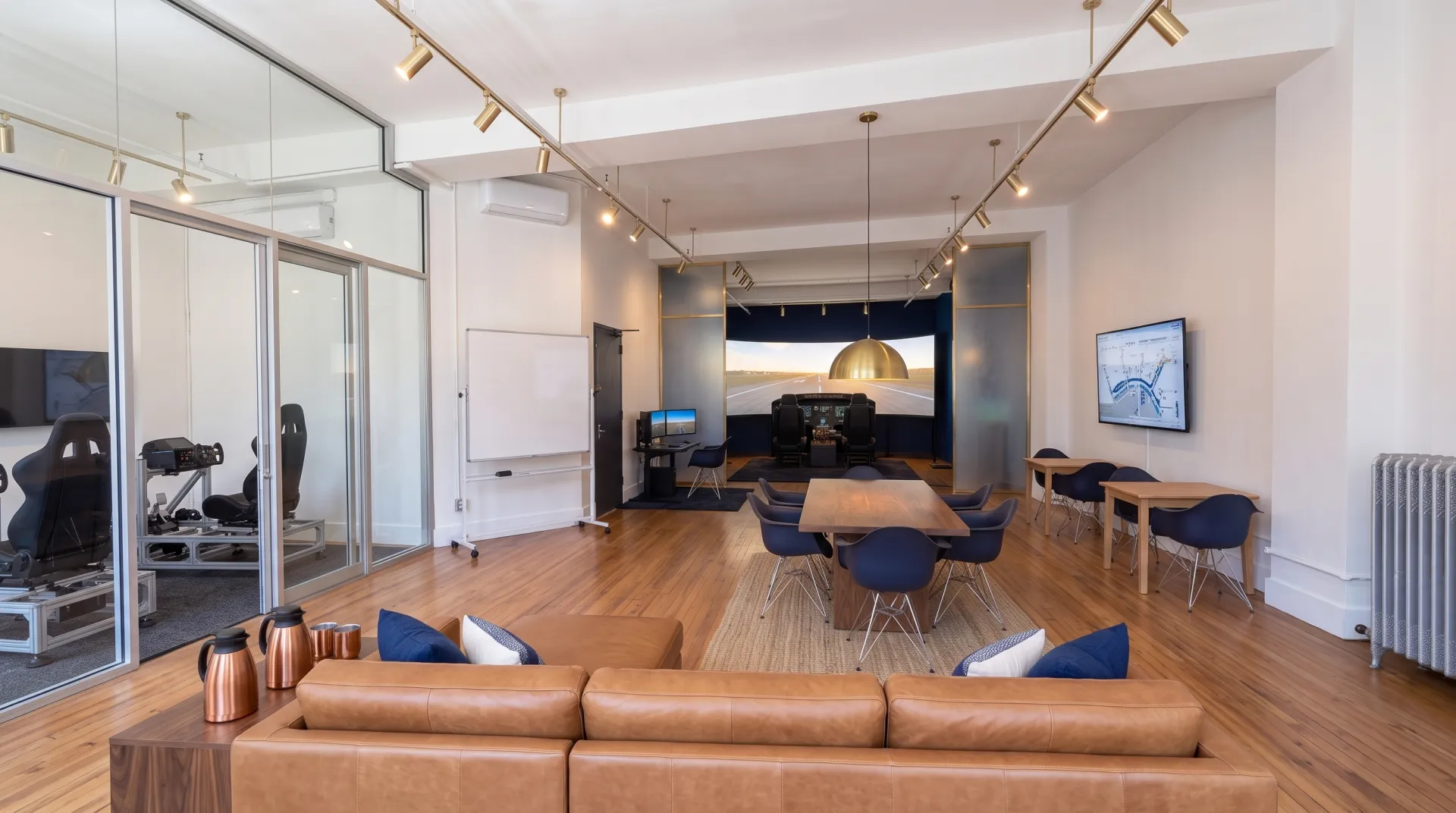
Our studio is at 35 West 31st Street, Suite 901 in Midtown Manhattan, and it operates by appointment only. The space houses our Garmin G1000 Advanced Aviation Training Device (AATD). We will add the Cirrus SR20/SR22 simulators with Garmin G3000 flight decks and our virtual reality (VR) simulators. All roles work on site: instructors teach in the studio, the VR operator runs sessions there, and the video and content creator films there, though editing and publishing work can flex to wherever you work best. The studio is a short walk from multiple subway lines, which makes commuting from anywhere in New York City straightforward.
Apply using the form at the bottom of this page or on any role page: pick the position, upload your resume, and tell us briefly why the role fits you. We review every application and reply within one to two weeks if there is a potential match. From there the process is an initial phone or Zoom interview, a role-specific evaluation at the studio, and then onboarding. For flight instructors the evaluation is a simulator session where we look at your teaching and your Garmin avionics fluency. For content and operations roles it is a practical working session. The whole process usually takes two to three weeks from application to first day.
Yes. If you are a fit for more than one role, submit one application for the position that interests you most and mention the other roles in your message. We read every application personally, so a note like "primarily applying for VR Simulator Operator, but also interested in the Aviation Operations internship" works perfectly. Some of the best fits overlap: a student pilot might operate VR sessions while learning the business through operations work, or a content producer might grow into covering everything our instructors teach. We are a small team, and people who can contribute in more than one area are especially valuable to us.
Pick a position, upload your resume, and tell us a bit about yourself.