
WHERE ARE YOU IN YOUR JOURNEY?
Jump to the Right Stage for You
YOUR STEP-BY-STEP PATH
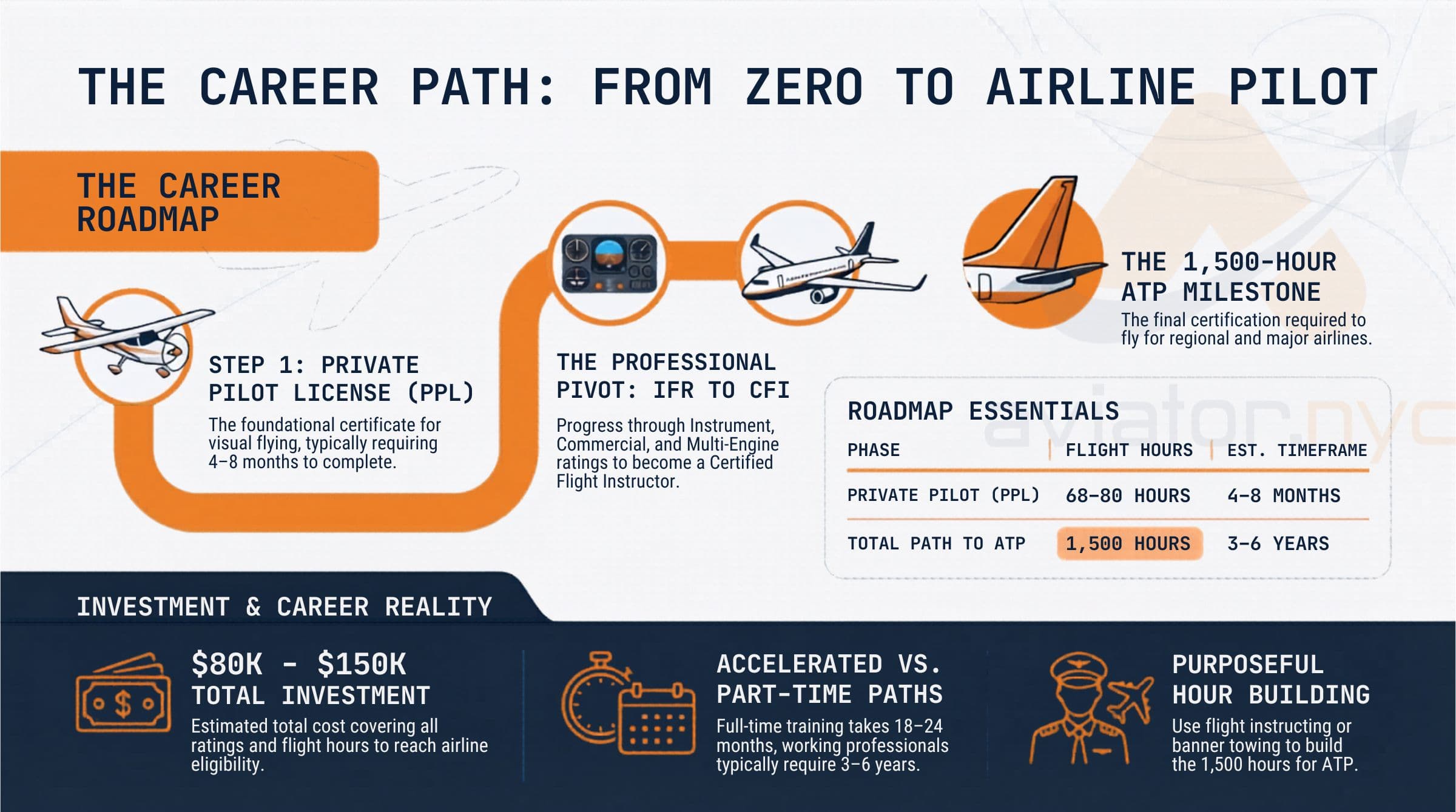
From Zero to Airline Pilot
Select your current stage to see what it takes, what it costs, and how Aviator's airline pilots help you get there.
New to Flying? Start Here — Your Private Pilot License (PPL)
Your foundation for all flying—learn to fly visually in good weather.
The Private Pilot License is your first certificate. It teaches you to fly in good weather using outside visual cues (VFR). After PPL, you can add ratings (Instrument, then Commercial) if you want to go further. Reality check: The FAA minimum is 35–40 hours, but most part‑time students finish in 60–100+ hours depending on how often they fly, weather, and schedule consistency.
You're at this stage if:
- You have zero flight hours and are just starting
- You're a career-changer planning your first step toward airlines
- You want to fly for personal reasons but might go further later
Common Questions
How long does it really take to reach the airlines?
Most part-time students take 4–6 years from zero to regional airline First Officer. Full-time students at accelerated programs can reach minimums in 18–24 months, but still need to build 1,000–1,500 hours through instructing or other commercial flying.
What if I just want to fly for fun — not a career?
That's great — most of our students are hobby pilots. Start with PPL and see where it takes you. You can always add ratings later.
Is it too late if I'm 30 or older?
No. Airlines hire pilots into their 50s. What matters is reaching ATP minimums and passing the medical. Many of our students are career-changers in their 30s and 40s.
Fit and scheduling matter more than anything. Find someone who matches your learning style and availability.
So there are no surprises later. Most healthy adults pass without issues.
Learn more →Learn procedures and radios before burning airplane time. Save money and build confidence.
Learn more →Full cost breakdown available at aviator.nyc/pilot-license-cost-nyc/
- 40 hours total flight time (can include simulator)
- 20 hours with an instructor
- 10 hours solo in single‑engine airplane
- 5 hours solo cross‑country (>50 NM)
- 150 NM solo cross‑country with 3 landings
- 3 landings at towered airport
- 3 hours cross‑country training (dual)
- 3 hours night training + 10 night landings
- 3 hours instrument training ("under the hood")
- 3 hours within 2 months of checkride
Aviator's Role at This Stage
Use our Manhattan AATD to master radio calls, G1000 procedures, and emergency flows before burning expensive airplane time. Our airline pilot instructors teach you professional habits from day one.
TOTAL INVESTMENT
What Does It Cost to Become an Airline Pilot?
Career pilot training is a significant commitment. Here's the honest overview — and where simulator training at Aviator saves you real money.

Career Pilot Resources
Deep-dive articles from airline pilots on every stage of the path
Career Pilot Roadmap
From zero to airlines — every certificate, rating, and milestone.
Part 61 vs Part 141
Which training path gets you to the airlines faster — and at what cost?
Training Cost Guide
Full cost breakdown for private pilot through ATP — realistic NYC budgets.
Foreign License Conversion
International pilot? Convert your license to FAA without a checkride.
Best Training Airports
Compare airports within 2 hours of NYC for your flight training.
Does the avionics panel matter while you are earning a private certificate?
Midtown studio: Open at 35 West 31st Street, Suite 901.
You are working toward a private pilot certificate and paying for every hour, in the airplane and in the simulator.
You have heard that glass panels and round dials are different worlds, and you do not want to spend hours learning something that will not transfer.
Through the first six to ten hours there is very little practical difference between a round-dial panel and a glass one, because that time is airmanship: attitude, power, trim, and where to look. The difference shows up later, and it shows up sharply.
How to choose
- Treat the early hours as airplane time, not panel time. Pick the simulator whose airplane matches what you rent.
- When you start cross-country and navigation work, switch your attention to the panel. This is where the G1000 earns its place: flight plan entry, procedure loading, and approach logic.
- Carry it forward. That Garmin workflow is the same logic you meet in a GTN 650 or GTN 750, and in the earlier GNS 430W and 530W navigators.
| G1000 Suggested for you | Cirrus SR Delayed to 2027 | |
|---|---|---|
| Aircraft | Cessna 172R / 172S, Cessna 182T / T182T, Piper Archer, and Diamond DA40 | Cirrus SR20 and Cirrus SR22 |
| Avionics | Garmin G1000 NXi | Garmin Perspective Touch+ (G3000 displays, GTC 580 controllers) |
| Panel type | Knobs and soft keys | Touchscreen controllers |
| Autopilot | GFC 700 | GFC 700 |
| Software | Garmin G1000 PC Trainer (manufacturer software) | Cirrus Perspective Touch+ profile on X-Plane 12 |
| FAA status | FAA-approved AATD, loggable with an instructor | FAA-approved AATD, loggable with an instructor |
| Available | Now, in Midtown Manhattan | Delayed to 2027. It will run at the new Midtown studio. |
What you get
Navigation skills built on the panel you will actually use, and early hours that were never wasted on the wrong question.
What it costs to guess
Pilots who postpone the avionics until they are in the airplane end up learning menu structure at cruise speed, which is the most expensive classroom there is.
These are not video games
The G1000 simulator is an FAA-approved Advanced Aviation Training Device (AATD). Flown with an instructor, the time counts toward the instrument rating, instrument currency, the private pilot certificate, and the commercial certificate.
The Cirrus SR simulator will be an FAA-approved Advanced Aviation Training Device (AATD). Flown with an instructor, the time will count toward the instrument rating and instrument currency.
The Vision Jet simulator will be an FAA-approved Advanced Aviation Training Device (AATD). Flown with an instructor, the time will count toward the instrument rating, instrument currency, and type rating preparation.
The VR simulators are recreational. They are not FAA approved, and time in them does not count toward any certificate, rating, or currency, even with an instructor.
Which Simulators Build a Professional Pilot?
Midtown studio: Open at 35 West 31st Street, Suite 901.
Start on the G1000, where instrument fundamentals and Garmin flight-plan logic are built. Then add touchscreen G3000 fluency on the Cirrus machines, because the same suite runs in the single-pilot jets you may fly later. Airlines hire on discipline and automation management, and both platforms train exactly that.
G1000 Flight Simulator
Suggested for youFlight training airplanes, a Cessna 172 and similar. This is the certified equipment people train in toward a license.Fundamentals first; the G3000 machines are the step up once those are solid.Cirrus SR Series Simulator
Delayed to 2027The Cirrus SR20 and SR22, the airplanes famous for the whole-airframe parachute.Delayed to 2027. It will run at the new Midtown studio.SF50 Vision Jet Simulator
Delayed to 2027The Cirrus SF50 Vision Jet, the only civilian jet built with a whole-airframe parachute.Delayed to 2027. It will run at the new Midtown studio.
VR Flight Simulators
The F/A-18 Hornet, F-16 Fighting Falcon, A-10 Thunderbolt II, and P-51 Mustang lead the recreational launch lineup, alongside a Cessna 172 and a Cirrus SR20 in X-Plane 12. Not FAA approved, and time in it never counts toward a certificate, rating, or currency, even with an instructor.
More about the VR simulatorsCareer Pilot FAQs
Airline path, CFI, Part 61 vs 141, and timeline.
Career Pilot Path
From zero time to airline career — certificates, timeline, and Part 61 vs 141.
Aviator NYC's career pilot program starts with private pilot training and progresses through instrument, commercial, and ATP — the same path every airline captain follows.
- Private Pilot License (PPL) — 40–75 hours, your foundation certificate
- Instrument Rating (IR) — required for airline operations and IFR flying
- Commercial Pilot License (CPL) — 250 hours total time, allows you to fly for compensation
- Airline Transport Pilot (ATP) — 1,500 hours total time (1,000 with R-ATP), required for airline captain
Aviator NYC's instructors started the same way you will — CFI is the most common path to building the 1,500 hours needed for an airline career.
- CFI requires a commercial certificate and ~250 total flight hours
- Most flight instructors earn $30–$60/hour while building time toward ATP minimums
- Teaching accelerates your own learning — instructors develop deeper aeronautical knowledge
- Aviator NYC hires CFIs who want to teach, not just build hours — that distinction matters
Aviator NYC operates under Part 61 — for career pilots, the choice depends on whether you need VA benefits or plan to train full-time.
- Part 141: commercial certificate at 190 hours (vs 250 for Part 61) — saves time and money for full-time students
- Part 141: required for most GI Bill flight training benefits
- Part 61: no fixed syllabus, more flexibility for working professionals training part-time
- Part 61 does NOT count Part 141 cross-country time — 50 hours lost if you switch paths
Aviator NYC trains career changers in their 30s, 40s, and beyond — there is no age limit for earning pilot certificates or getting hired by airlines.
- Regional airlines hire pilots regardless of age — they need qualified candidates
- Major airlines evaluate experience and training records, not age
- Many successful airline captains started training in their 30s or later
- The FAA mandatory retirement age is 65 — plenty of career runway if you start at 35
Aviator NYC graduates who train full-time can reach regional airline minimums in 2–3 years — part-time students typically take 4–6 years.
- PPL + IR + CPL: 12–24 months of active training
- CFI time building to 1,500 hours: 12–24 months of full-time instructing
- R-ATP (Restricted ATP): available at 1,000 hours with qualifying aviation degree
- Regional airline hiring is strong — qualified pilots are in demand
Non-U.S. Citizen?
TSA approval is required before your second lesson. We do NOT sponsor visas.
We do NOT sponsor visas.
Learn about TSA requirements →Plan Your Path to the Airlines
Get a personalized roadmap from airline pilots who've done it. We'll walk through your timeline, budget, and which stages Aviator can help with most.