How Does Teenage Pilot Training Work in NYC?
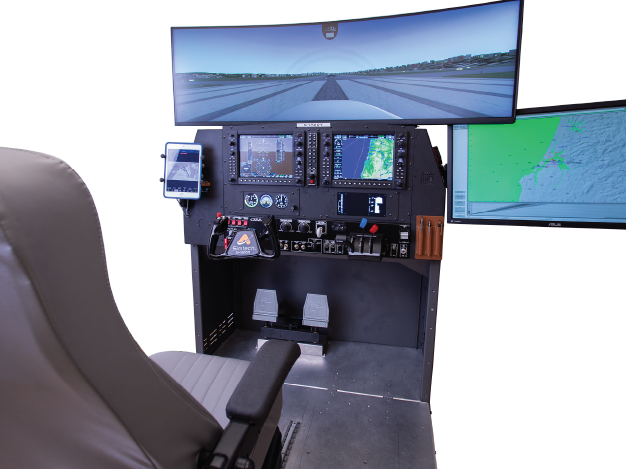
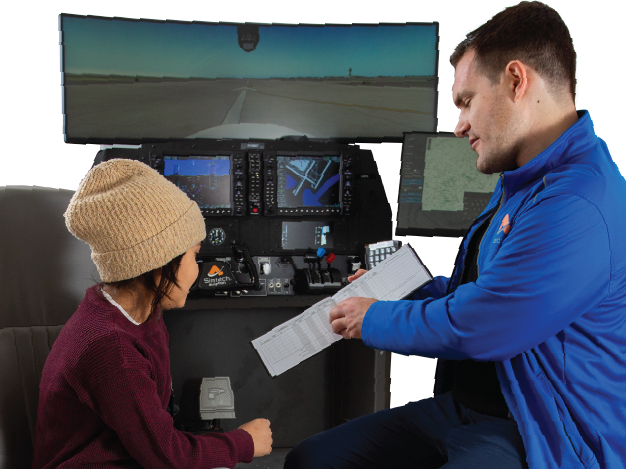
Your teenager can solo at 16 and, just a year later, earn their private pilot certificate at 17. Along the way, our airline pilot instructors mentor them through every milestone — building skills in the simulator between airplane flights.
How Simulator Training Helps Your Teenager
Airplane training is expensive, and it's hard to schedule from NYC. So the simulator bridges the gap — it keeps your teen progressing between flights at a fraction of the cost.
Build Skills Between Flights
When you can't get to the airplane, the simulator keeps training going. As a result, your teen arrives at the aircraft ready to progress — not review basics.
Mentored by Airline Pilots
Our instructors fly professionally, and some walked this exact path — solo at 16, private pilot at 17. In other words, they mentor, not just teach.
Clear Milestone Roadmap
First, know exactly what's needed at each age — solo, written exam, checkride. In short, no guesswork about the FAA certification path.
The Pilot Certificate Timeline
What is the minimum age for a pilot's license? Here is every FAA milestone from 14 to 18.
Glider Solo (An Option for Early Starters)
At 14, a student can solo in a glider. However, this is less common. For example, it's offered through groups like Civil Air Patrol and flight schools in upstate New York and Arizona. We don't offer glider training — instead, this section is here for families researching the full picture.
Before any solo, your teen must have:
- Sufficient training to meet the standard
- An instructor endorsement (the instructor signs off that the student has the skills and knowledge to fly solo)
- An FAA Student Pilot Certificate
- An FAA Medical Certificate
In other words, it's not just an age requirement — training must be finished before this age, so your teen can solo on their birthday.
Solo in a Powered Aircraft
At 16, your teen can solo in a powered aircraft like a Cessna 172 or Cirrus.
Powered aircraft solo requirements:
- Meet the Airman Certification Standards (ACS)
- Instructor endorsement
Glider path: If they also pursued glider training, then they can earn their Private Pilot Certificate for Glider at 16. To do this, they must pass the aeronautical knowledge (written) exam and a checkride with an FAA examiner.
Finally, the earliest any milestone can happen is the date of their birthday.
Where the Simulator Makes the Biggest Difference
This is the window where simulator training has the most impact. Between airplane flights, your teen builds skills, practices steps, and stays engaged — all at a fraction of the cost of airplane time.
For example, sharp, motivated students who study four hours for every one flight hour can be endorsed for solo around 10 hours of airplane time. Realistically, though, very sharp students finish solo prep in about 20 hours.
In addition, the most motivated students can start building instrument rating knowledge in the simulator. The minimum age for an instrument rating is 17 — so starting early gives them a head start.
Private Pilot Certificate
At 17, your teen can earn their Private Pilot Certificate for powered aircraft.
Requirements:
- Meet the Airman Certification Standards (ACS)
- Pass the written (aeronautical knowledge) exam
- Pass the practical exam (checkride)
- Instructor endorsement
Commercial Pilot Certificate
Up to 50 hours of simulator time can count toward commercial pilot certificate rules. For example, commercial rights include becoming a flight instructor or lowering insurance premiums as an aircraft owner. However, this does not mean getting hired at an airline — rather, it means holding the rating for commercial rights.
Also, this connects to the instrument rating started at 16-17. For motivated families, then, it's a "nice to know" milestone on the horizon.
Train Smarter Between Airplane Flights
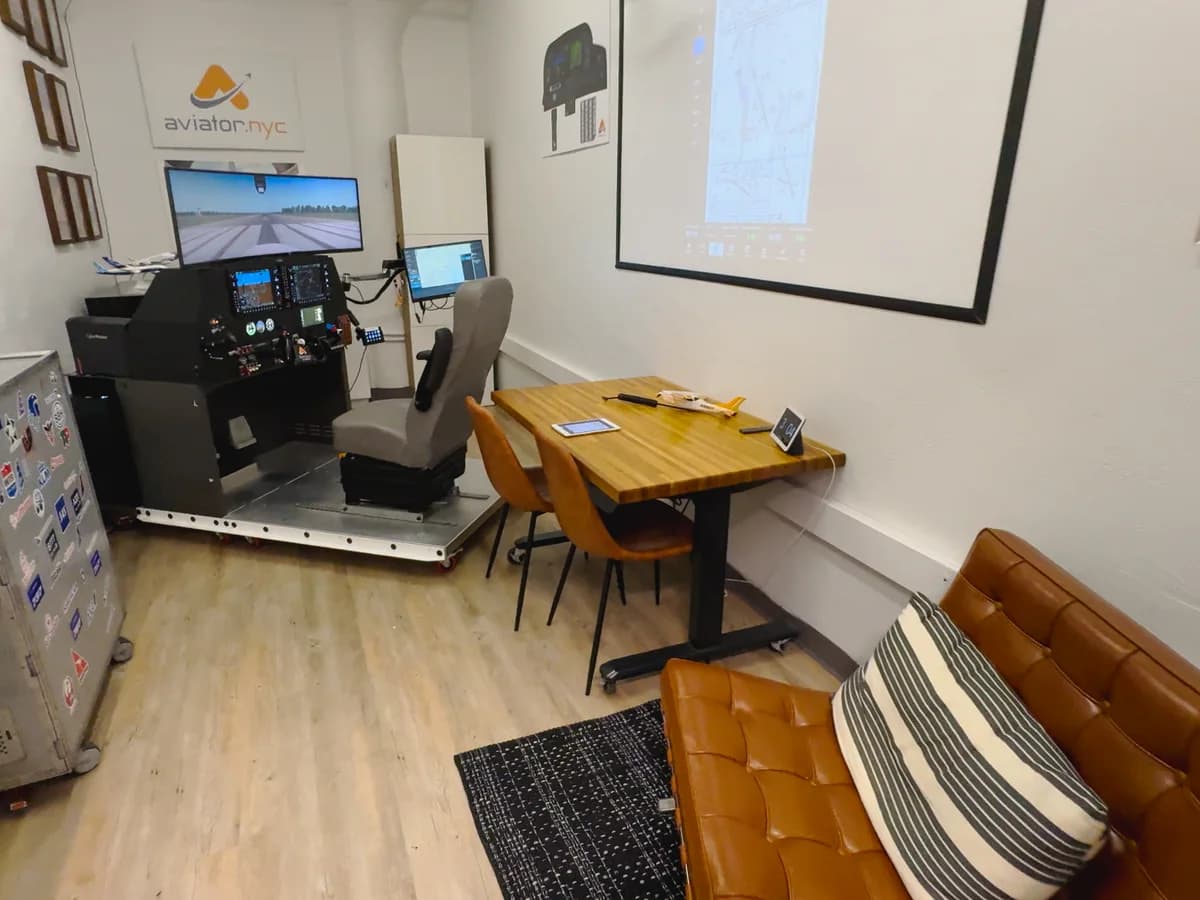
Most pilots in NYC face the same challenge: airplane training is expensive, weather-dependent, and hard to schedule. However, for a teen on the path to their pilot certificate, the simulator changes the equation.
- Keeps the passion alive — maintains interest and momentum
- Continuous skill building — learning does not stop between flights
- Cost-effective progression — a fraction of airplane lesson costs
- Mentorship from airline pilots — instructors who walked this path
- No fixed timeline — every student is different, and that is okay
“Our job is to help empower those who are trying to make it through and want to build momentum forward.”
Important: FAA Medical for Teens
Before your teen can solo, they need an FAA Medical Certificate and Student Pilot Certificate. However, if your teen has taken ADHD medication, antidepressants, or any stimulant drug, the FAA Medical process takes much longer. So start this early, and it won't delay solo or certification milestones.
Is Your Teen Ready?
It varies from person to person. However, the easiest way to find out is to book a simulator lesson, and then work with the instructor.
How Instructors Evaluate Readiness
The instructor evaluates your teen as a pilot — not as a teenager. In other words, their performance is measured against the same standard as any student pilot being certified by the federal government. After all, the instructor is putting their certificate on the line.
So most instructors will give honest feedback early on. Here are signs they will flag:
- Not preparing before flights or not studying
- Treating flights as a joy ride rather than training
- Disconnected from the learning process
- Not meeting the standard for pre-flight preparation
More Than a Pilot Certificate
This is not just about becoming an airline pilot. In fact, a private pilot certificate is a powerful edge — for competitive college applications, military academy profiles, and life.
For one thing, flying builds a mindset that transfers to every field:
- Procedural, analytical thinking — pilots are trained to be methodical
- Always three steps ahead — the airplane is always moving
- Fast decision-making under real consequences
- Discipline that makes other complex fields feel manageable
For example, many people in the aviation industry started exactly this way — earning their certificate young, and then using it to strengthen their West Point, Naval Academy, or Air Force Academy applications. Others, meanwhile, built it into a business and lifestyle skill, and in time came to own and operate aircraft safely.
“If you think like a pilot, a lot of other fields become very easy. Pilots are analytical, fast thinkers. The airplane is always moving — you always have to be three steps ahead.”
Whether your teen wants to pursue aviation professionally, use it as a college application edge, or simply develop the discipline and confidence that comes from earning an FAA certificate — this is where it starts.
Build Momentum with the 6-Hour Bundle
If your teen is committed to the path, then the 6-hour bundle is the smartest way to train. First, lock in a discounted hourly rate at $180/hr. Then get enough time to build real skills and momentum between airplane flights.
View all pricing and session options at our pricing page.

Your Teen's Instructors Aren't Just CFIs. They're Active Airline Pilots.
Our instructors fly professionally — and some walked this exact path.
They earned their solo at 16, private pilot at 17, and now they mentor the next generation.
They share their experiences so your teen can follow those footsteps.
Which simulator fits a teenager on the path to a certificate?
Midtown studio: Open at 35 West 31st Street, Suite 901.
You can solo at sixteen and hold a private pilot certificate at seventeen, so the hours you fly now are the ones that count later.
Two panels in front of you, and no clear sense of which one is building the habits your instructor will expect in the airplane.
We train teens toward real checkrides, not toward a high score. That means matching the simulator to the airplane you will take the checkride in.
How to choose
- Fly the G1000 simulator. The training fleet you will rent is overwhelmingly Cessna and Piper with a G1000 panel.
- Build the fundamentals first. Through the first six to ten hours, the panel barely changes what you are learning.
- When you reach navigation, the G1000 stops being scenery and starts being the thing you are actually training on.
| G1000 Suggested for you | Cirrus SR Delayed to 2027 | |
|---|---|---|
| Aircraft | Cessna 172R / 172S, Cessna 182T / T182T, Piper Archer, and Diamond DA40 | Cirrus SR20 and Cirrus SR22 |
| Avionics | Garmin G1000 NXi | Garmin Perspective Touch+ (G3000 displays, GTC 580 controllers) |
| Panel type | Knobs and soft keys | Touchscreen controllers |
| Autopilot | GFC 700 | GFC 700 |
| Software | Garmin G1000 PC Trainer (manufacturer software) | Cirrus Perspective Touch+ profile on X-Plane 12 |
| FAA status | FAA-approved AATD, loggable with an instructor | FAA-approved AATD, loggable with an instructor |
| Available | Now, in Midtown Manhattan | Delayed to 2027. It will run at the new Midtown studio. |
What you get
Hours that transfer directly into the airplane you will solo in, with an instructor who is teaching to certificate standards.
What it costs to guess
Training on a panel you will not fly means relearning the workflow later, on the clock, in an airplane.
These are not video games
The G1000 simulator is an FAA-approved Advanced Aviation Training Device (AATD). Flown with an instructor, the time counts toward the instrument rating, instrument currency, the private pilot certificate, and the commercial certificate.
The Cirrus SR simulator will be an FAA-approved Advanced Aviation Training Device (AATD). Flown with an instructor, the time will count toward the instrument rating and instrument currency.
The Vision Jet simulator will be an FAA-approved Advanced Aviation Training Device (AATD). Flown with an instructor, the time will count toward the instrument rating, instrument currency, and type rating preparation.
The VR simulators are recreational. They are not FAA approved, and time in them does not count toward any certificate, rating, or currency, even with an instructor.
Teen Pilot Training FAQs
Solo at 16, PPL at 17, simulator training, and the path ahead.
Teen Pilot Training FAQs
Solo at 16, PPL at 17, simulator training, and the path ahead.
Aviator NYC students can solo a real aircraft at age 16 — the FAA minimum under 14 CFR 61.87.
- Student pilot certificate required (apply free through IACRA at age 16)
- FAA medical certificate required before solo
- Instructor sign-off after demonstrating proficiency in the aircraft
- Simulator training before 16 builds the skills needed to solo efficiently once eligible
Aviator NYC students can earn their private pilot certificate at age 17 — after completing 40+ flight hours, the written test, and a practical checkride.
- FAA minimum: 40 hours total flight time (most students need 60–75)
- Written knowledge test: 60 questions, 70% to pass
- Practical checkride: oral exam + flight test with an FAA examiner
- Students who started simulator training at 14–15 typically need fewer aircraft hours
Aviator.NYC offers the G1000 NXi and will offer the Cirrus G3000 Perspective Touch+ for teen students.
- G3000 touchscreen: intuitive for younger students, same tech as Cirrus SR20/SR22
- G1000 NXi: matches training aircraft at Republic Airport (KFRG) and Morristown Airport (KMMU)
- Both are FAA-approved AATDs with loggable hours toward certificates
- Ages 16+: simulator time counts toward the 40-hour PPL minimum
Aviator NYC's teen pilot path: simulator training → student certificate at 16 → solo → checkride at 17.
- Ages 14–15: build skills in the simulator — instrument scan, checklist discipline, radio communication
- Age 16: student pilot certificate + medical, transition to aircraft, first solo
- Age 17: complete training requirements, pass checkride, earn private pilot certificate
- Ages 18+: instrument rating, commercial certificate, and career pilot path available
Location
TRAIN TO FLY IN MANHATTAN
Midtown Manhattan

Loading reviews...
Tap any station for live arrival times