Cirrus SR20 and SR22 owners
Keep instrument skills current and rehearse touchscreen workflows between flights without spending aircraft time. Start with our instrument currency simulator training.
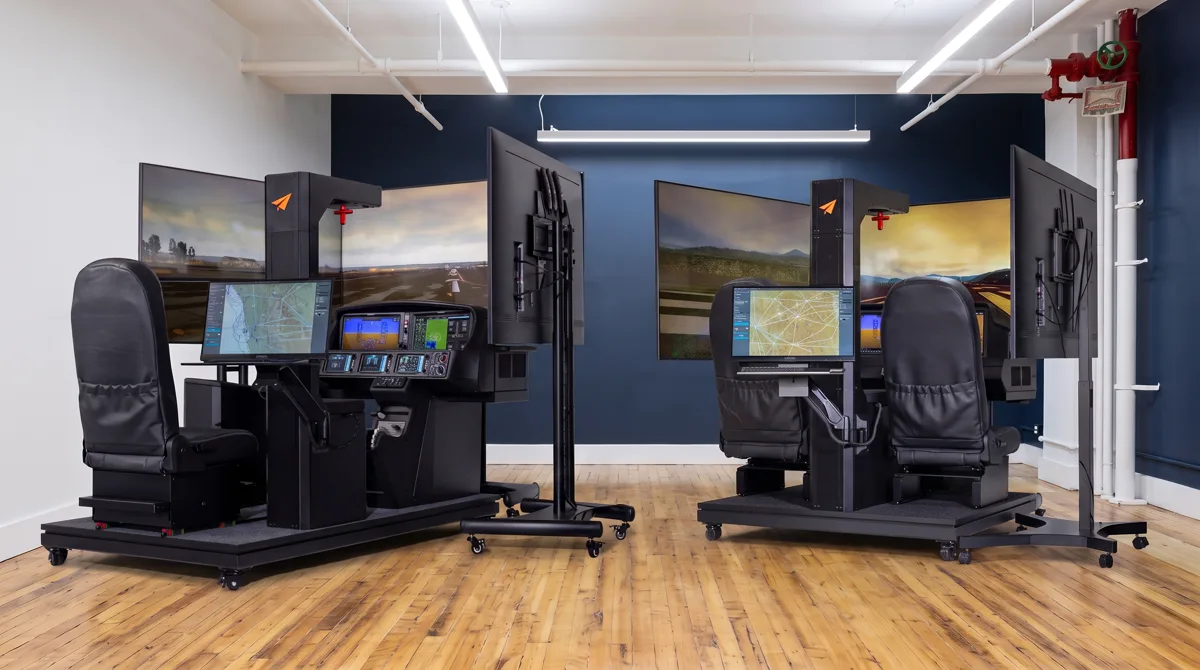
Aviator.NYC plans Cirrus SR-series and Cirrus SF50 Vision Jet simulator training in Manhattan, each on its own Advanced Aviation Training Device (AATD). Both simulators are delayed to 2027. Join the waitlist to hear when booking opens, then choose the simulator that matches the aircraft you fly or plan to fly.
Fill in the form below with your name, email, and the Cirrus you fly or hope to fly. Joining registers your interest and does not book a session. We will email waitlist members when booking opens, so you can choose a simulator, an aircraft profile, and a session time.
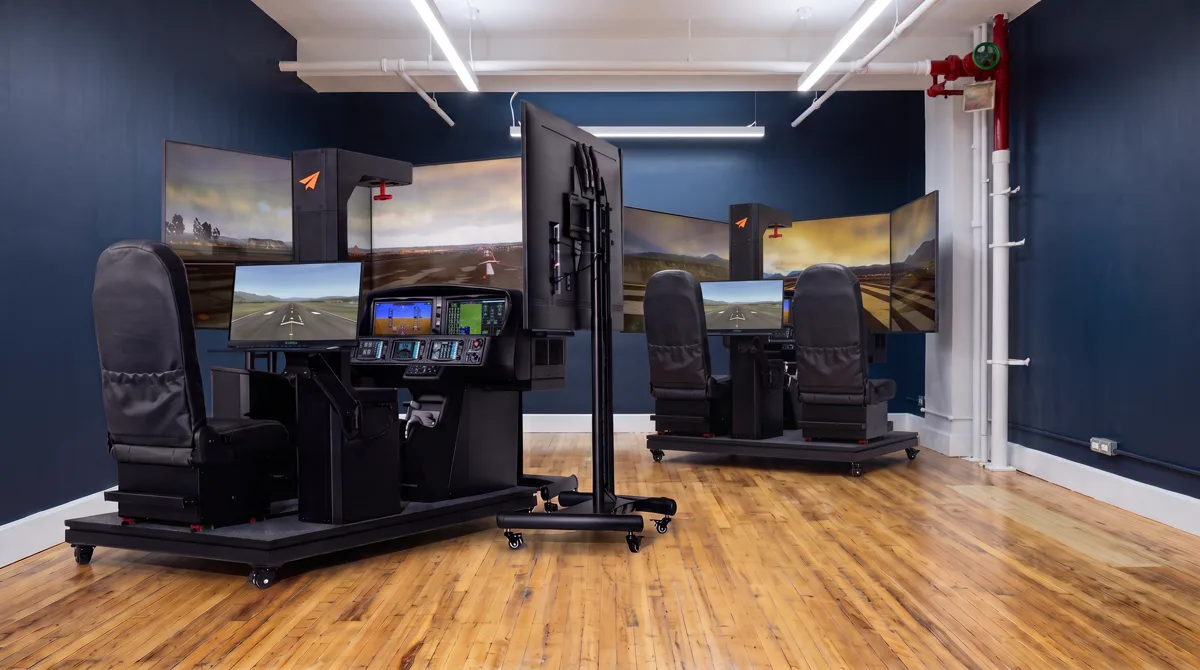
Aviator.NYC will run two separate Cirrus simulators: a two-seat SR-series simulator for the SR20, SR22, and SR22T, and a single-seat Vision Jet simulator. Each will carry its own FAA approval, so you train on the device that matches your aircraft. Our G1000 simulator in Hudson Square is open today.
Forecast rates for the SR-series simulator are $290 per hour for dual instruction, which includes your instructor, and $150 per hour for solo practice without one. Vision Jet preparation is forecast at $340 per hour with a two-hour minimum. A six-hour dual bundle lowers the rate to $265 per hour.
| Session | Forecast rate | What is included |
|---|---|---|
| SR-series dual instruction | $290/hr | Simulator time with your instructor for the full session. Choose the SR20, SR22, or SR22T profile. |
| SR-series solo practice | $150/hr | Simulator time on your own, for procedures you already know how to fly. No instructor is included. |
| Six-hour dual bundle | $1,590 | Three two-hour dual sessions at $265/hr, with your instructor included in every session. |
| Vision Jet preparation | $340/hr | Dual instruction on the separate Vision Jet simulator, with a two-hour minimum per booking. |
Cirrus simulator training suits pilots who fly a Cirrus, plan to buy one, or are preparing for a Vision Jet type rating. You do not need to own a Cirrus. Sessions are simulator training only, and Aviator.NYC does not rent aircraft. Pick the group closest to you below.
Keep instrument skills current and rehearse touchscreen workflows between flights without spending aircraft time. Start with our instrument currency simulator training.
Build procedure discipline and automation habits on the workflow you will use after your checkride. See our instrument rating training guide.
Practice procedures and avionics before lessons so your time in the airplane goes further. See how it fits our private pilot training in NYC.
Practice single-pilot workflow and instrument procedures on the Vision Jet simulator before a formal course. Read about our business jet instrument training program.
If time away has dulled your flows and instrument scan, rebuild them in the simulator before your first flight back. Start with rusty pilot training.
All three SR profiles will run on the same two-seat SR-series simulator, so you choose one when you book. If the Cirrus is new to you, start with the SR20 and learn the touchscreen workflow at a slower pace. Move to the SR22 or SR22T once the workflow feels automatic.
| Profile | Practice focus |
|---|---|
| Cirrus SR20 | Initial workflow practice: flight planning, approach loading, and autopilot modes at a slower pace. |
| Cirrus SR22 | Faster workflow practice, with less time between decisions on departure and approach. |
| Cirrus SR22T | Engine-management practice added to the SR22 workflow for higher-altitude flights. |
You can prepare for a Vision Jet type rating here, but the type rating itself comes from a formal course elsewhere. Preparation will run on the single-seat Vision Jet simulator, separate from the SR-series device. It will help you arrive at that course already comfortable with the workflow.
See how simulator preparation fits the business jet instrument training program.
You will be able to practice seven kinds of sessions, from instrument procedures to emergencies. Open a question below to see what each one covers. Every scenario can be paused and repeated, so you can rehearse a hard moment until it feels routine.
Fly instrument approaches, holds, and course tracking under instrument flight rules (IFR) without waiting for weather or an aircraft. You can repeat one approach until your flows are consistent. Your instructor can then note what needs more work before you fly.
Rehearse maneuvers, radio calls, and scenario-based decisions before your flight review, so the review feels like a check rather than a rebuild. Our FAA WINGS guide explains the proficiency program. Not every session earns WINGS credit, so ask your instructor first.
Build fluency with the touchscreen controllers: flight plan entry, procedure loading, autopilot coupling, and engine pages. Repeating these tasks on the ground frees attention for flying in the aircraft later. Start with the tasks that feel slowest to you right now.
Practice running a flight without a second pilot: checklists, alerts, radio calls, and automation choices competing for your attention. The goal is workload management, deciding what to do first when several tasks arrive together. This skill applies in any single-pilot aircraft, piston or jet.
Learn Vision Jet procedures on the single-seat Vision Jet simulator: normal flows, checklist order, and the pace of jet-speed decisions. This builds procedure familiarity before a type rating course. It does not replace that course or its checkride, which happen elsewhere.
Moving from analog gauges or another glass cockpit? Practice what feels different in a Cirrus: the touchscreen controllers, autopilot modes, and whole-airframe parachute decisions. You can arrive for an aircraft checkout already knowing where things are and what each mode does.
Rehearse engine failures, electrical failures, partial panel flying, and icing encounters without real risk. Pause at the critical moment, talk it through with your instructor, then fly it again. Repetition turns a checklist you have read into actions you can perform.
Our instructors include airline pilots and flight instructors trained under airline pilot mentorship. Most are active airline pilots who fly professionally, and they teach automation and checklists the way airline crews use them. Read more about the team on our About Aviator.NYC page.
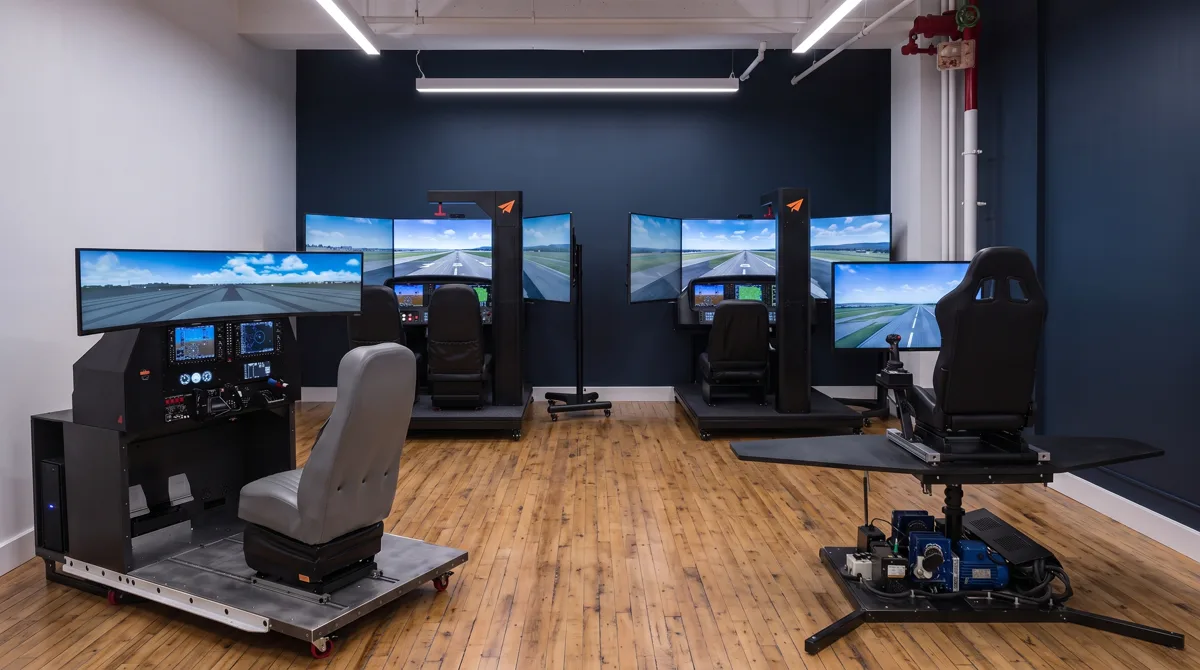
The Cirrus simulators will run at our Midtown Manhattan studio at 35 West 31st Street, Suite 901. The studio opens October 1, 2026, and visits are by appointment only. The simulators follow later: both are delayed to 2027, so the studio opening is not a Cirrus booking date.
Before you join, it helps to know when booking opens and what the simulators will and will not do. The answers below cover FAA approval, ownership, the avionics workflow, the Vision Jet type rating, and what the waitlist sends. Rates are in the pricing table above.
Not yet. Both Cirrus simulators are delayed to 2027, and booking opens once they are installed at the new Midtown studio. Waitlist members hear first when booking opens. In the meantime, our G1000 simulator is available for instrument and private pilot simulator training.
The Cirrus SR simulator will be an FAA-approved Advanced Aviation Training Device (AATD). Flown with an instructor, the time will count toward the instrument rating and instrument currency. The Vision Jet simulator will have its own separate approval, and its time will also count toward type rating preparation.
No. You do not need to own a Cirrus to train in either simulator. Sessions will be simulator training, useful for owners, renters, students, and pilots deciding whether to buy. Aviator.NYC does not rent aircraft, so any flying in a real Cirrus happens elsewhere.
Both simulators will run a Cirrus Perspective Touch+ profile on X-Plane 12. Built around the Cirrus panel specifically, so the touchscreen controller workflow matches the airplane rather than a generic glass layout. It is workflow practice, not the manufacturer's own trainer software.
No. Aviator.NYC will offer simulator preparation for the Vision Jet type rating, not the rating itself. The rating comes from a formal type rating course and checkride elsewhere. Preparation on the Vision Jet simulator helps you arrive familiar with its workflow and procedures.
The waitlist is for booking updates on the Cirrus simulators. We will email you when booking opens, along with the final rates set at launch. Joining is free, and it does not book a session or commit you to any training.