For retirees and late starters
Keep your mind busy. Learn to fly.
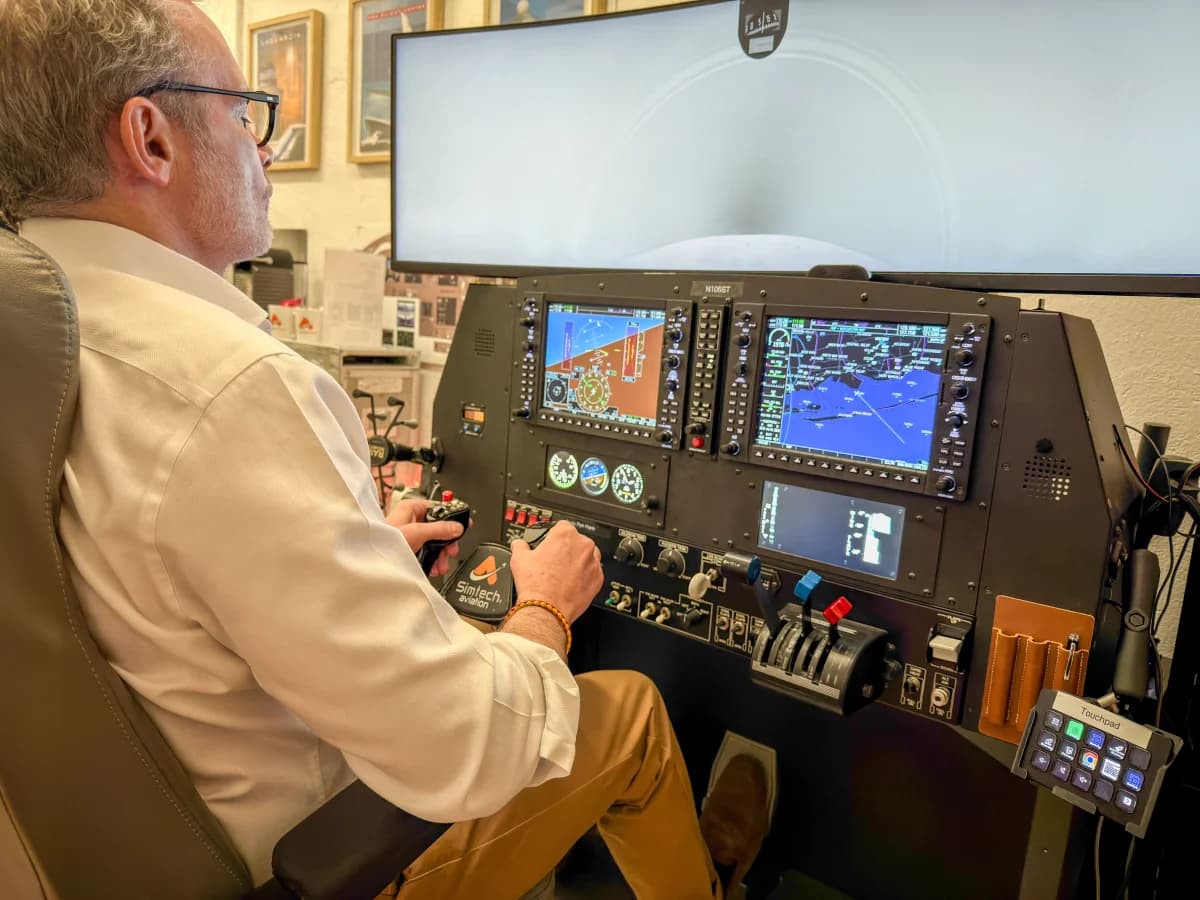
Retirement hands you time, and most of what fills it is easy. Flight training is not: weather, navigation math, radio calls and procedures, taught one to one by certified flight instructors, supervised by airline pilots, in an FAA-approved simulator in Midtown Manhattan. No medical, no license, no experience, and no airplane unless you ever want one. Start with a three-lesson term.
- 3 lessonsOne term
- 1 to 1Instructor-led
- 0 examsNo medical, no test
The problem
What happens to a mind with nothing hard to do?
Easy fills a week fast. The crossword gets solved, the lecture gets listened to, the app gets opened and closed, and none of it pushes back.
The enemy is not age. It is easy. A week with nothing in it that is new, structured and genuinely difficult. You were built for harder work than that, and you know it.
| Easy | A flight lesson |
|---|---|
| You watch | You fly, and talk, and read the instruments, at once |
| It gets no harder | Next week's lesson is harder because you got better |
| Nobody is waiting for you | An instructor is, with your notes from last time |
| Done in an afternoon | A syllabus that takes a year to run out |
What you learn
What does a flight lesson exercise?
| Lesson element | What you do |
|---|---|
| Weather briefing | Read coded weather reports (METAR) and forecasts (TAF), then decide whether to fly. |
| Aircraft performance | Work through the arithmetic of weight, air density, and takeoff and landing distance. |
| Navigation | Read charts, calculate headings, time and fuel, then enter a flight plan in the G1000 cockpit displays. |
| Radio | Hear a clearance, hold it in working memory, and read it back in standard phraseology. |
| Checklists and procedures | Follow checks and spoken steps in the right order under time pressure. |
| The flight | Use hands, eyes and voice at once: aircraft position, airspeed, altitude and the next radio call. |
Your instructors
Who teaches these lessons?
The person in the right seat teaches this for a living. Our instructors are certified flight instructors who want to share what they know about flying, and the program is supervised by airline pilots. They teach beginners every week and remember what a first lesson feels like. In the simulator nothing is at stake except the next radio call.
Meet the team

Julian
ATP
Peter
ATP
Charles
ATP
Elijah
ATP
William
ATP
Ethan
ATP
Liam

Jack
The plan
How does a term work?
- Book a three-lesson term.
One booking, three two-hour lessons, used within 90 days.
- Fly once a week.
Same instructor where we can, same seat, a harder lesson each time.
- Get your notes.
After every lesson your instructor writes up what you did and what comes next, so the week between is not wasted.
What changes
What does a term change?
After three lessons you can read a weather report, brief a flight, fly a traffic pattern and talk to a controller in the right words. You have an instructor who knows your name and a logbook with your hours in it. The next term is harder, because you are better.
Or another year of easy.
Start a three-lesson termThe research
What does the research say about learning hard things after 60?
The benefits in these studies were on the skills trained. None studied flight lessons or any disease.
Researchers keep finding the same thing about learning late in life: what helps is sustained, demanding and new. When older adults in a Texas study spent three months learning digital photography or quilting, their memory test scores improved; the group that only socialized did not (Park et al., 2014). In the largest trial of its kind, people in their seventies who trained reasoning and speed still showed gains ten years later, on the skills they had trained (Rebok et al., 2014). Sixteen weeks of piano lessons did something similar for working memory in adults aged 60 to 80 (Bugos and Wang, 2022). And a Stanford study that put pilots aged 40 to 69 in a simulator every year for three years found the most experienced pilots declined the least (Taylor et al., 2007).
None of these studied flight lessons, and none promises anything about disease. We quote them because they describe what a lesson is.
Requirements
Do I need a medical, a license or experience?
You need nothing to start: no medical, no license, no experience, no age limit.
A medical certificate matters only if you ever decide to fly an airplane as pilot in command; simulator lessons are not an aircraft operation.
If you flew years ago, say so, and the first lesson starts where you left off.
Explore the private pilot syllabusCost
How much does a term cost?
A three-lesson term costs $1,080: three two-hour lessons, used within 90 days. Pick a weekly or fortnightly cadence with your instructor.
Where
Where are the lessons?
By appointment only
Location
TRAIN TO FLY IN MANHATTAN
Midtown Manhattan

Loading reviews...
Tap any station for live arrival times
Questions
Common questions
No. There is no upper age limit for flight training, and most of our students are beginners.
Questions before your first lesson?
Tell us what you would like to learn and we will help you plan your first visit.