How many simulator hours count toward a private pilot license?
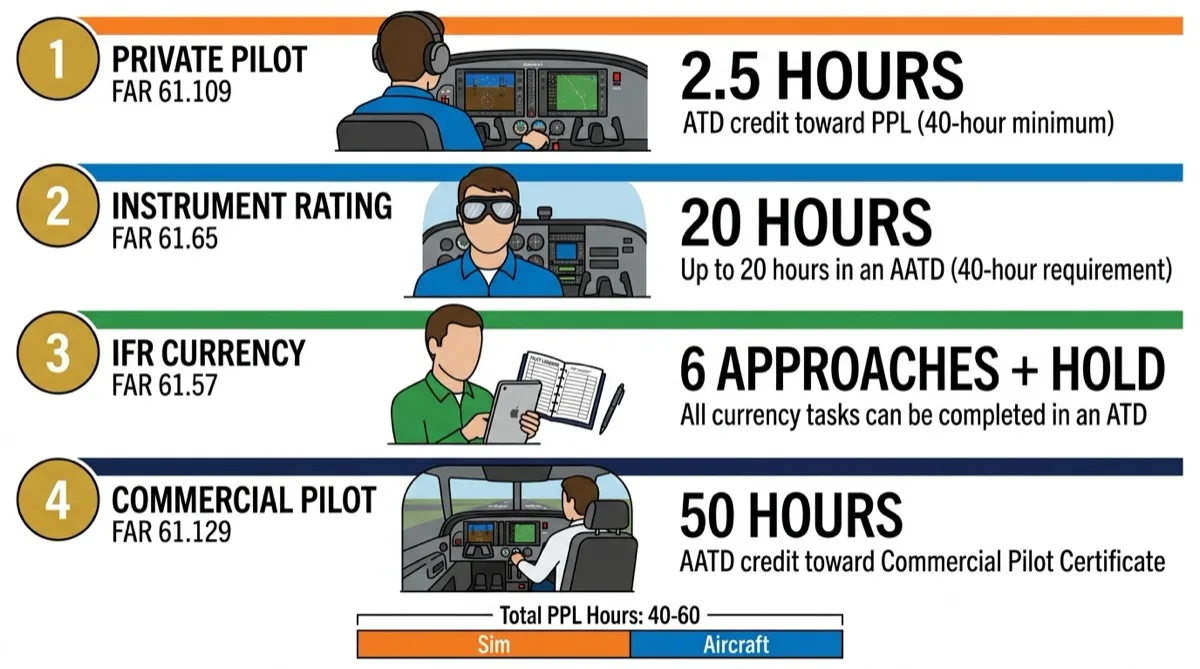
Under FAR 61.109(i), the FAA allows up to 2.5 hours of ATD time toward the 40-hour minimum required for a Private Pilot License. ATD stands for Aviation Training Device and covers two categories: the BATD (Basic Aviation Training Device) and the AATD (Advanced Aviation Training Device). Both qualify for the 2.5-hour PPL credit.
Not every simulator qualifies. Home flight simulators (X-Plane, Microsoft Flight Simulator) do not count toward FAA certificate requirements, even with an instructor present. A BATD (Basic Aviation Training Device) allows up to 2.5 hours as well but has fewer capabilities. Only time logged in an AATD or full flight simulator with a qualified instructor is creditable.
Aviator NYC's Garmin G1000 NXi simulator is an FAA-approved AATD — every hour you fly with an instructor is loggable in your official FAA pilot logbook. But the 2.5-hour credit understates the real value: students who build foundational skills in the simulator first typically need 15-25 fewer hours of aircraft rental to reach checkride proficiency. That's where the real savings are.
How many simulator hours count toward an instrument rating?
This is where simulator training has its biggest regulatory advantage. Under FAR 61.65(i), the FAA allows up to 20 hours of AATD time toward the 40-hour instrument rating requirement — half the total training can be completed in a simulator.
For pilots who already hold a private pilot license and want to earn their instrument rating, this means 20 hours of approaches, holds, intercepting and tracking courses, and partial panel work can all be done in an AATD at a fraction of airplane rental cost.
Even after earning your instrument rating, the simulator remains essential for IFR currency. Under FAR 61.57, all currency requirements — 6 instrument approaches, a hold, and intercepting and tracking courses within 6 calendar months — can be completed entirely in an AATD. This is why many licensed pilots maintain IFR currency in the simulator rather than flying actual approaches in weather.
Why don't more flight schools use simulators?
Here is the uncomfortable truth about flight training: most flight schools discourage simulator use because it takes revenue away from their airplanes. Flight schools make money from aircraft rental. Instructors build flight hours in the airplane — hours that count toward their airline transport pilot certificate — not in the simulator. The financial incentives work against the student.
Yet the training value is undeniable. Sporty's Complete Flight Training Course — one of the most widely used training programs in the country — integrates simulator modules at 34 of its 59 PPL lessons. Their syllabus is used by both Part 141 and Part 61 schools, and the simulator integration is built into the curriculum because it works. The lesson plans are the same regardless of which regulatory path a school operates under.
The cost advantage for students is straightforward. Simulator time costs significantly less per hour than aircraft rental plus fuel plus insurance. But beyond cost, simulators solve a fundamental training problem: there are critical emergency scenarios that cannot be safely practiced in most airplanes.
What can you practice in a simulator that you can't in an airplane?
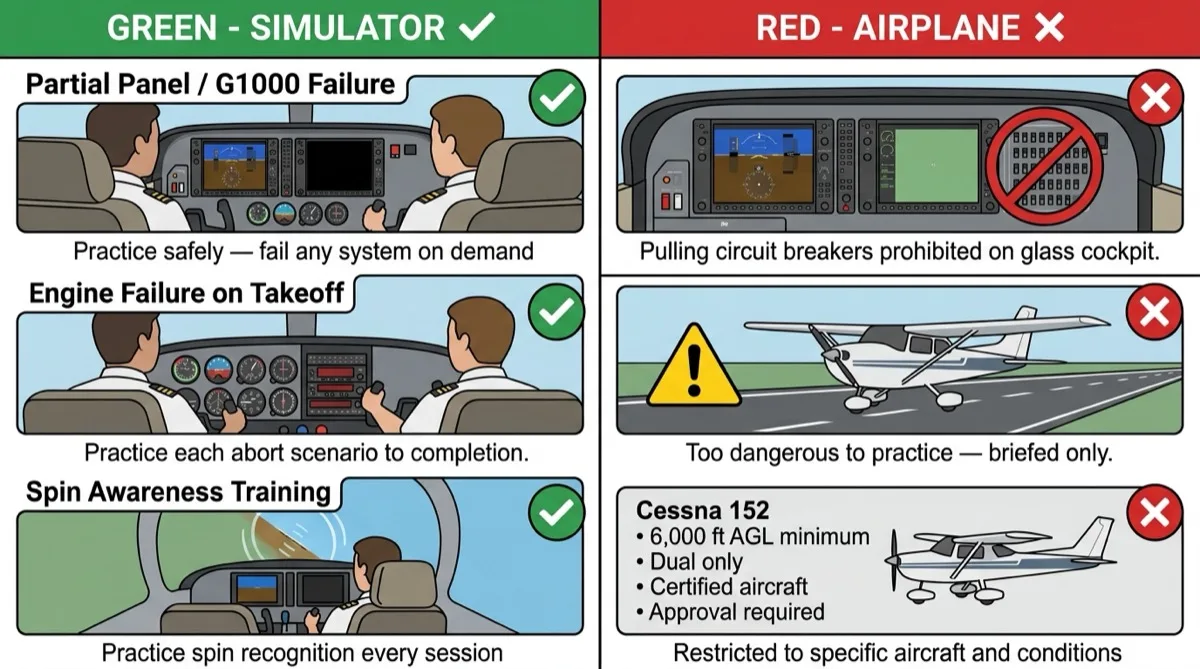
Partial panel and glass cockpit failures: Most flight schools prohibit pulling circuit breakers on G1000 or equivalent glass cockpit aircraft to simulate instrument failures. This is an industry-wide safety practice — glass cockpit systems are integrated, and pulling one breaker can cascade failures to other critical systems. The simulator replicates the exact same failure modes safely.
Engine failure during takeoff: Flight schools brief abort plans before every takeoff (engine failure before rotation, after rotation with runway remaining, after rotation without runway). But you can only brief the response — actually cutting the engine on a student's takeoff roll would be dangerous. In the simulator, you practice each scenario to completion.
Spin awareness and recovery: Most schools require spin-certified aircraft (typically a Cessna 152), dual flights only, minimum 6,000 feet AGL entry altitude, and instructor approval. In the simulator, spin scenarios are available in every session without any of these constraints.
Repeated approach practice: In an airplane, each instrument approach requires a safety pilot, proper PIC coordination, and view limiting devices — adding cost and scheduling complexity. In the simulator, you fly approach after approach with immediate feedback. Learn more about emergency scenarios you can only practice in a simulator.
How many simulator hours count toward a commercial pilot certificate?
Under FAR 61.129, the FAA allows up to 50 hours of AATD time toward the 250-hour commercial pilot certificate requirement. This is the largest simulator credit available for any FAA certificate — and it must be in an AATD specifically, not a BATD.
For pilots on the career pilot path, this represents a significant cost savings. Fifty hours of aircraft rental at $250-350/hour is $12,500-17,500. The same 50 hours in an AATD costs a fraction of that — and the training value is arguably higher because the simulator allows focused practice of commercial maneuvers, instrument procedures, and emergency scenarios without the limitations of real-world weather and airspace.
How do you log simulator time?
AATD time is logged as “simulated instrument time” in your pilot logbook when an authorized instructor is present. Each entry should include: date, total AATD time, training location, instructor name and certificate number, and the type of training device used.
ForeFlight and paper logbooks are both accepted by the FAA. Many students use ForeFlight's digital logbook for convenience and backup, while maintaining a paper logbook as the primary record. Your instructor at Aviator NYC logs each session in your book at the end of every lesson.
Learn more about our FAA-approved AATD simulator and how it compares to other training device categories.