What are the benefits of ADS-B?
ADS-B gives pilots and controllers the same, sharper picture of the sky. The FAA lists these benefits:
- Traffic in the cockpit. With ADS-B In, you see the aircraft around you on your display. The traffic service is free on every ADS-B In receiver.
- Weather in the cockpit, with no subscription. A receiver on 978 MHz also gets FIS-B: radar images, METARs, TAFs, PIREPs and notices such as temporary flight restrictions. The FAA charges no subscription or usage fee.
- Controllers see you more precisely, and more often. Radar takes 5 to 12 seconds to update an airplane's position. ADS-B updates it about every second, from GPS, so controllers can spot a conflict sooner.
- Coverage where radar is weak. Radar cannot see through mountains or far over the horizon. ADS-B ground stations are small and easy to place, so in many areas they see airplanes lower than radar can.
- Faster search and rescue. A precise last position takes much of the "search" out of search and rescue.
Verbatim, FAA, "Ins and Outs" (ADS-B):
ADS-B Out works by broadcasting information about an aircraft's GPS location, altitude, ground speed and other data to ground stations and other aircraft, once per second. Air traffic controllers and properly equipped aircraft can immediately receive this information. This offers more precise tracking of aircraft compared to radar technology, which sweeps for position information every 5 to 12 seconds.
None of this replaces your eyes. The AIM still asks you to keep up your visual scan (AIM 4-1-20).
How is ADS-B different from a transponder?
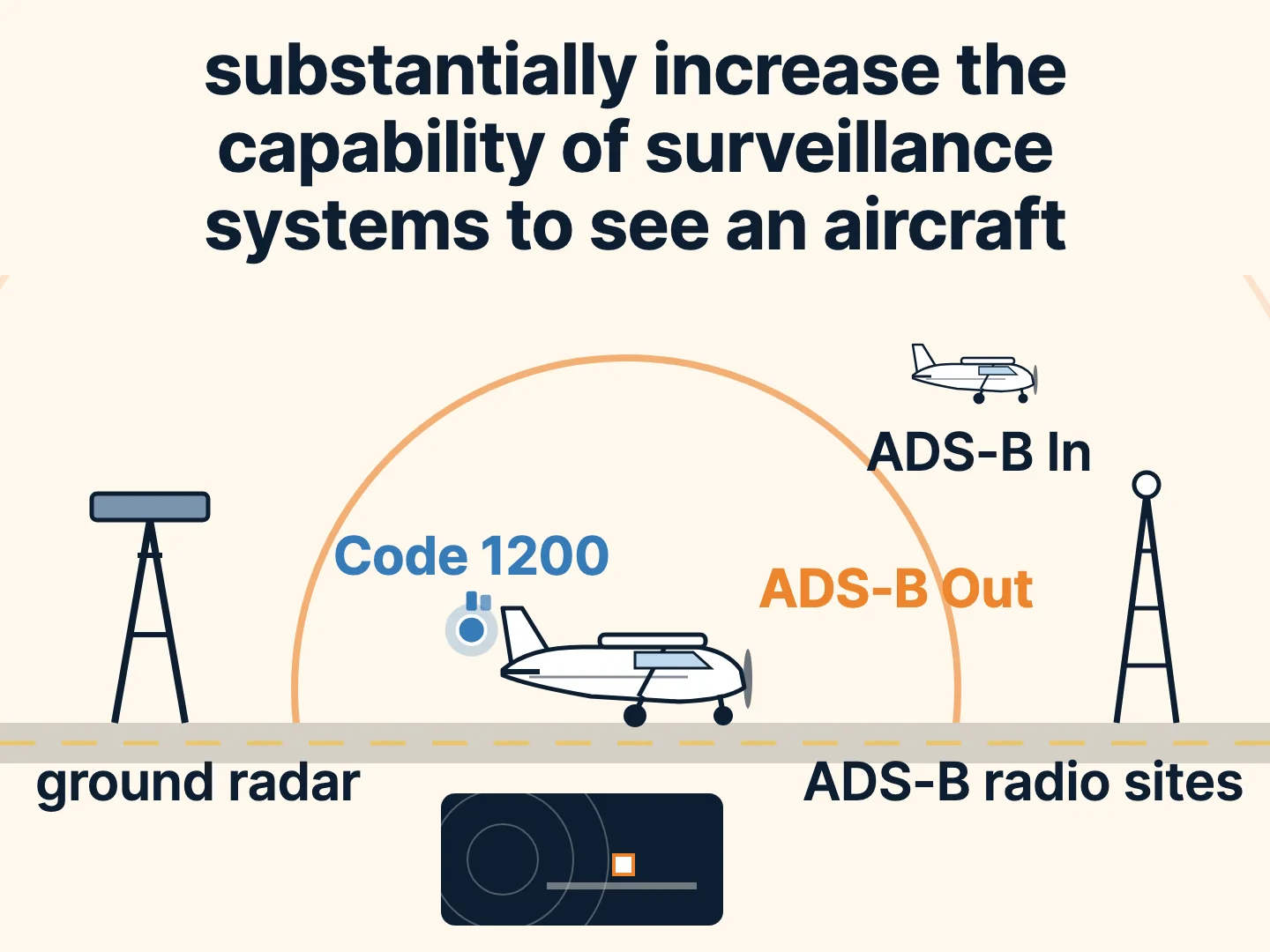
A transponder waits to be asked. ADS-B speaks on its own.
- Transponder: a ground radar sends a signal, and the transponder replies with your four-digit code and altitude. The radar works out where you are. On a VFR flight the code is 1200 unless ATC gives you another (AIM 4-1-20).
- ADS-B Out: the airplane works out its own position from satellites and broadcasts it as data, with no question from the ground (AIM 4-5-7).
- ADS-B In: the receiving side. It shows traffic and, on 978 MHz, weather. The rules require Out, not In.
ADS-B Out goes out on one of two frequencies, 1090 MHz or 978 MHz; which one a given 172 uses is in its POH supplement.
The diagrams on this page are AI-generated teaching images. If you see an issue, please tell us through the contact form.
Where is ADS-B Out required?
Since January 1, 2020, in most of the busy airspace around a big city (14 CFR 91.225). That includes Class A, B and C airspace and the area within 30 nautical miles of the busiest airports, from the surface to 10,000 feet. Around New York that means John F. Kennedy International, LaGuardia and Newark Liberty International (14 CFR Part 91, Appendix D). The transponder rule, 14 CFR 91.215, covers largely the same airspace.
When are they on?
Before the airplane moves, and until it is parked again.
Verbatim, FAA Aeronautical Information Manual, paragraph 4-1-20, Transponder and ADS-B Out Operation, "Transponder and ADS-B operations on the ground":
Civil and military aircraft should operate with the transponder in the altitude reporting mode (consult the aircraft's flight manual to determine the specific transponder position to enable altitude reporting) and ADS-B Out transmissions enabled at all airports, any time the aircraft is positioned on any portion of the airport movement area. This includes all defined taxiways and runways.
Verbatim, 14 CFR 91.225(f), partial:
each person operating an aircraft equipped with ADS-B Out must operate this equipment in the transmit mode at all times
The AIM says "should"; the regulation says "must" for ADS-B Out.
In the checklist, that means on before taxi. The 172S POH sets the transponder in its BEFORE TAKEOFF checklist (Section 4, p. 4-17, step 24), but the FAA wants it on as soon as the airplane is on the movement area. So our pre-taxi checklist turns the transponder to its altitude reporting mode, on 1200 for a VFR flight, before the airplane moves.
Watch and read
Our video: Cessna 172 Engine Run-up, from 4:17: where the POH checklist sets the transponder, before takeoff (cessna-172-g1000-engine-runup, 257 s)
Sources:
- FAA, "Ins and Outs" (ADS-B Out, ADS-B In, radar update every 5 to 12 seconds)
- FAA, ADS-B "Benefits" (traffic, FIS-B weather, update rate, low-altitude coverage, search and rescue, no cost to the user)
- FAA, "ADS-B In Pilot Applications" (TIS-B free on all receivers, FIS-B free on 978 MHz)
- FAA, Equip ADS-B "Frequently Asked Questions" (no subscription or usage fees; coverage lower than radar)
- FAA Aeronautical Information Manual, paragraph 4-1-20, Transponder and ADS-B Out Operation
- FAA Aeronautical Information Manual, paragraph 4-5-7, Automatic Dependent Surveillance-Broadcast (ADS-B) Services
- 14 CFR 91.225, Automatic Dependent Surveillance-Broadcast (ADS-B) Out equipment and use
- 14 CFR 91.215, ATC transponder and altitude reporting equipment and use
- 14 CFR Part 91, Appendix D, Section 1, airports with the 30-nautical-mile requirement
- Cessna Model 172S NAV III Pilot's Operating Handbook (172SPHAUS), Section 4, p. 4-17, BEFORE TAKEOFF, step 24