What is a practice area and why does it matter?
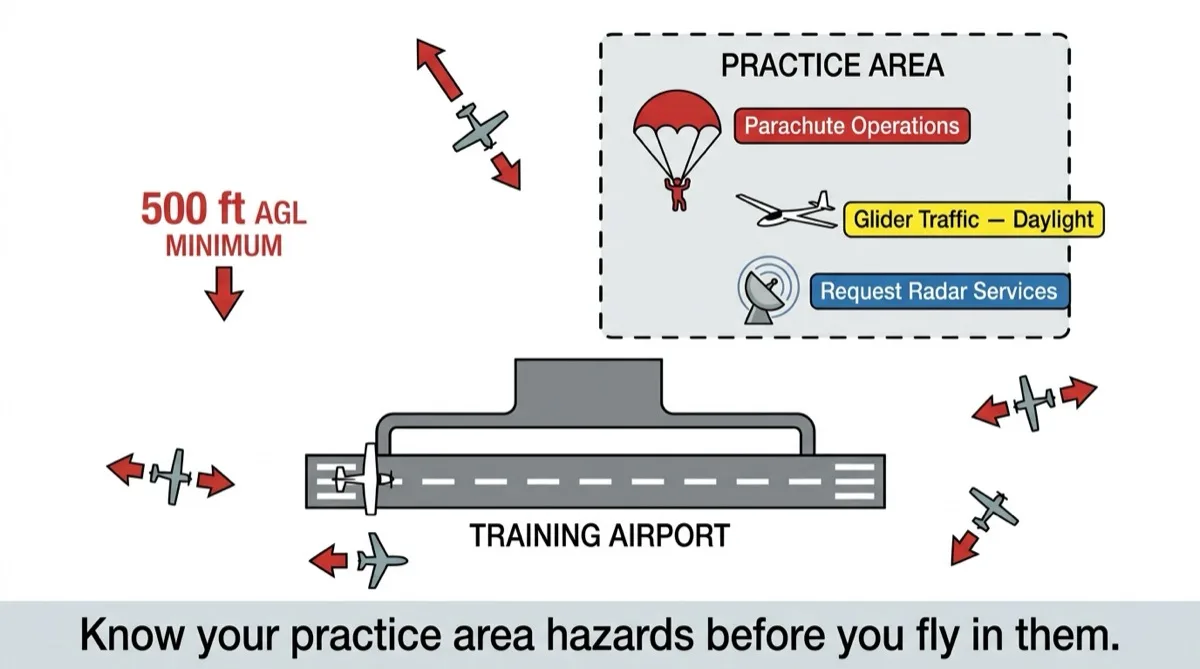
A practice area is designated airspace near a training airport where student pilots practice maneuvers — slow flight, stalls, steep turns, and ground reference maneuvers like rectangular courses, S-turns, and turns around a point. These areas are typically 10-25 nautical miles from the airport, far enough from the traffic pattern to allow maneuvering but close enough to return quickly.
Practice areas near Long Island airports have specific hazards that every student pilot must know. Brookhaven Airport (KHWV) has extensive parachute operations — skydive aircraft may be authorized to land on closed or secondary runways, and jumpers descend through the same airspace where students practice maneuvers. Glider traffic operates at Brookhaven Airport (KHWV) during daylight hours. Both require checking the Chart Supplement and current NOTAMs before every flight.
Radar services from ATC are highly recommended in practice areas but do not replace the pilot's see-and-avoid responsibility. When ATC provides radar services, pilots must maintain a continuous watch on the assigned frequency and respond to all ATC calls. If ATC is unable to provide radar, the pilot monitors the frequency independently. Near New York City, the airspace is congested enough that radar services add a significant layer of safety.
What safety checks do pilots do before every maneuver?
The pre-maneuvering checklist is standard at most flight schools. Before any practice maneuver, pilots verify seven critical items: fuel selector on BOTH tanks, mixture set to RICH (or properly leaned above 5,000 feet), seatbelts fastened and switches/lights set, radios tuned to the best frequencies, altitude confirmed safe for the planned maneuver, clearing turns complete, and an emergency landing field identified within glide range.
Clearing turns are a minimum 180 degrees of turn — accomplished as two 90-degree turns in opposite directions, a single 180-degree turn, or a full 360-degree turn. The purpose is to scan the entire area for traffic before beginning a maneuver that might involve unusual attitudes or reduced visibility. If traffic is detected during a maneuver, the pilot must abort immediately and maintain visual separation.
At Aviator NYC, this safety flow is taught from Lesson 1. Students practice the complete checklist before every maneuver in the simulator — building the habit so it becomes automatic before they ever fly in a real practice area with real traffic.
What is an abort plan and why do pilots brief it before every takeoff?
Professional flight schools teach abort plan briefings before every takeoff — the same practice that airline pilots follow on every flight. The briefing covers what to do if the engine fails at each critical phase of departure.
A standard abort plan covers four scenarios: engine failure or malfunction before rotation (throttle to idle, brake heavily, retract flaps, secure the engine); engine failure after rotation with usable runway remaining (pitch for best glide speed, land straight ahead); engine failure after rotation without runway, below traffic pattern altitude (shallow turn toward the best available field, secure the engine); and engine failure at or above traffic pattern altitude (return to the airport for landing). An alternate airport is identified as part of every briefing.
At Aviator NYC, students don't just brief these scenarios — they practice each one in the simulator. Stage 2 of the PPL curriculum (Lessons 7-9) covers engine failure in flight and during takeoff. Students experience the actual decision-making under pressure, not just the theoretical response. Learn more about emergency procedures training in the simulator.
What are solo weather minimums?
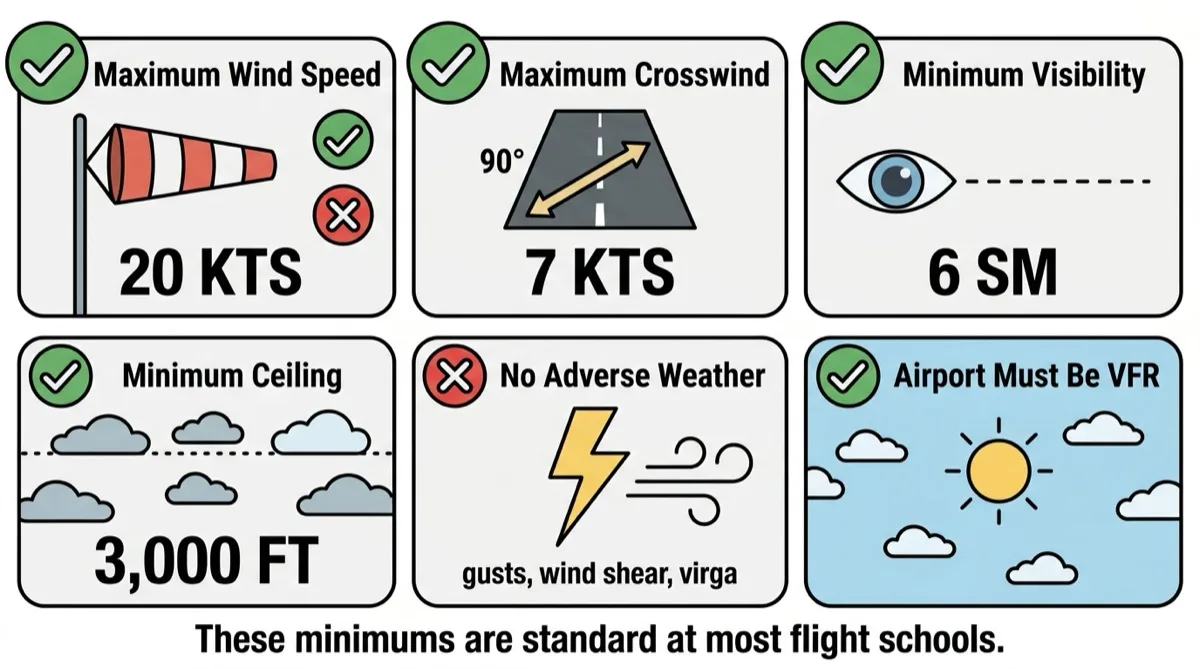
Most flight schools enforce similar weather limits for student solo flights. While specific numbers vary slightly between schools, the common standard includes: maximum wind of 20 knots, maximum crosswind component of 7 knots, minimum visibility of 6 statute miles, minimum ceiling of 3,000 feet AGL, the airport must be in VFR conditions, and no adverse weather conditions (gusty winds, shifting winds, wind shear, dust devils, virga).
These minimums can only be waived by the school's chief instructor or manager. The student's own instructor may set stricter personal limits based on the student's experience level and demonstrated skill. A student with 5 solo hours might have a 12-knot wind limit; a student preparing for the checkride might be cleared to the school's full 20-knot maximum.
For solo cross-country flights, students are typically required to file a VFR flight plan, and the instructor retains a copy. The flight plan must be activated if the student cannot obtain VFR flight following from ATC.
In Aviator NYC's simulator, students fly in all weather conditions — crosswinds, low visibility, turbulence, thunderstorm avoidance — to build proficiency before encountering these conditions for real. When a student has already landed in a 15-knot crosswind dozens of times in the simulator, doing it for the first time in the airplane is challenging but not overwhelming.
How does simulator training prepare you for practice area flying?
All the safety discipline — checklists, clearing turns, abort plans, weather assessment — becomes automatic through repetition in the simulator. By the time Aviator NYC students transition to the airplane at airports like Republic Airport (KFRG) or Morristown Airport (KMMU), the foundational procedures are second nature.
Traffic pattern operations at Republic Airport (KFRG), including documented noise abatement procedures, can be practiced in the simulator before your first flight there. Students learn the entry and exit points, the standard altitudes, and the radio calls — so the first airplane flight is about applying known procedures in a real environment, not learning everything from scratch.
Night training introduces additional restrictions that most students don't expect. At shorter runways (under 3,000 feet), all night landings must be full stop and taxi back — no touch-and-go operations. At longer runways (4,000+ feet), touch-and-go is permitted only when at least 200% of the calculated takeoff distance remains. Students who have practiced night operations in the simulator understand these procedures before encountering the reduced visual references of actual night flying.
Aviator NYC's Stage 3 curriculum (Lessons 10-12) covers VOR navigation, GPS navigation, airport operations, and airspace — the exact skills needed for cross-country flights in the practice area and beyond. Explore the simulator lesson plans to see how each stage builds on the previous one, or start with your first simulator lesson.
Understanding the full investment is also important — see the flight training cost breakdown and check out the Republic Airport (KFRG) training guide for details on the airport environment where many Aviator NYC students complete their airplane training.