What emergency procedures can't be practiced in an airplane?
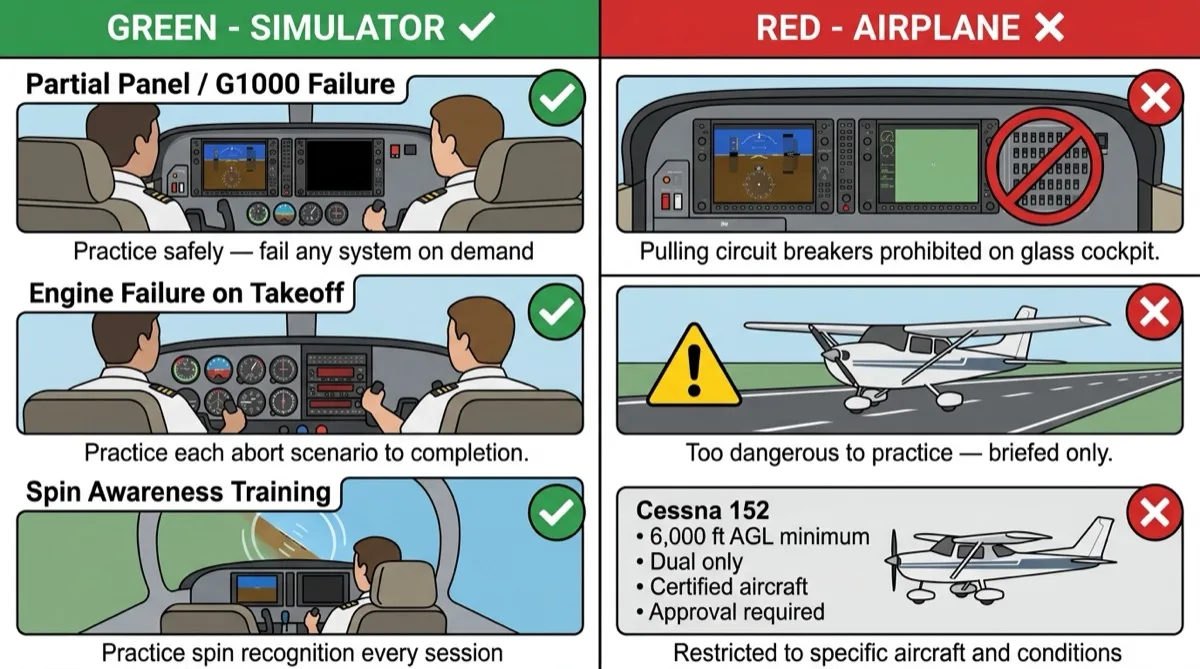
Partial panel and glass cockpit failures: Most flight schools prohibit pulling circuit breakers on G1000 or equivalent glass cockpit aircraft to simulate instrument failures. Glass cockpit systems are integrated — the primary flight display, multi-function display, engine instruments, and navigation all share electrical buses. Pulling one breaker can cascade failures to other critical systems that may not reset in flight.
Engine failure during takeoff: Professional flight schools brief an abort plan before every takeoff — engine failure before rotation, after rotation with usable runway remaining, after rotation without runway below traffic pattern altitude, and engine failure at or above pattern altitude. But you can only brief the response. Actually cutting the engine during a student's takeoff roll would create a genuinely dangerous situation.
Electrical system failures: In the airplane, all partial panel instrument maneuvers must be performed in VMC with at least 5 statute miles visibility. No partial panel practice at night. These restrictions exist for safety but significantly limit when and how often you can train for the scenarios that matter most.
Spin entry and recovery: Most flight schools require a spin-certified airplane (typically a Cessna 152), dual flights only, entry altitude of 6,000 feet AGL or higher, and instructor and manager approval. Recovery must be complete within two full turns. These restrictions mean spin training is rare, scheduled weeks in advance, and limited to a handful of sessions.
Why do flight schools prohibit pulling circuit breakers?
Glass cockpit systems like the Garmin G1000, G3000, and Perspective+ are deeply integrated. The primary flight display, multi-function display, engine monitoring, transponder, GPS, and communication radios share electrical buses and data networks. When you pull a circuit breaker in the airplane, you might not just lose one display — you could affect transponder output, GPS navigation, or radio communication.
There is also the risk of the breaker not resetting in flight. A circuit breaker that trips and refuses to reset is a real emergency — not a training exercise. The FAA Airplane Flying Handbook acknowledges that advanced avionics failures are best practiced in simulation environments where incorrect responses don't put lives at risk.
How do simulators solve the emergency training problem?
At Aviator NYC, Stage 2 of the PPL curriculum (Lessons 7-9) is entirely dedicated to systems and emergencies: engine failure in flight, engine failure during takeoff, and abnormal operations including slow flight, stalls, and spin avoidance. These are the scenarios that most flight schools restrict in the airplane — but you practice them to completion in every simulator session.
Stage 4 (Lessons 13-15) covers G1000 proficiency including G1000 abnormal procedures — practicing the exact instrument failure scenarios that are prohibited to simulate in the airplane. You learn what happens when the PFD fails, when engine instruments go dark, when you lose GPS — and how to respond using backup instruments and procedures.
The simulator removes every restriction that limits emergency training in the airplane: no weather requirements (practice partial panel in simulated IMC), no altitude minimums (engine failure at any phase of flight), no special aircraft (every session uses the same G1000 NXi cockpit), and unlimited repetition (the same scenario can be practiced until the student masters the correct response). You can explore the complete PPL curriculum to see how emergency training fits into the lesson progression.
What about IFR approach practice?
Practicing instrument approaches in the airplane requires coordination that adds cost and complexity. You need a safety pilot in the right seat who agrees to act as pilot-in-command while you fly under a view limiting device (hood or foggles). Both pilots must clearly establish PIC responsibilities before departure — if the safety pilot declines PIC responsibility, the approach practice flight is not authorized.
In Aviator NYC's simulator, you fly the same ILS, VOR, and RNAV/GPS approaches to Republic Airport (KFRG), Morristown Airport (KMMU), and other northeast corridor airports — using real published approach plates and real-world frequencies. No safety pilot coordination, no view limiting devices, no VMC requirements.
Aviator NYC offers 25 LOFT (Line Oriented Flight Training) scenarios with real approach data from local airports. These scenarios replicate actual instrument procedures that pilots fly in the region, including the approach environment, missed approach procedures, and ATC communication. Explore the full LOFT scenario library to see what approaches are available.
At non-towered airports, instrument approach practice requires continuous position reports on the CTAF — advising distance and altitude — and the decision to break off the approach if pattern traffic conflicts. In the simulator, you build this communication discipline without the pressure of real traffic.
What does a pre-maneuver safety flow look like?
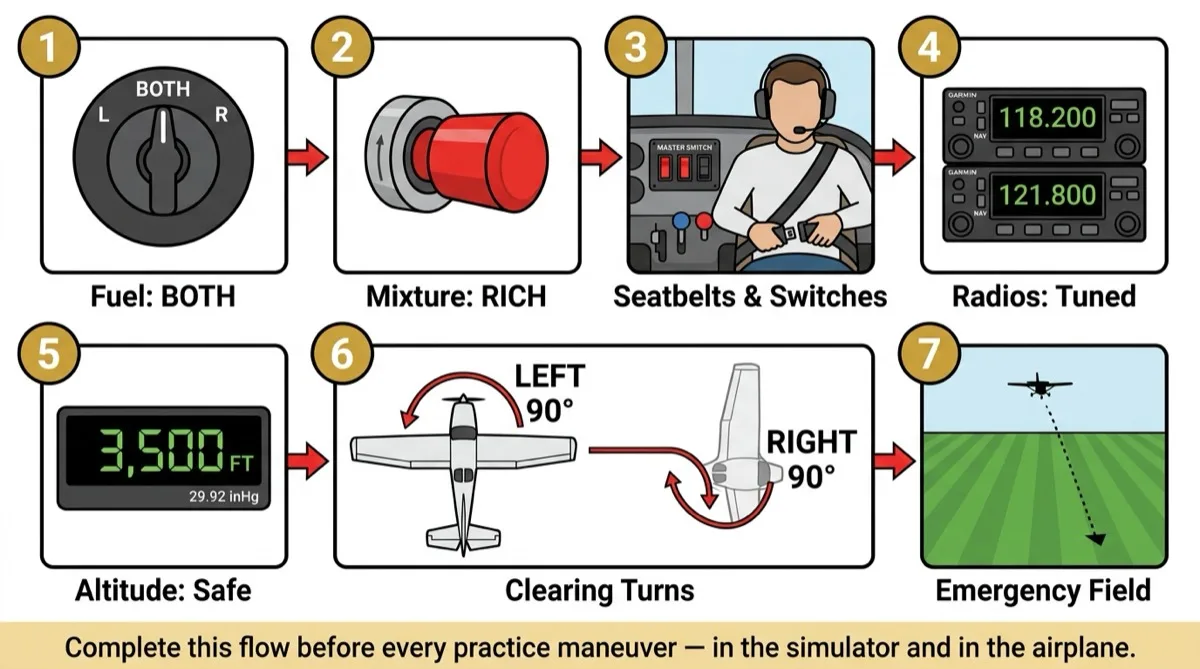
Before any practice maneuver — in the simulator or in the airplane — pilots complete a pre-maneuver safety flow. This checklist is standard at most flight schools and covers seven critical items: fuel selector on BOTH tanks, mixture set to RICH (or leaned for altitude above 5,000 feet), seatbelts fastened and switches/lights set, radios tuned to the best frequencies, altitude confirmed safe for the planned maneuver, clearing turns complete (minimum 180 degrees to check for traffic), and an emergency landing field identified within glide range.
Clearing turns ensure the practice area is clear of other traffic. If traffic is detected during a maneuver, the pilot must abort immediately and maintain visual separation. This discipline is non-negotiable — in the practice area near airports like Republic Airport (KFRG), where parachute operations and glider traffic share the airspace, traffic awareness is critical. Learn more about practice area safety procedures.
At Aviator NYC, students practice this flow from Lesson 1. By the time they transition to the airplane, running through the pre-maneuver safety checklist is automatic — the same way airline pilots run their checklists without thinking about each individual item.