What is a practice area and why does it matter?
A practice area is designated airspace near a training airport where student pilots practice maneuvers — slow flight, stalls, steep turns, and ground reference maneuvers like rectangular courses, S-turns, and turns around a point. These areas are typically 10-25 nautical miles from the airport, far enough from the traffic pattern to allow maneuvering but close enough to return quickly.
Where are the practice areas near Republic Airport (KFRG)?
Republic Airport (KFRG) students typically use two practice areas. Thesouth practice area takes you southeast over the Captree Bridge and out over Fire Island National Seashore — you stay south of the shoreline between Captree and Long Island MacArthur Airport (KISP). The north practice area is along the north shore over Northport, staying west of the Stony Brook area. Republic-based students also practice traffic pattern work at Brookhaven Airport (KHWV), which sits between the two practice areas.
Pilots training out of Long Island MacArthur Airport (KISP) use a south practice area over Smith's Point and Mastic, and a north practice area between Northport and Port Jefferson. These areas overlap with Republic's practice areas — which is exactly why flight following matters. On a busy training day, multiple schools from Republic, MacArthur, and Brookhaven are all maneuvering in the same airspace over the same stretch of shoreline.
Where are the practice areas near North Jersey airports?
Students training at Essex County Airport (KCDW) in Caldwell typically practice maneuvers west and northwest of Fairfield, staying below the New York Class B airspace shelf (floor at 3,000 feet MSL in this area). A common practice area is near Mahwah close to the New York state line, though this area gets congested — traffic converges from Teterboro (KTEB), Caldwell (KCDW), Lincoln Park (N07), and Morristown (KMMU). Some students go further west toward the Delaware River area for less crowded airspace, roughly 25-30 nautical miles from CDW.
Boonton Reservoir (6 miles west of CDW, recognizable by a small island) is a standard VFR reporting point when calling CDW Tower. From there, students continue northwest toward the Ramapo Mountains and the Wanaque Reservoir corridor. Morristown Airport (KMMU) students use similar areas to the northwest — the New Jersey Highlands between Greenwood Lake, Warwick, and Sparta offer relatively sparse population for maneuvering practice.
The key difference from Long Island is terrain and airspace complexity. North Jersey practice areas include hills, ridgelines, and reservoirs that Long Island's flat coastal geography doesn't have — students must account for higher terrain when selecting emergency landing fields. The airspace is also layered: the Class B shelf overhead, CDW and MMU Class D below, and Lincoln Park (N07) sitting just outside CDW's Class D boundary. Pilots who understand this airspace in the simulator before flying in it have a significant advantage. The Morristown Airport training guide and Essex County Airport training guide cover the full training environment at each airport.
Why is flight following critical in the practice area?
On Long Island, NY Approach on 120.05 (the Islip sector) covers both the north and south shore practice areas within 20 nautical miles. Before you taxi at Republic, call FRG Clearance and request flight following to the practice area — they should assign a squawk code on the ground. Republic's departure frequency is the JFK sector, which is significantly busier than the Islip sector, so expect a handoff once you reach the shoreline. If you don't get a squawk on the ground, contact NY Approach on 120.05 before entering the MacArthur Class Charlie airspace.
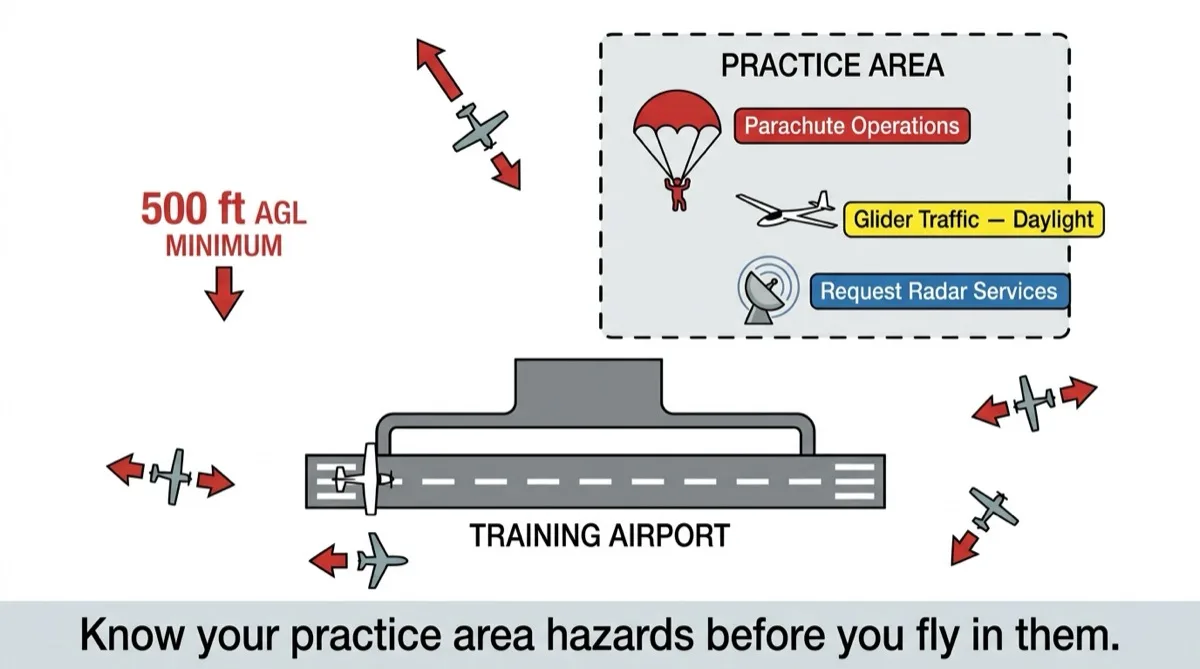
Practice areas near Long Island airports also have specific hazards that every student pilot must know. Brookhaven Airport (KHWV) has extensive parachute operations — skydive aircraft may be authorized to land on closed or secondary runways, and jumpers descend through the same airspace where students practice maneuvers. Glider traffic operates at Brookhaven during daylight hours. Both require checking the Chart Supplement and current NOTAMs before every flight.
Radar services from ATC are highly recommended in practice areas but do not replace the pilot's see-and-avoid responsibility. When ATC provides radar services, pilots must maintain a continuous watch on the assigned frequency and respond to all ATC calls. If ATC is unable to provide radar, the pilot monitors the frequency independently. Near New York City, the airspace is congested enough that radar services add a significant layer of safety — and prevent accidentally busting the MacArthur Class Charlie.
What safety checks do pilots do before every maneuver?
The pre-maneuvering checklist is a memory item at most flight schools — meaning pilots complete it from memory, then verify with the written checklist. Before any practice maneuver, pilots confirm: autopilot off, fuel selector on BOTH, mixture set appropriately (best power for most maneuvers, RICH for emergency procedures and ground reference), and seats and seatbelts upright and secure. Then the CLEAR acronym covers the final five items: Clearing turns complete, Lights all on, Emergency field within glide range, Altitude safe for the maneuver, Radios tuned to best frequencies.
Clearing turns are a minimum 180 degrees of turn — accomplished as two 90-degree turns in opposite directions, a single 180-degree turn, or a full 360-degree turn. The purpose is to scan the entire area for traffic before beginning a maneuver that might involve unusual attitudes or reduced visibility. If traffic is detected during a maneuver, the pilot must abort immediately and maintain visual separation.
At Aviator NYC, this safety flow is taught from Lesson 1. Students practice the complete checklist before every maneuver in the simulator — building the habit so it becomes automatic before they ever fly in a real practice area with real traffic.
What is an abort plan and why do pilots brief it before every takeoff?
Professional flight schools teach abort plan briefings before every takeoff — the same practice that airline pilots follow on every flight. The briefing covers what to do if the engine fails at each critical phase of departure.
A standard abort plan covers four scenarios, keyed to how much runway remains ahead: engine failure or malfunction on the runway during the takeoff roll (maintain directional control, throttle to idle, brake heavily, retract flaps, secure the engine); engine failure airborne with runway remaining ahead (maintain aircraft control, pitch for best glide speed, secure the engine, land straight ahead on the remaining runway); engine failure airborne with no runway remaining, below traffic pattern altitude (maintain control, pitch for best glide speed, land straight ahead with minimum turning at the most suitable landing area, secure the engine); and engine failure at or above traffic pattern altitude (a turn back into the wind — “the impossible turn” — may be possible, but only if it was briefed, trained in that make and model, and the pilot is certain of reaching the field; otherwise land at a suitable landing area). Turning back is not appropriate for student or low-time pilots; when flown, the turn is made into the wind, usually toward the crosswind side. An alternate airport is identified as part of every briefing.
Whatever the phase, the pilot's first job is to fly the airplane — positive control takes priority over restarts, radio calls, and checklists, and the fuel and engine are switched off just before touchdown.
A related decision tool is the 50/70 Rule for rejected takeoffs: by the time you reach the 50% mark of the runway, if you have not attained 70% of your liftoff speed, reject the takeoff. This gives pilots an objective, pre-planned decision point rather than relying on subjective judgment during a high-workload phase of flight.
Flight schools also teach a passenger briefing before every flight. The first six items use the SAFEST acronym: Seats and seatbelts, Air vents and courtesy lights, Fire extinguisher location and operation, Emergencies and exits, Sterile cockpit (focused conversation during taxi, takeoff, and landing), and Traffic awareness (passengers call out other aircraft using the clock method). Six more items cover the cockpit and command — flight controls, personal comfort, external factors, positive exchange of flight controls, who is Pilot-In-Command, and any final questions — the same crew-coordination approach airline pilots use. See the full 12-item passenger briefing.
At Aviator NYC, students don't just brief these scenarios — they practice each one in the simulator. Stage 2 of the PPL curriculum (Lessons 7-9) covers engine failure in flight and during takeoff. Students experience the actual decision-making under pressure, not just the theoretical response. Learn more about emergency procedures training in the simulator.
What are the weather minimums for training flights?
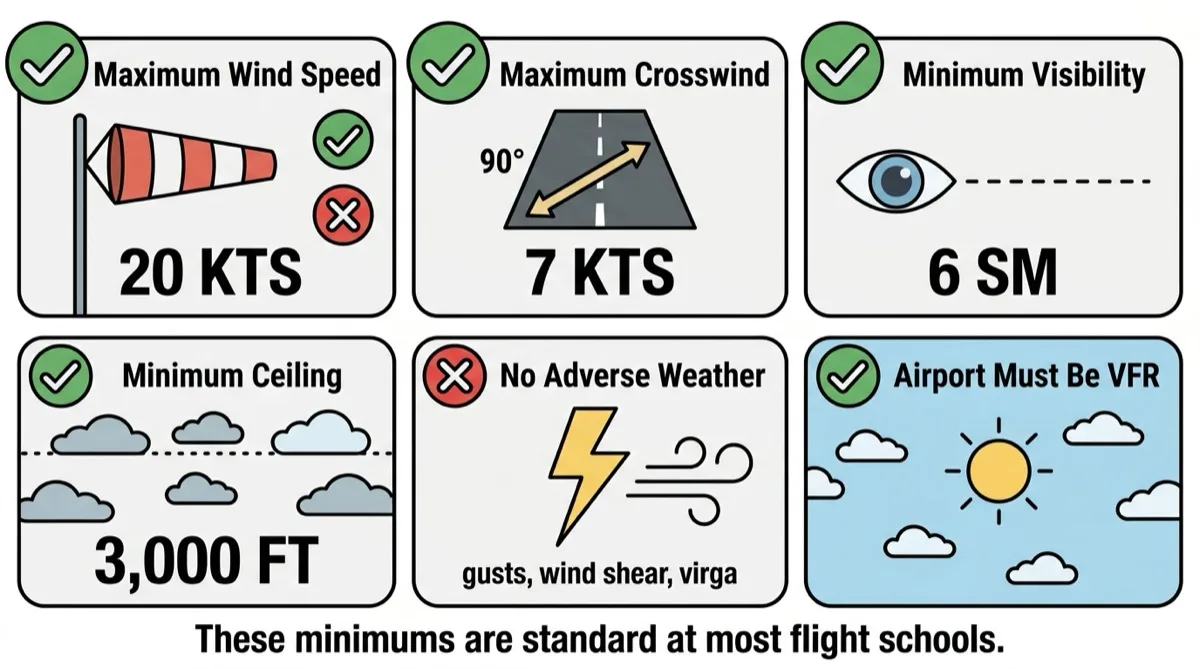
Flight schools set different weather minimums depending on the type of flight and the pilot's certificate level. Most schools publish a complete weather matrix covering dual instruction, solo pattern work, solo local flights, and solo cross-country flights — each with different ceiling and visibility requirements.
Dual instruction (with your CFI)
Dual flights with an instructor have the lowest weather minimums because the CFI can handle deteriorating conditions. Typical dual minimums at Part 141 schools are 3 statute miles visibility and 1,500-2,000 feet ceiling for local pattern work. Night dual training typically requires higher minimums — 5 statute miles and 2,500 feet. For a student's first lesson, most instructors want standard VFR conditions or better so the student can focus on learning rather than fighting weather.
Student solo flights
Solo weather minimums are significantly stricter. The standard across most schools: 5 statute miles visibility and 2,000-2,500 feet ceiling for local solo, with solo cross-country requiring 7 statute miles and 2,500 feet. Student pilots are not authorized for night solo flights, and all student solo landings must be full stop, taxi back — no touch-and-go operations. Students are also prohibited from Special VFR and VFR-on-Top operations.
Wind limits by certificate level
Wind limits are typically tiered by experience level. Student pilots are limited to 15-20 knots maximum surface wind with a 7-8 knot crosswind component. Private pilot certificate holders may fly in up to 20 knots with 12 knots crosswind. Commercial students get up to 25 knots and 15 knots crosswind. The crosswind component must not exceed the maximum demonstrated crosswind published in the aircraft's POH — for a Cessna 172, that's typically 15 knots.
These minimums can only be waived by the school's chief instructor, manager of training, or safety officer. The student's own instructor may set stricter personal limits based on the student's demonstrated skill. A student with 5 solo hours might have a 12-knot wind limit; a student preparing for the checkride might be cleared to the school's full maximum.
Fuel reserves at most schools are stricter than the FAA minimum. While the FAA requires 30 minutes of reserve fuel for VFR day flights and 45 minutes for VFR night, many Part 141 schools require a full one hour of reserve fuel for all flights — dual, solo, day, night, and IFR. Cross-country departures typically require carrying the maximum fuel allowed by weight and balance.
For solo cross-country flights, students are typically required to file a VFR flight plan for each leg, open the flight plan with FSS, remain on it throughout the flight, and close it at each destination. Some schools require students to prepare two cross-country flight plans — one for a northern route and one for a southern route — so a flight isn't cancelled entirely due to weather affecting one direction.
In Aviator NYC's simulator, students fly in all weather conditions — crosswinds, low visibility, turbulence, thunderstorm avoidance — to build proficiency before encountering these conditions for real. When a student has already landed in a 15-knot crosswind dozens of times in the simulator, doing it for the first time in the airplane is challenging but not overwhelming.
THIS IS A LOT — AND THAT'S THE POINT
Weather minimums, wind limits, fuel reserves, crosswind components — you're not expected to know this before your first lesson. Your instructor walks you through each concept hands-on in the simulator. By lesson 3, this page will read like a checklist you already know.
How does simulator training prepare you for practice area flying?
Checklists, briefings, weather assessment, abort plans, pre-maneuver flows, traffic pattern procedures, takeoff and landing techniques — reading all of this at once can feel overwhelming. That feeling is normal, and it's exactly the reason most people want to learn to fly. Flying an airplane is a genuine challenge — it demands discipline, judgment, and skill that very few activities require. That's what makes it worth doing.
The question is not whether there is a lot to learn. There is. The question is whether you have someone who breaks it down in the right order so each piece builds on the last. That's what an instructor does — not hand you a manual and wish you luck, but sit next to you and guide you through each skill until it clicks.
In the simulator, students practice the complete takeoff sequence — from the “Before Takeoff” checklist through setting flaps, verbalizing “Gauges green, airspeed alive,” rotating at 55 knots, and climbing at Vy (74 knots) or Vx (62 knots) as appropriate. They practice traffic pattern operations: power-off approaches with specific flap settings and airspeeds at each leg (80 knots downwind, 70 on base, 61-65 on final), and the critical habit of checking “final is clear” before turning base. They learn the 3-6 Rule for descent planning: 3 times the altitude to lose equals miles out to begin descent, and 6 times your ground speed gives you the descent rate in feet per minute.
By the time Aviator NYC students transition to the airplane at airports like Republic Airport (KFRG) or Morristown Airport (KMMU), these procedures are second nature. The first airplane flight is about applying known procedures in a real environment, not learning everything from scratch.
Night training introduces additional restrictions that most students don't expect. At shorter runways (under 3,000 feet), all night landings must be full stop and taxi back — no touch-and-go operations. At longer runways (4,000+ feet), touch-and-go is permitted only when at least 200% of the calculated takeoff distance remains. Students who have practiced night operations in the simulator understand these procedures before encountering the reduced visual references of actual night flying.
Aviator NYC's Stage 3 curriculum (Lessons 10-12) covers VOR navigation, GPS navigation, airport operations, and airspace — the exact skills needed for cross-country flights in the practice area and beyond. Explore the simulator lesson plans to see how each stage builds on the previous one, or start with your first simulator lesson.
Understanding the full investment is also important — see the flight training cost breakdown and check out the Republic Airport (KFRG) training guide for details on the airport environment where many Aviator NYC students complete their airplane training.