Choosing an airport is step 1 of the PPL training roadmap.
How Do Flight Training Airports Near NYC Compare?
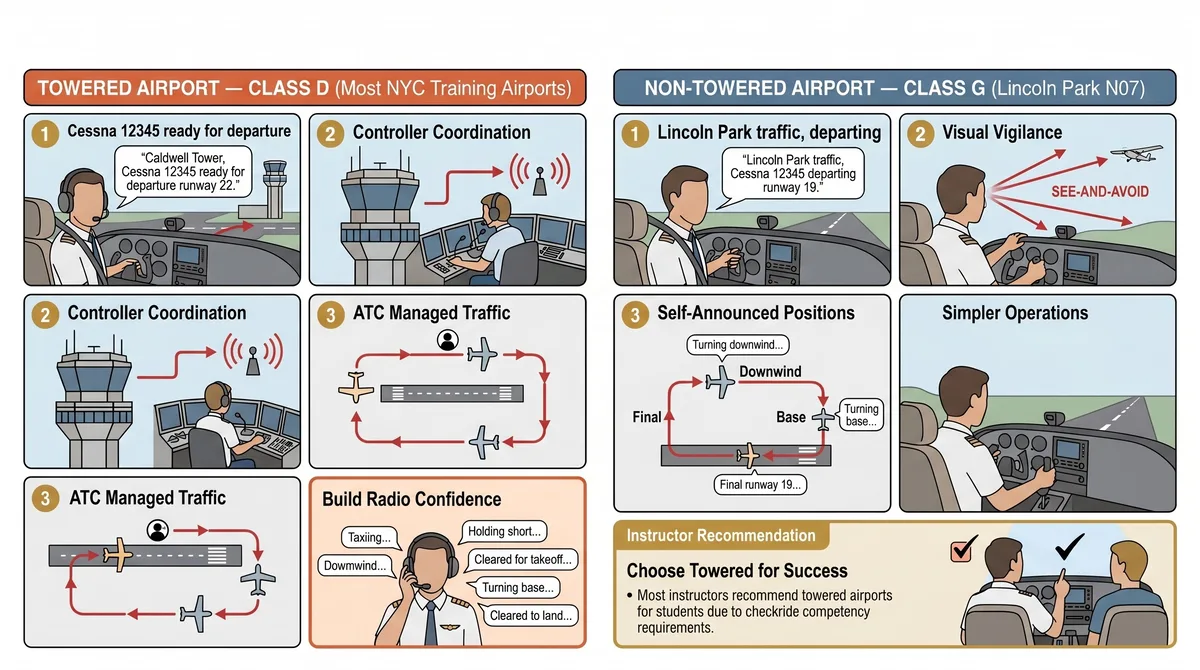
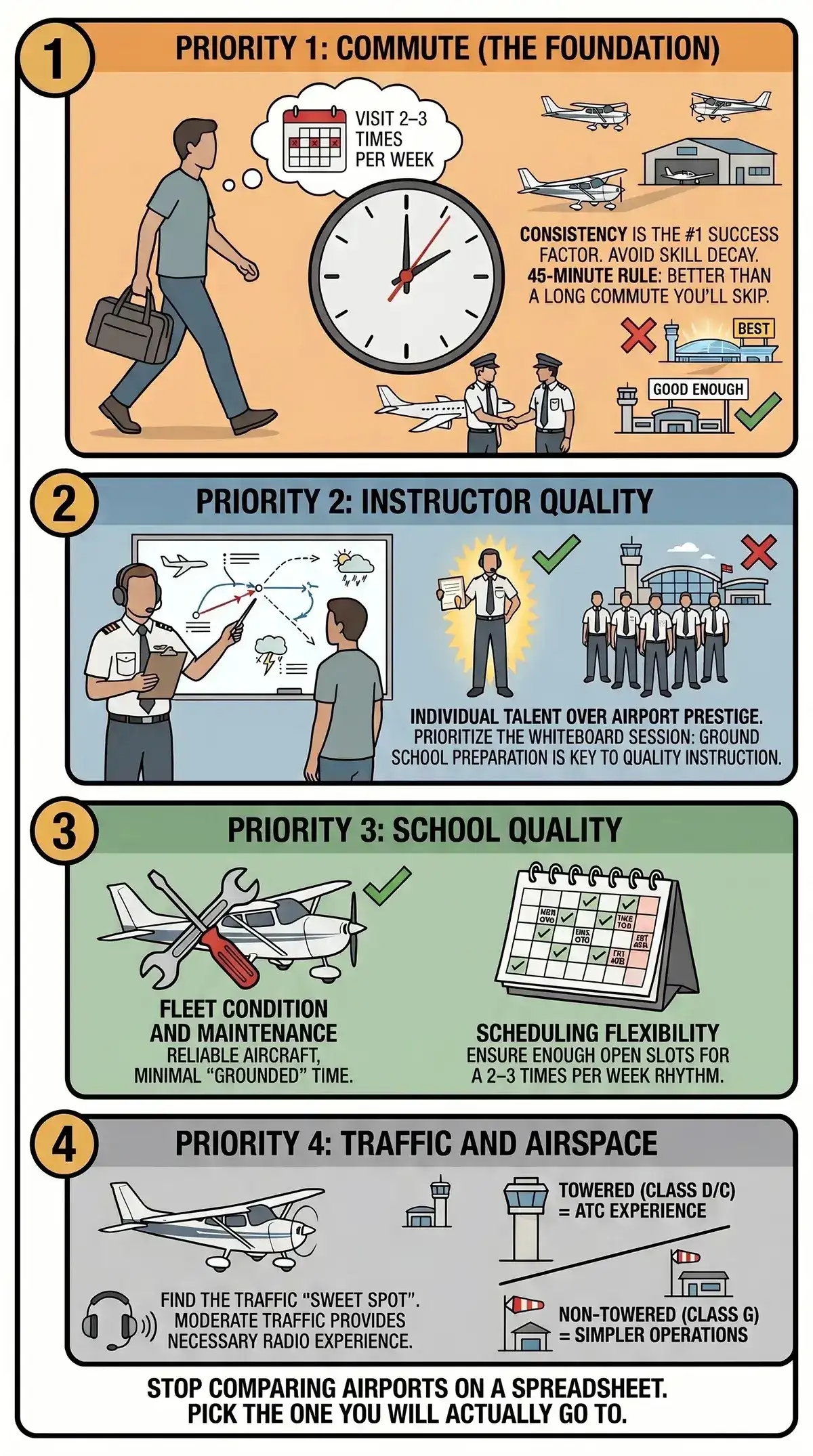
Use this comparison table to evaluate airports based on your location, commute tolerance, and training priorities. Towered airports (Class D) provide more radio communication experience, while non-towered airports offer less wait time. At most training airports, you will check in at the flight school or the airport's FBO (Fixed Base Operator) — the facility that provides fuel, parking, and ground services for private aircraft. Think of the FBO as the airport's front desk for general aviation.
| Airport | Location | Commute | Airspace | Traffic | Best For |
|---|---|---|---|---|---|
| Farmingdale Republic (KFRG) | Long Island, NY | 1-1.5 hrs (LIRR) | Class D | Very Busy | Brooklyn/Queens residents |
| MacArthur (KISP) | Long Island, NY | 1.5-2 hrs (drive) | Class C | Moderate | Less congestion, tower experience |
| Essex County (KCDW) | Caldwell, NJ | 45 min-1.5 hrs (bus) | Class D | Moderate | Midtown/Port Authority access |
| Morristown (KMMU) | Morristown, NJ | 1-2 hrs (NJ Transit) | Class D | Busy | Major GA hub, diverse fleet |
| Lincoln Park (N07) | Lincoln Park, NJ | 1-1.5 hrs (NJ Transit) | Class G | Low | Non-towered, relaxed environment |
| Linden (KLDJ) | Linden, NJ | 45 min-1 hr | Class D | Moderate | Closest to Manhattan (challenging airspace) |
| White Plains (KHPN) | White Plains, NY | 1.5 hrs (Metro-North) | Class D | Moderate | Bronx/Westchester residents |
Which Long Island Airports Offer Flight Training?
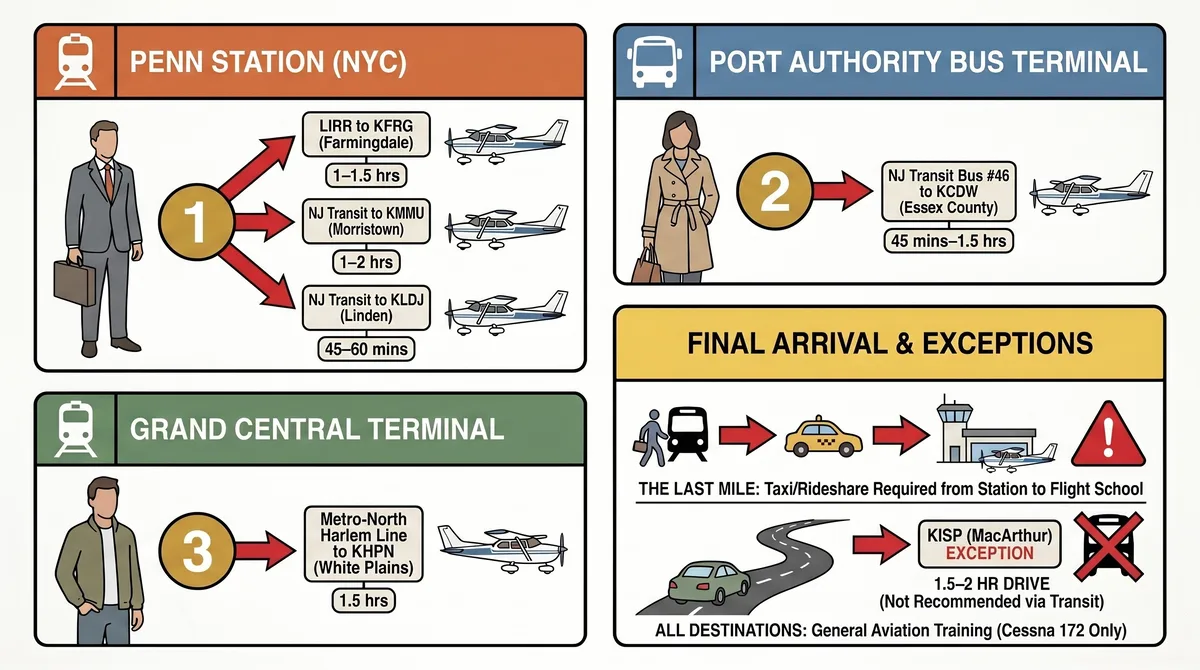
Long Island has 5+ flight training airports, with Farmingdale Republic (KFRG) and MacArthur (KISP) being the most popular choices for NYC-based student pilots. These airports serve students from Brooklyn, Queens, and all of Long Island, typically reached via the Long Island Rail Road from Penn Station. Farmingdale Republic is the dominant training airport with over a dozen flight schools, while MacArthur offers a less congested Class C environment roughly 50 miles east of Manhattan. Further east, Brookhaven (KHWV) and Gabreski (KFOK) airports provide quieter training environments but require a car and 1.5-2 hour drive. Most Long Island training airports have Class D towered airspace, giving students essential radio communication practice from day one of their flight training.
Farmingdale Republic Airport (KFRG)
Farmingdale Republic Airport (KFRG) is one of the busiest general aviation airports in the entire United States, handling over 200,000 operations per year across its two runways. Located in Suffolk County approximately 40 miles east of Manhattan, it is the primary flight training hub for the New York City metropolitan area. Wait times of 30-45 minutes for takeoff are common during peak weekend hours due to the sheer volume of training flights. The airport is accessible via the LIRR Ronkonkoma line from Penn Station—about 1 hour to Farmingdale Station, followed by a short taxi or rideshare to the field. More than a dozen flight schools operate here with competitive pricing, offering everything from private pilot through airline transport pilot certificates in Cessna, Piper, and Cirrus aircraft.
Read our complete guide to every flight school at Republic Airport (KFRG) →
Long Island MacArthur Airport (KISP)
Long Island MacArthur Airport (KISP) operates under Class C airspace with a fully operational control tower and radar approach control, located in Ronkonkoma approximately 50 miles east of Manhattan. The Class C experience is similar to Class D—you make one additional radio call compared to a Class D airport, but the procedures are essentially the same. While there is some commercial airline traffic from carriers like Breeze Airways and Frontier, it is significantly less busy than Farmingdale Republic and wait times for takeoff are minimal. The airport has two runways (6,002 and 5,034 feet) and sits at an elevation of 99 feet MSL, offering straightforward approaches without significant terrain or obstruction concerns. Training here gives students exposure to mixed traffic environments without the congestion penalties of busier fields.
The tradeoff is a longer commute (approximately 2 hours by car from Manhattan) and a different airport layout. As a larger airport with airline service, MacArthur is not as flight-school-friendly in its layout compared to smaller GA airports. However, if you find a flight school there that works for you, it can be a solid training environment with less congestion than Farmingdale. Use the AOPA Flight School Finder to search for schools at KISP.
Read our complete guide to flight schools at MacArthur Airport (KISP) →
Other Long Island Airports
Additional flight training options on Long Island include Brookhaven Airport (KHWV) in Shirley, Francis S. Gabreski Airport (KFOK) in Westhampton Beach, and East Hampton Airport (KHTO). Brookhaven is a non-towered Class G airport roughly 60 miles from Manhattan with a 4,225-foot runway and minimal traffic delays, making it ideal for students who want uninterrupted pattern work. Gabreski is a former Air National Guard base with a 9,000-foot runway and Class D airspace—one of the longest runways available for general aviation training in the region. East Hampton offers a scenic coastal training environment but is the farthest at approximately 100 miles from the city. All three require a car to reach and are best suited for Long Island residents east of Farmingdale who want shorter local commutes and less congested airspace for initial training.
Which New Jersey Airports Offer Flight Training?
New Jersey has 8+ flight training airports, ranging from 45 minutes to 2 hours from Manhattan, making it the most accessible region for flight training from Midtown. Most are reachable via NJ Transit buses or trains from Port Authority Bus Terminal or Penn Station. The primary training airports are Essex County (KCDW) in Caldwell, Morristown Municipal (KMMU), Lincoln Park (N07), and Linden (KLDJ)—each with distinct advantages depending on your location and training goals. New Jersey airports generally sit west of the Hudson River beneath the New York Class B airspace, which means departures to the west and north reach practice areas quickly. Airport rental rates in New Jersey tend to be slightly lower than Long Island equivalents due to reduced demand pressure, though the difference is typically $10-20 per hour.
Essex County Airport (KCDW)
Essex County Airport (KCDW), located in Caldwell, New Jersey, is the closest flight training airport to Midtown Manhattan that offers a full-service training environment. The airport sits approximately 20 miles west of the city and is reachable in 45 minutes to 1.5 hours depending on traffic. NJ Transit Bus Route #46 runs directly from Port Authority Bus Terminal to Caldwell—buy tickets in advance via the NJ Transit app for the smoothest commute. KCDW operates under Class D airspace with a control tower, giving students essential radio communication experience, and has a 4,553-foot primary runway. The airport is notably less congested than Farmingdale Republic, meaning shorter taxi times and more actual flying per lesson. Several established flight schools operate here with Cessna and Piper fleets, and the practice area to the west is accessible within minutes of departure.
Read our complete guide to flight schools at Essex County Airport (KCDW) →
Morristown Municipal Airport (KMMU)
Morristown Municipal Airport (KMMU) is one of the largest and busiest general aviation airports in the northeastern United States, located approximately 30 miles west of Manhattan in Morris County, New Jersey. The airport features two runways (the longest at 5,998 feet), full instrument approach capabilities, and a Class D control tower. NJ Transit's Morris & Essex Line runs from Penn Station to Morristown Station in approximately 70 minutes, followed by a short rideshare to the field. The commute totals 1-2 hours depending on connections. Multiple flight schools operate at KMMU with diverse fleets including Cessna 172s, Piper Archers, and multi-engine aircraft, making it possible to complete all ratings from private through commercial at one airport. The mix of corporate jets, turboprops, and training aircraft gives students exposure to real-world traffic management and professional radio communication standards.
Read our complete guide to flight schools at Morristown Airport (KMMU) →
Lincoln Park Airport (N07)
Lincoln Park Airport (N07) is the only non-towered general aviation airport within practical commuting distance of New York City, located in Lincoln Park, New Jersey, approximately 30 miles west of Manhattan. This small, privately owned airport operates in Class G airspace with a single 2,860-foot runway that is notably short and narrow compared to other training airports in the region. The runway has obstacles on the south end, including trees and rising terrain, which means students must be very precise with their approach speeds and landing techniques. Most instructors require students to practice takeoffs and landings at a larger airport like Essex County or Morristown before soloing at Lincoln Park, which can add 3-5 extra training hours. The airport sits at 182 feet MSL elevation in a valley surrounded by hills, creating unique wind patterns that challenge new pilots.
That said, Lincoln Park is one of the most laid-back general aviation airports in the area. It has a great on-field restaurant and a real community feel. The bus stop is a bit far from the airport itself—you get dropped in a residential area and need to walk or arrange a ride—which makes it less convenient than airports with closer transit access. Fixed-wing and helicopter schools operate here; check the AOPA Flight School Finder for current options at N07.
Read our complete guide to flight training at Lincoln Park Airport (N07) →
Linden Airport (KLDJ)
Linden Airport (KLDJ) in Linden, New Jersey, holds the distinction of being the closest flight training airport to Manhattan at just 45-60 minutes by car or NJ Transit train. The airport features a 4,136-foot runway with Class D towered airspace and sits at only 23 feet MSL elevation along the Arthur Kill waterway. However, its position directly south of Newark Liberty International (KEWR) makes the surrounding airspace genuinely challenging for student pilots. You are operating under the Newark Class B airspace shelf, which restricts altitudes on departure and requires careful navigation to avoid airspace violations. Departures to the south and west must thread between the Class B floor and terrain, and you will spend more time navigating to and from the practice area compared to airports farther from the Class B. Every extra 0.1 on the Hobbs meter is six minutes of billable time, making this commute advantage partially offset by longer flight times to reach uncontrolled practice areas.
Linden also has a short runway and is primarily a helicopter operation. Flight school options are limited. That said, every airport has its trade-offs—Farmingdale has long taxi delays, Caldwell and Morristown have their own busy periods. If you like the flight school, the instructors, and the aircraft at Linden, an experienced CFI will guide you through the airspace. Search for schools at KLDJ on the AOPA Flight School Finder.
Is White Plains Airport Good for Flight Training?
White Plains Airport (KHPN), officially Westchester County Airport, is the best flight training option for students living in Westchester County, the Bronx, or upper Manhattan. Located in White Plains, New York, approximately 33 miles north of Midtown Manhattan, it is reachable in about 1.5 hours via Metro-North Railroad's Harlem Line from Grand Central Terminal to the White Plains station, followed by a short taxi to the airport. KHPN operates under Class D airspace with a control tower and features two runways (the longest at 6,548 feet), making it one of the better-equipped training airports in the region. The airport handles a mix of general aviation, corporate jet traffic, and limited commercial airline service, creating a diverse traffic environment that gives student pilots excellent real-world radio communication and situational awareness practice. Several flight schools operate at KHPN offering private pilot through instrument rating training at rates competitive with Long Island and New Jersey airports.
Read our complete guide to flight schools at Westchester Airport (KHPN) →
Should You Choose Part 61 or Part 141?
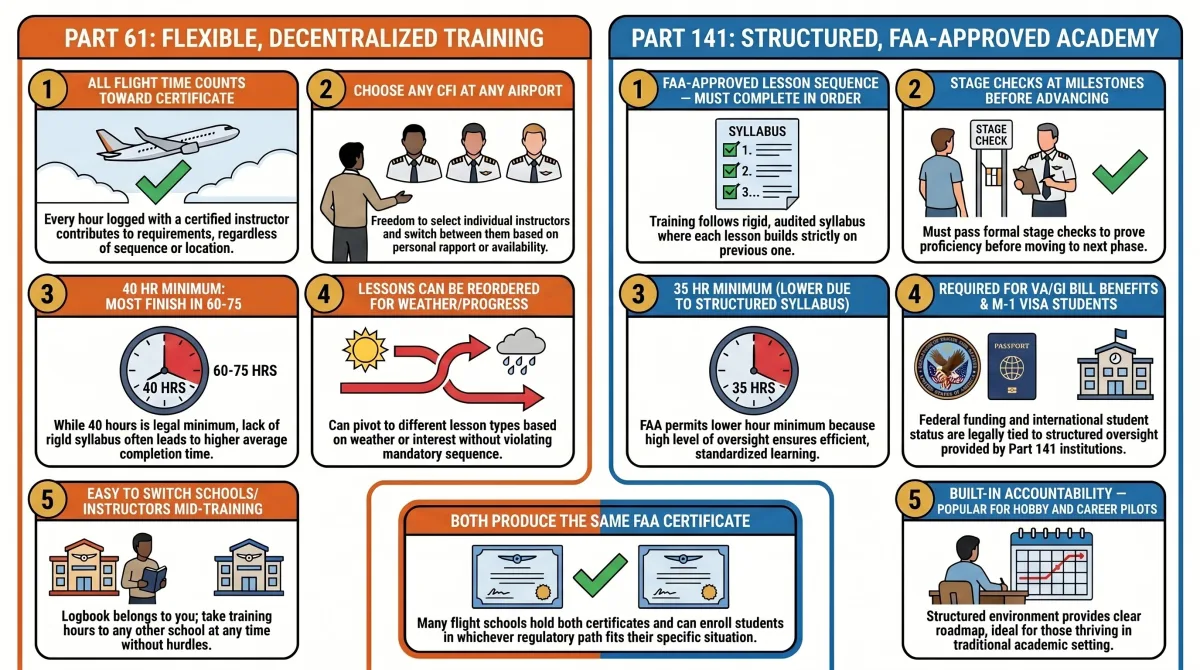
Most NYC-area airports offer both Part 61 and Part 141 flight schools. Part 61 gives you flexible scheduling and pay-as-you-go billing — every flight counts toward your certificate regardless of syllabus order. Part 141 follows an FAA-approved structured curriculum with mandatory stage checks and can reduce minimum hour requirements. Part 141 is required for VA/GI Bill benefits and M-1 visa training. Both paths lead to the identical FAA certificate — airlines do not distinguish between them. Read our full Part 61 vs Part 141 flight training comparison for a detailed breakdown.
Where Can You Find Flight Schools Near NYC?
Use the interactive map below to explore flight training airports and schools across New York, New Jersey, and Connecticut. For help understanding how flight training costs work at different airports, see our Private Pilot License cost guide.
Frequently Asked Questions
If you're still early in your research, our private pilot training guide covers costs, timelines, and how simulator training fits into your path — regardless of which airport you choose.
SELECT YOUR PATH
NYC / AVIATOR.NYCNEW PILOTS: WHAT'S YOUR GOAL?
LICENSED PILOTS: SELECT TRAINING
FLY AS A HOBBY
Learn safely, step-by-step, and at your own pace.
A private pilot license in NYC typically costs $12,000–$34,000. Most students need 60–80 flight hours to reach checkride proficiency. Simulator training at $215/hr saves over 45% compared to aircraft rental at each stage — and over 60% with a $1,080 training bundle ($180/hr). Pay-as-you-go pricing with no membership fees or upfront commitment.
See the full private pilot license cost breakdown →Yes. You need at least a Third Class FAA Medical Certificate before you can fly solo. Most healthy adults pass without issues — the exam covers basic vision, hearing, and general health. Schedule your exam with an Aviation Medical Examiner (AME) early in training. Important: if you have ever been prescribed medication for anxiety, depression, or ADHD — even as a child — talk to an AME before investing heavily in training to avoid surprises.
How to get your FAA medical certificate for flight training →Yes. Aviator.NYC's FAA-certified Advanced Aviation Training Device (AATD) with Garmin G1000 NXi avionics logs hours that count directly toward your private pilot certificate. Simulator training at $215/hr saves over 45% compared to aircraft rental — and over 60% with a training bundle — with no weather cancellations or maintenance delays. Train on 20+ aircraft configurations from Cessna 172 to Beechcraft Bonanza, all in Midtown Manhattan.
FAA-approved flight simulator training in NYC →Most students earn their private pilot license in 4–12 months depending on training frequency. The FAA requires a minimum of 40 flight hours, but most students need 60–80 hours to reach checkride proficiency. A typical path: Weeks 1–2 in the simulator building foundations, Weeks 3–12 flying dual and solo at a local airport, then Months 3–12 completing cross-country flights and checkride prep. You control the pace — train around your work schedule.
Private pilot training timeline and milestones →Start with a 2-hour discovery session ($430) in Aviator.NYC's Manhattan simulator. No experience needed — your airline pilot instructor walks you through takeoff, flight, and landing. After your first session, you'll know if flight training is right for you. From there, a structured path takes you from simulator foundations to your first solo flight at a local airport.
Book your first flight lesson in Manhattan →Part 61 defines requirements for pilot certification. Part 141 defines requirements for school approval. Both use the same commercially available lesson plans and lead to the same FAA certificate. The key difference: under Part 61, every flight you take counts toward your certificate requirements. Under Part 141, off-syllabus flights don't count toward the 141 program. Part 61 dominates in NYC because the off-syllabus flexibility better serves students who train infrequently and want every flight hour to always count. Aviator.NYC operates under Part 61 — by design.
Part 61 vs Part 141 flight training — which is right for you →The FAA Private Pilot Knowledge Test is a 60-question multiple-choice exam covering aerodynamics, weather, navigation, regulations, and flight planning. You need a score of 70% or higher to pass. Most students use online prep courses like Sheppard Air or Sporty's and pass within 2–4 weeks of focused study. Pass the written test early in your training — it builds confidence and lets you focus on flying skills.
Private pilot training steps and written exam prep →Instructor quality matters more than price. Look for instructors with airline or professional experience who teach part-time because they love it — not because they're building hours. Visit 1–2 schools in person. Ask about cancellation rates, aircraft availability, and whether they use FAA-approved simulators to reduce cost. For NYC-area students, the closest GA airports are Republic Airport (KFRG), Morristown Airport (KMMU), Essex County Airport (KCDW), Westchester Airport (KHPN), and Lincoln Park Airport (N07).
Best flight training airports near New York City →FLY AS A CAREER
From first lesson to professional pilot — one clear path.
The career path follows six stages: Private Pilot License → Instrument Rating → Commercial Certificate → Multi-Engine Rating → CFI Certification → Airline Transport Pilot (ATP). Each rating builds on the previous one. You need 1,500 total flight hours for an ATP certificate, which most pilots build by instructing after earning their CFI. The entire pathway from zero experience to airline-eligible typically takes 4–6 years part-time or 18–24 months full-time.
See the complete career pilot roadmap — PPL through ATP →The complete career pathway costs roughly $80,000–$150,000+ spread across multiple ratings: Private Pilot ($12,000–$34,000), Instrument Rating ($9,250–$21,000), Commercial ($15,000–$50,000), Multi-Engine ($6,000–$8,000), and CFI ($3,000–$5,000). You don't pay this all at once — each rating is a separate phase. Simulator training at $215/hr saves over 45% at every stage compared to aircraft time, and over 60% with training bundles. Once you earn your CFI, you earn $30–$60/hour while building the hours you need for airlines.
Full pilot license cost breakdown by rating →With consistent training, 18–24 months is realistic for the accelerated path. Most part-time students take 4–6 years. The bottleneck is building 1,500 total hours for an ATP certificate. After earning your CFI, instructing is the most common way to build hours while getting paid. Regional airlines are currently hiring pilots at 1,500 hours with competitive first-year pay.
Airline Transport Pilot requirements and timeline →The instrument rating is your next step. It teaches you to fly in clouds and low visibility using only your instruments — a requirement for every professional pilot path. The instrument rating requires 40 hours of instrument training (up to 20 hours can be in an FAA-approved simulator) and 50 hours of cross-country PIC time. Most working professionals complete it in 3–6 months.
Instrument rating — step 2 in the career pilot roadmap →Yes, for most career pilots. The CFI (Certified Flight Instructor) certificate lets you earn $30–$60/hour teaching other pilots while building the 1,500 hours you need for airlines. It also deepens your own flying knowledge — teaching forces mastery. Requirements: Commercial Pilot Certificate, Instrument Rating, 250+ total hours, and passing the CFI practical test. The training typically takes 20–30 additional flight hours.
CFI certification — step 5 in the career pilot roadmap →Airlines require a First Class FAA Medical Certificate. This is a more thorough exam than the Third Class medical used for private flying. It includes detailed vision, hearing, cardiovascular, and neurological screening. Most healthy adults pass. Get your First Class medical early — before investing in career training — to catch any potential issues. The exam is done by an Aviation Medical Examiner (AME) and is valid for 12 months.
FAA medical certificate requirements for career pilots →Yes, extensively. The FAA allows up to 20 hours of simulator time toward your instrument rating, up to 50 hours toward your commercial certificate, and up to 25 hours toward your ATP. Simulator training at $215/hr saves over 45% compared to aircraft at the standard rate — and over 60% with training bundles — across every stage of the career path. Aviator.NYC's AATD features the Garmin G1000 NXi and GFC 700 autopilot used in modern training aircraft, so skills transfer directly to the airplane.
How FAA-approved simulator training reduces career pilot costs →The multi-engine rating is required for most airline jobs. There is no FAA minimum flight time required, but most students need 10–15 hours of training. Cost is typically $6,000–$8,000. Training covers VMC demonstrations, single-engine operations, and asymmetric thrust management. Most pilots complete it in 1–2 weeks of intensive training.
Multi-engine rating — step 4 in the career pilot roadmap →YOUTH PROGRAM (AGES 8-17)
Safe, age-appropriate lessons that grow with your child.
Children can start simulator-based flight training at age 8. There are no medical requirements for simulator lessons. Training is structured by age: ages 8–12 focus on basic stick-and-rudder control, instrument scanning, and simple ATC calls in 1-hour sessions. Ages 13–15 progress to traffic patterns, VOR navigation, and checklist discipline in 2-hour sessions. The simulator is a zero-risk environment supervised by professional instructors.
Youth aviation program milestones by age →Under FAA regulations (FAR 61.87), a student pilot can solo a glider at age 14 and a powered airplane at age 16. At age 17, they are eligible for a full Private Pilot Certificate with 40+ hours of training. Starting simulator training at age 8–12 gives your child years of structured skill building before solo eligibility, creating a significant head start over peers who begin at 16.
FAA solo flight age requirements for young pilots →Youth training uses pay-as-you-go pricing designed for younger attention spans. 1-hour sessions at $215, 2-hour sessions at $430. A 6-hour training bundle ($1,080) saves over 30% compared to individual sessions. No membership fees or upfront commitment.
Youth flight training pricing and session options →Ages 8–12: Discovery and foundation — basic controls, instrument scanning, simple radio calls. Ages 13–15: Structured skill building — traffic patterns, navigation, checklist discipline. Age 16: Solo flight eligible (FAR 61.87) — pre-solo maneuvers, emergency procedures, student certificate. Age 17: Private Pilot Certificate eligible (FAR 61.103) — checkride, cross-country flights, instrument basics introduction.
Complete youth aviation age milestones and FAA requirements →Not for simulator training. Children ages 8–15 train exclusively in the FAA-approved simulator and do not need a medical certificate. A medical certificate is only required before solo flight in an actual aircraft, which is not permitted until age 16. When the time comes, most healthy teenagers pass the Third Class medical easily.
FAA medical requirements for student pilots under 18 →Yes. Early training creates a massive head start. A student who begins at age 8 has 8 years of structured skill building before solo eligibility at 16. Hours logged in the FAA-approved AATD simulator count toward future certificate requirements. By age 17, a dedicated student can hold a Private Pilot Certificate while peers are just starting. This is a direct path toward airline or professional aviation careers.
Career pilot roadmap starting from youth training →Instructors are active airline pilots or experienced CFIs who specialize in youth aviation training for ages 8–17. They understand age-appropriate pacing, use patient teaching methods, and make sessions engaging without sacrificing real aviation standards. Parents are welcome to observe every lesson from the instructor station.
Meet our airline pilot flight instructors →The FAA-approved AATD simulator is a zero-risk training environment. No aircraft is involved until your child reaches solo eligibility at age 16+. Children practice stalls, engine failures, and emergency procedures safely and repeatedly. The simulator uses the same Garmin G1000 NXi avionics found in real training aircraft, so skills transfer directly when they transition to flying.
FAA-approved flight simulator for youth training →INSTRUMENT RATING
Everything you need to know about earning your instrument rating:
The FAA requires 50 hours of PIC cross-country time, 40 hours of actual or simulated instrument time (up to 20 hours in an FAA-approved AATD like Aviator.NYC's simulator), and passing both a written knowledge test and a practical checkride. You must already hold a Private Pilot Certificate. The 20 simulator hours alone save over $4,400 compared to logging that time in an airplane.
FAA instrument rating requirements explained (14 CFR 61.65) →Total cost typically ranges from $9,250 to $16,800 depending on pace and how much airplane time you add. The simulator-first approach saves over $4,400 compared to airplane-only training. Dual instruction starts at $215/hr in the simulator — over 45% less than aircraft rental. Training bundles save over 60%. Pay-as-you-go with no upfront commitment.
Instrument rating cost breakdown and simulator savings →Your first lesson starts with a 20-minute briefing covering instrument scan fundamentals and the G1000 NXi layout. Then 90 minutes of hands-on simulator time: straight-and-level flight by instruments only, basic attitude control, and an introduction to the instrument scan pattern. Your instructor is an airline pilot who flies IFR professionally — not someone learning alongside you. No experience with instruments required.
What to expect in your first IFR simulator lesson →Most working professionals complete their instrument rating in 3–6 months training 1–2 sessions per week. The 10-lesson simulator curriculum covers fundamentals through mock checkride. After the simulator phase, you transition to the airplane for cross-country time and real-world IFR experience. Consistent weekly sessions are more effective than sporadic blocks — instrument skills decay fast without regular practice.
Instrument rating training timeline and milestones →A structured 10-lesson progression: Lessons 1–2 build instrument scan and basic attitude flying. Lessons 3–5 introduce VOR navigation, holding patterns, and your first approach. Lessons 6–7 cover precision approaches (ILS, GPS). Lessons 8–9 add STARs, complex arrivals, and lost communications. Lesson 10 is a full mock checkride. Each session: 20-min briefing, 90-min simulator, 10-min debrief.
See the full 10-lesson IFR training plan →After building proficiency in the simulator, you take your instrument skills to the airplane at a local airport. The G1000 NXi in the simulator matches the avionics in common training aircraft (Cessna 172S, Cessna 182T), so the cockpit layout transfers directly. Cross-country flights build the PIC time required for your rating while practicing real ATC communications, weather decision-making, and approach procedures in actual conditions.
IFR simulator-to-airplane transition guide →The instrument rating checkride has two parts: an oral exam (~1.5 hours) covering regulations, weather theory, approach procedures, and decision-making scenarios; and a flight test (~2 hours) where you fly approaches, holds, intercepting and tracking courses, and demonstrate partial panel skills. The DPE will test unusual attitudes and recovery, and at least one missed approach. Lesson 10 in the curriculum is a full mock checkride that mirrors the real exam.
Instrument rating checkride preparation →IFR CURRENCY OPTIONS
Choose your IFR currency training option:
The FAA WINGS (Pilot Proficiency Program) lets you earn safety credit while rebuilding IFR proficiency. Aviator.NYC's LOFT scenarios are structured as WINGS activities — you get IFR currency practice and FAA safety credit simultaneously. Each scenario is a realistic cross-country flight with approaches, holds, and decision-making challenges designed by active airline pilots.
IFR currency through FAA WINGS simulator scenarios →Short, focused simulator sessions built around airports you actually fly to. Practice ILS, RNAV, and LOC approaches at local airports like Teterboro Airport (KTEB), Republic Airport (KFRG), Westchester Airport (KHPN), and Morristown Airport (KMMU). Complete your 6 approaches, holding, and tracking requirements in one or two sessions. No travel to an airport, no weather delays, no Hobbs time running while you brief approaches.
IFR currency approaches at NYC-area airports →Custom sessions built around your experience level, aircraft type, and specific currency needs. If you fly a Bonanza, we configure the G1000 NXi to match. If you need RNAV (GPS) approaches specifically, we build a profile focused on those. Your airline pilot instructor tailors the session to what you actually need — not a one-size-fits-all curriculum.
Custom IFR currency training sessions →Guided IFR currency practice with an airline-experienced CFII. Includes structured approach profiles, real-time feedback on instrument scan and procedures, and FAA WINGS credit. Ideal if you've been out of the IFR system for a while and want professional guidance rebuilding precision. If your currency has lapsed beyond 6 months, you'll need an Instrument Proficiency Check (IPC) — available as part of dual sessions. Dual sessions start at $430 for 2 hours.
Dual IFR currency training with instrument proficiency check →Independent simulator access for current IFR pilots at $190 for 2 hours. No checkout required — if you're familiar with G1000 NXi operations and know how to log approaches for currency, you can practice the required 6 approaches, holding, and tracking on your own. Solo practice saves roughly 75% compared to aircraft rental time. Available in bulk bundles for even greater savings.
Solo IFR currency simulator practice →Can't Get to an Airport Regularly?
Start building flight skills at our Manhattan simulator facility. FAA-approved AATD training counts toward your certificate and fits a busy NYC schedule.
See Something Inaccurate?
If you're a flight school, instructor, or student with updated information, let us know. We review and correct all submissions.