Descending
Learn to perform glide descents, powered descents, and cruise descents. Understand the effect of flap and power on descent performance, and practice sideslipping as a method of increasing descent rate. This exercise is combined with the climbing exercise and includes a carburetor icing supplement.
Lesson Objectives
- Perform glide, powered, and cruise descents at specified airspeeds
- Level off from a descent at a specified altitude within ±100 ft
- Understand the effect of flap and power on descent rate and angle
- Perform a sideslip to increase descent rate without increasing airspeed
Descending is one of the four basic maneuvers, and one you will use on every single flight — from cruise descent planning all the way through to final approach. Understanding how to control your descent rate and airspeed independently gives you precision when it matters most: getting the airplane safely back on the ground.
Combined Exercise
This exercise is paired with Climbing (Exercise 7). Together, they cover all vertical maneuvering in normal flight. Many instructors teach both in the same lesson block, since entering a climb and entering a descent share the same Power-Attitude-Trim framework.
Carburetor Icing Supplement
This lesson includes a dedicated section on carburetor icing — a hazard that is most dangerous during descent when engine power is low. Make sure you understand the symptoms, detection, and correct use of carburetor heat before flying this exercise.
Simulator Practice
At Aviator.NYC, our FAA-approved AATD simulator is excellent for practicing descent profiles and approach configurations. The vertical speed indicator and trend vectors help you visualize how power and attitude interact to control your descent path.
Background Briefing Topics
- Forces in the Descent
- Gliding for Best Range
- Effect of Wind
- Effect of Weight
- Gliding for Best Endurance
- Effect of Flap
- Effect of Power
- Sideslipping
- Cruise Descent
- Carburetor Icing Supplement
Read the full Background Briefing →
Flight Exercise Topics
Forces in the Descent
In a descent, thrust is reduced or removed entirely. With less (or zero) thrust available to balance drag, the airplane would decelerate and eventually stall — unless another force takes over. That force is a component of weight acting along the flight path.
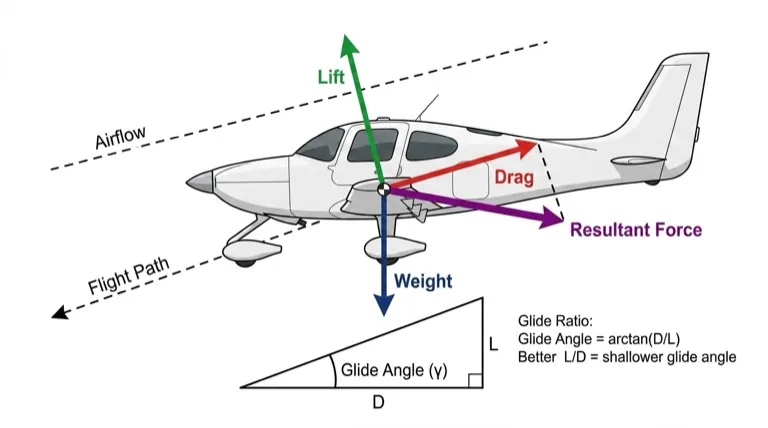
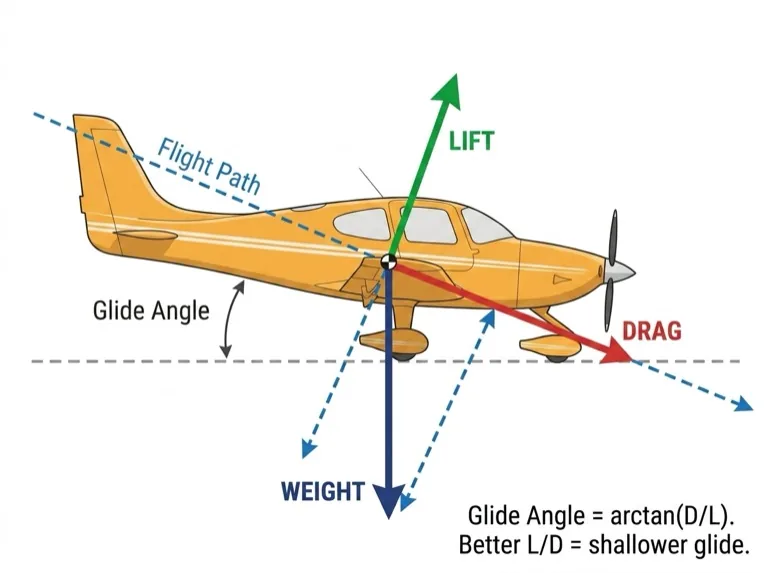
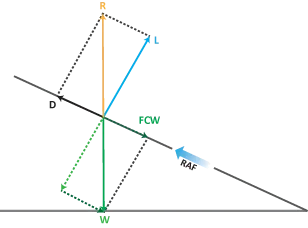
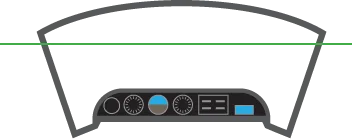
When the flight path is inclined downward, gravity has a forward component that replaces thrust. The steeper the descent angle, the greater the forward component of weight, and the more drag it can balance. In a glide with the engine at idle, the entire forward propulsive force comes from this weight component.
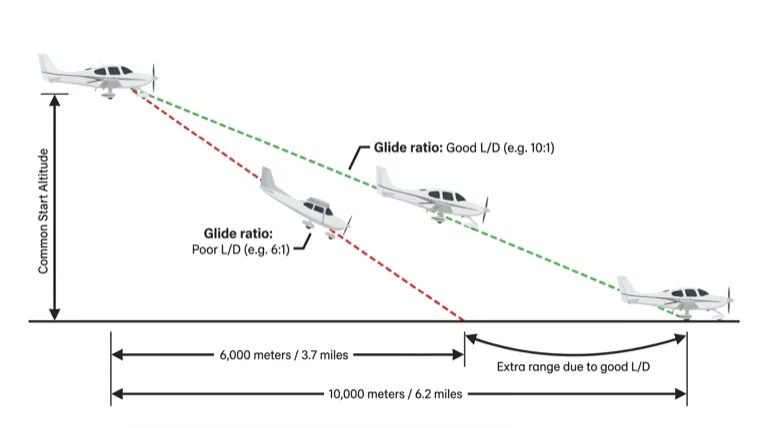
The Lift-to-Drag (L/D) ratio determines the glide angle. A higher L/D ratio means a shallower glide angle and greater glide range. This ratio is a fundamental aerodynamic property of the aircraft.
Gliding for Best Range
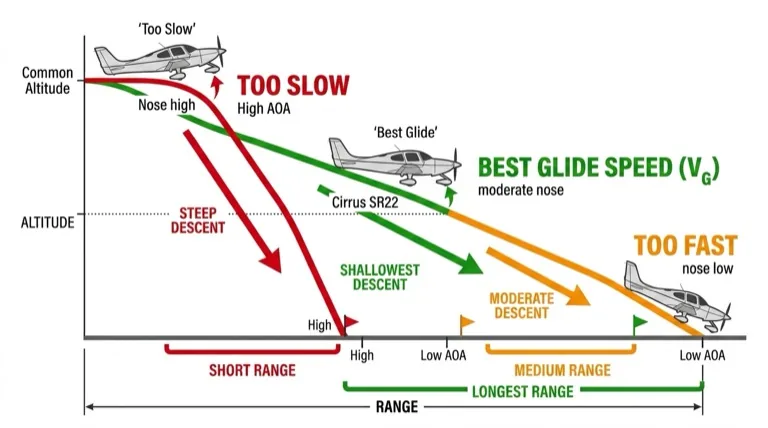
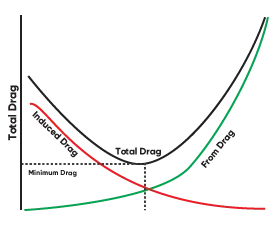
The best (shallowest) glide angle is achieved at the airspeed that produces the best L/D ratio. At this specific airspeed, drag is at its minimum for the lift being produced, giving maximum forward distance per foot of altitude lost.
Typical Training Aircraft Performance
Most training aircraft have a best L/D ratio of approximately 10:1. This means the airplane travels 10 feet forward for every 1 foot of altitude lost — equivalent to roughly 1.6 nautical miles per 1,000 feet of altitude in still air.
There is only one specific airspeed that achieves best L/D ratio. Flying faster or slower than this speed increases drag relative to lift and steepens the glide angle, reducing range. This airspeed is published in the Pilot's Operating Handbook (POH) as VBG or "Best Glide Speed."
| Altitude Lost | Distance Covered |
|---|---|
| 1,000 ft | ~1.6 nm |
| 2,000 ft | ~3.2 nm |
| 3,000 ft | ~4.8 nm |
| 5,000 ft | ~8.0 nm |
Effect of Wind
Wind affects glide range but does not affect rate of descent. The airplane descends through the air mass at the same vertical rate regardless of wind — but the ground it covers changes significantly.
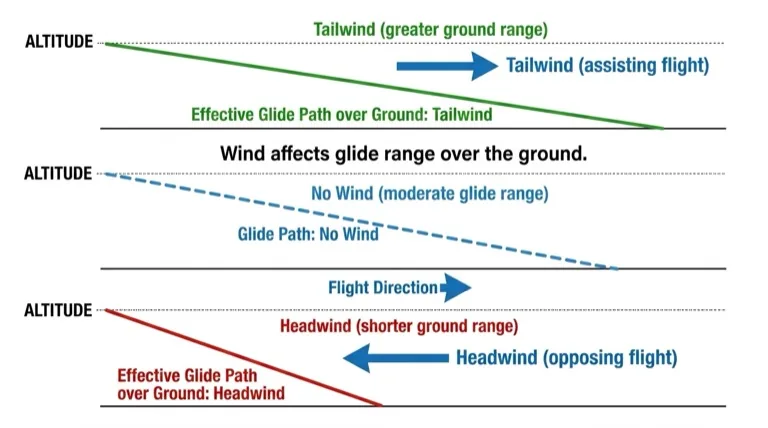
- Tailwind: Increases glide range over the ground. The air mass carrying the airplane moves in the same direction as flight, adding to ground distance covered.
- Headwind: Decreases glide range over the ground. The air mass moves opposite to flight, reducing the ground distance you can cover.
Key Point
In an engine failure, if you have a headwind, your actual glide range over the ground will be significantly less than the still-air figure. Factor this into your forced landing planning.
Effect of Weight
Weight does not affect the glide angle. Whether the airplane is heavy or light, the L/D ratio remains the same (it is an aerodynamic property, not a weight-dependent one). Therefore, the glide angle — and glide range — stays the same regardless of weight.
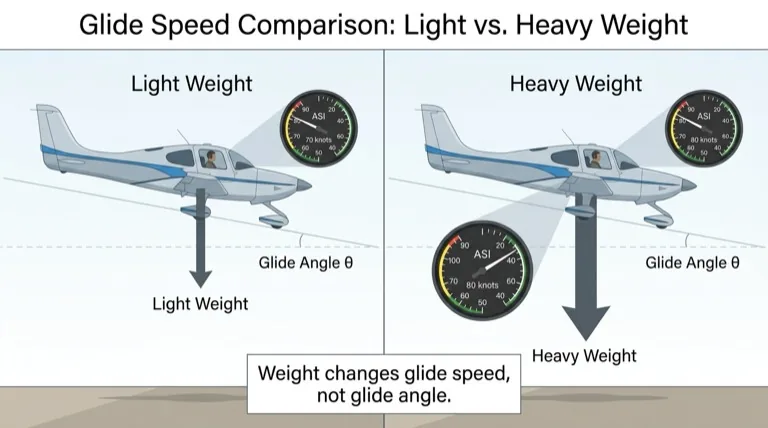
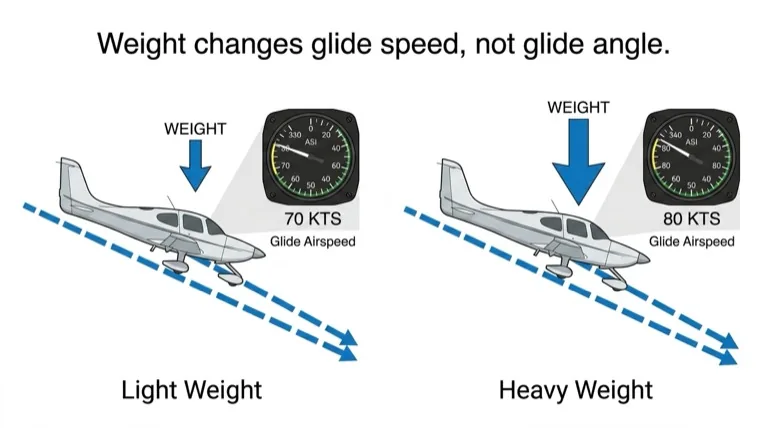
What changes is the glide speed. A heavier airplane must fly faster to generate the same lift coefficient at the best L/D angle of attack. The result:
- Heavier aircraft: same glide angle, but faster airspeed and higher rate of descent
- Lighter aircraft: same glide angle, but slower airspeed and lower rate of descent
Gliding for Best Endurance
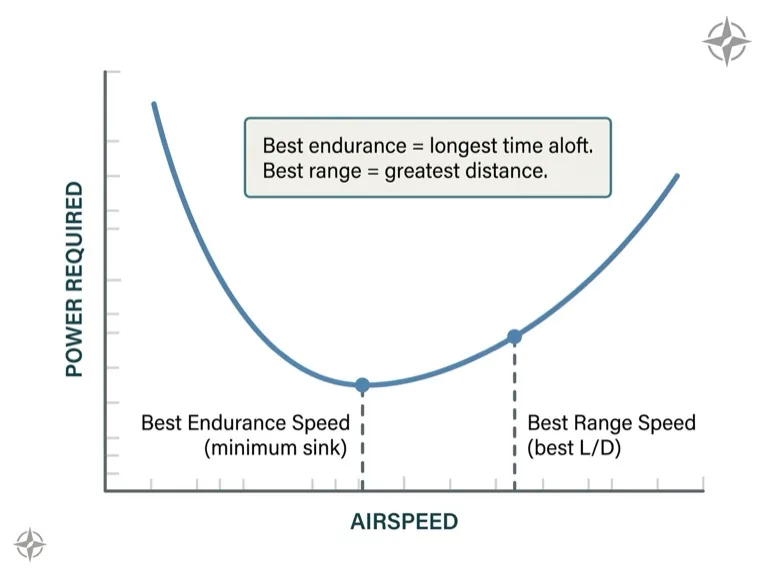
The minimum rate of descent occurs at the airspeed for minimum power required — which is slower than the best-range (best L/D) speed. At this speed, the airplane loses altitude at the slowest possible rate, maximizing time aloft.
Best endurance glide speed is rarely used in powered aircraft because:
- It sacrifices significant range for only a modest gain in time aloft
- The airplane is closer to the stall, reducing safety margin
- In an emergency, reaching a landing site (range) is almost always more important than staying airborne longer (endurance)
Effect of Flap
Extending flaps increases both lift and drag, but the drag increase is proportionally much greater. This worsens the L/D ratio, resulting in a steeper descent angle.
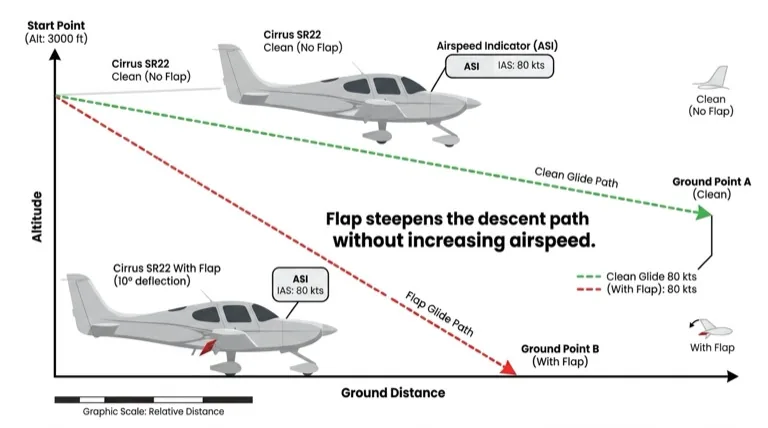
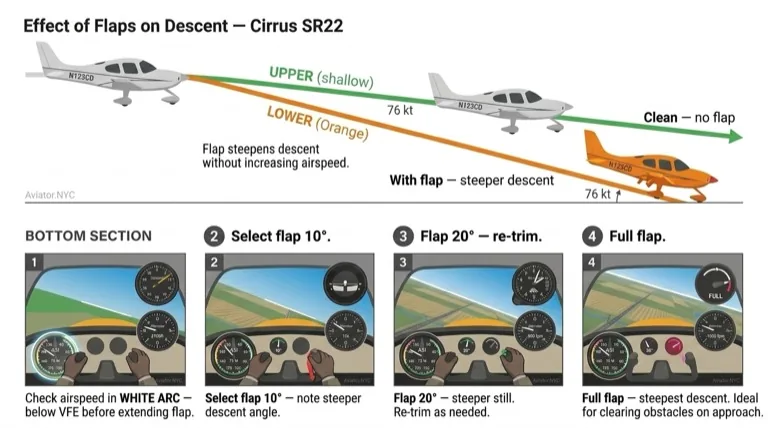
The major advantage of flap in a descent: it allows a steeper approach path without increasing airspeed. The increased drag acts as an aerodynamic brake, steepening the descent while the airplane maintains a safe, controlled speed.
This is exactly what you want on approach to land — a steep enough path to clear obstacles while maintaining a slow, controllable airspeed for touchdown.
Flap and Glide Range
Because flaps worsen L/D ratio, they reduce glide range. In an engine failure, you would normally glide clean (no flap) to maximize distance to a landing site, only adding flap when the field is assured.
Effect of Power
Adding power in a descent provides a forward force (thrust) that supplements the weight component. At a constant airspeed, adding power reduces both the descent angle and the rate of descent.
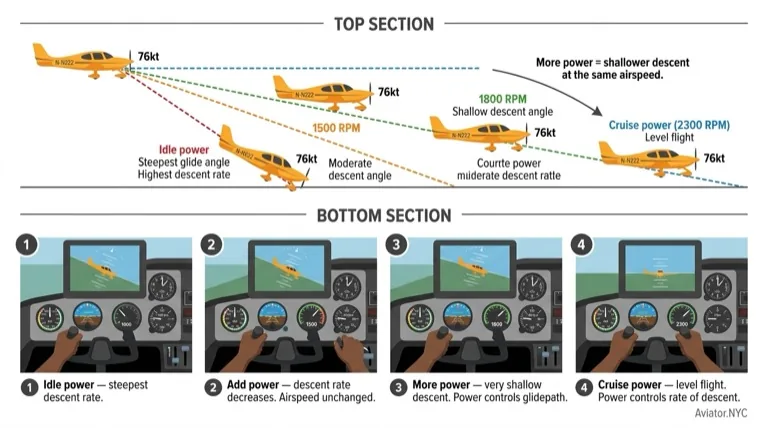
This gives us the fundamental control relationship for approach and descent:
- Power controls rate of descent (at a constant airspeed)
- Attitude (pitch) controls airspeed
This is the opposite of the common intuition that "nose down = go down faster." In fact, lowering the nose increases airspeed, while reducing power is what steepens the descent path at a given speed.
Sideslipping
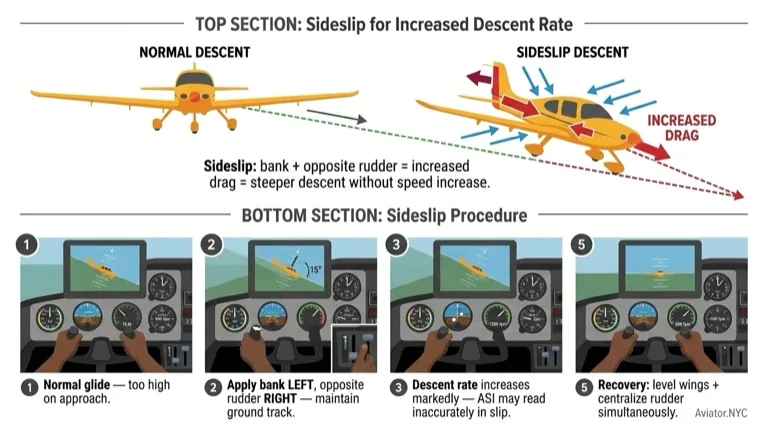
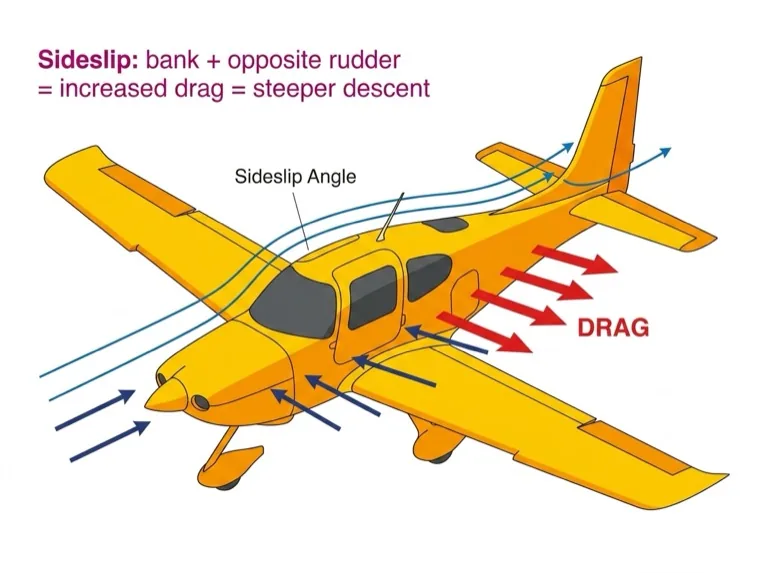
A sideslip is a deliberate cross-control maneuver: the airplane is banked in one direction while opposite rudder prevents the turn, causing the aircraft to slip sideways through the air.
The fuselage presents its side to the relative airflow, creating a marked increase in drag. This results in a significantly steeper descent without increasing airspeed — useful when you are too high on approach and need to lose altitude quickly.
Disadvantages of Sideslipping
- Uncomfortable: The uncoordinated flight creates unusual sensations for passengers
- Difficult airspeed control: The airspeed indicator (ASI) may read incorrectly due to the displaced airflow over the pitot tube and static ports
- High descent rates: Can exceed 1,500 fpm, requiring careful altitude management
Check the POH
Not all aircraft are cleared for sideslipping. Some aircraft have fuel system or engine limitations that prohibit extended slips. Always verify in the Pilot's Operating Handbook before using this technique.
Cruise Descent
A cruise descent is the gentlest form of descent — used to lose altitude gradually while maintaining cruise airspeed and passenger comfort. It is the standard technique for descending from cruise altitude toward the traffic pattern.
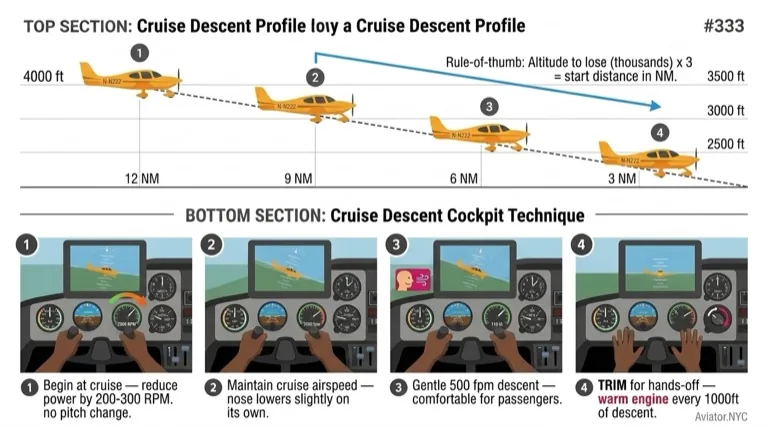
To enter a cruise descent: reduce power by approximately 200-300 RPM from cruise setting, maintain cruise airspeed, and allow the airplane to descend at roughly 500 feet per minute.
Rule of Thumb — Descent Planning
Height to lose (in thousands of feet) multiplied by 3 gives the approximate distance in nautical miles needed to descend. For example: 4,000 ft to lose = begin descent approximately 12 nm out.
| Altitude to Lose | Start Descent At |
|---|---|
| 1,000 ft | ~3 nm |
| 2,000 ft | ~6 nm |
| 3,000 ft | ~9 nm |
| 5,000 ft | ~15 nm |
Carburetor Icing Supplement
Critical Safety Topic
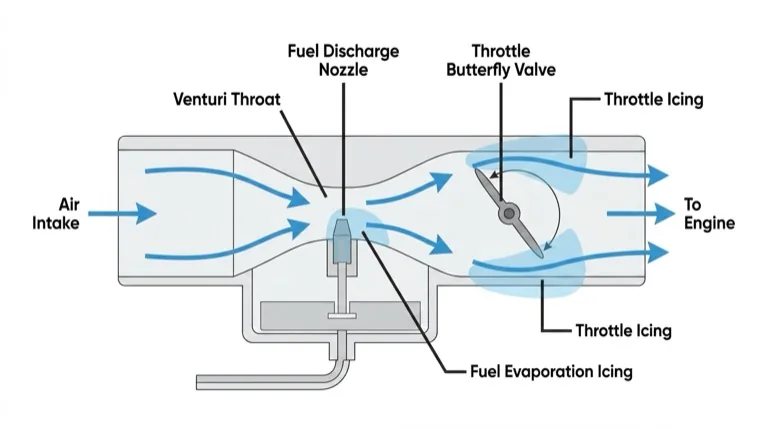
Carburetor icing is one of the most common causes of power loss in carbureted piston engines. It is most dangerous during descent when the throttle is nearly closed and engine power (heat) is at its lowest.
How Carburetor Ice Forms
Ice forms inside the carburetor through two mechanisms:
- Fuel icing (evaporation): As fuel vaporizes in the venturi, it absorbs heat from the surrounding air. This accounts for approximately 70% of the total temperature drop inside the carburetor.
- Throttle icing (pressure drop): Air expanding past the throttle valve drops in pressure and temperature (similar to releasing pressurized gas from a canister).
Combined, these effects can cause a temperature drop of up to 30 degrees Celsius inside the carburetor — enough to freeze moisture out of the air onto the throttle valve and venturi walls.
Conditions for Carburetor Icing
| Factor | Range / Threshold |
|---|---|
| Ambient temperature | -10°C to +30°C (yes, even on warm days) |
| Relative humidity | As low as 30% |
| Visible moisture | NOT required — can occur in clear air |
| Most dangerous phase | Descent / glide (low power, low engine heat) |
Symptoms (Fixed-Pitch Propeller Aircraft)
- Gradual RPM loss — the first and most subtle sign
- Altitude loss — as power decreases, the airplane begins to descend
- Rough running — occurs later as ice buildup becomes severe
Detection Method
Apply full carburetor heat. If RPM initially drops slightly (expected — hot air is less dense), then rises to a level HIGHER than before, ice was present and has been melted. Return carb heat to cold once RPM stabilizes.
Correct Use of Carburetor Heat
- Always apply FULL hot — partial heat can actually worsen icing by raising temperature into the range where ice forms most readily
- Apply for 5-10 seconds minimum to allow ice to melt
- Do NOT use above 75% power — hot unfiltered air at high power settings creates a detonation risk
- Always select cold (off) for takeoff, climb, and go-around — you need full power and filtered air
Rough Running After Applying Carb Heat?
If the engine runs roughly immediately after selecting carb heat — LEAVE IT ON. The roughness is caused by melted ice (water) passing through the engine. It will clear in a few seconds. Turning carb heat off at this point allows the ice to re-form.
Carburetor Heat in Descent
Descent is the most dangerous phase for carburetor icing because:
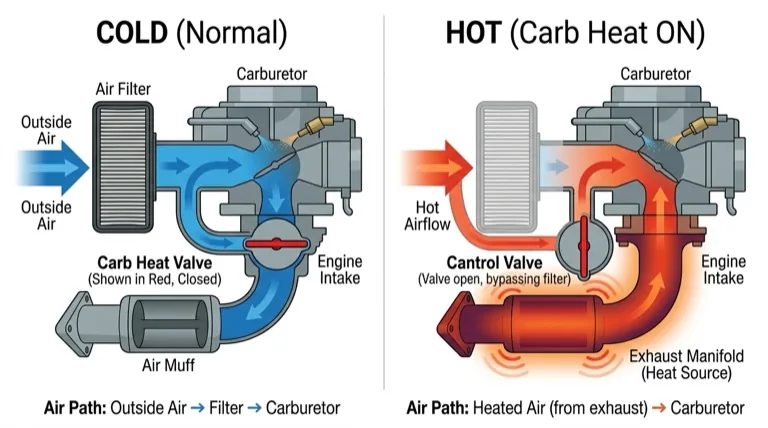
- The throttle is nearly closed, maximizing the pressure drop at the throttle valve
- Engine power is low, meaning the engine generates very little heat to warm the carburetor
- The pilot may be focused on approach tasks and miss the subtle early symptoms
Best practice: Apply carburetor heat before reducing power for descent, and warm the engine (increase power briefly) every 1,000 feet of descent to prevent ice buildup and keep the engine responsive.
Purpose
To descend at a specified airspeed in various configurations (clean, with flap, with power, sideslipping) and to level off accurately at a specified altitude. To practice the descent and level-off sequence used on final approach.
Airmanship
Lookout Below
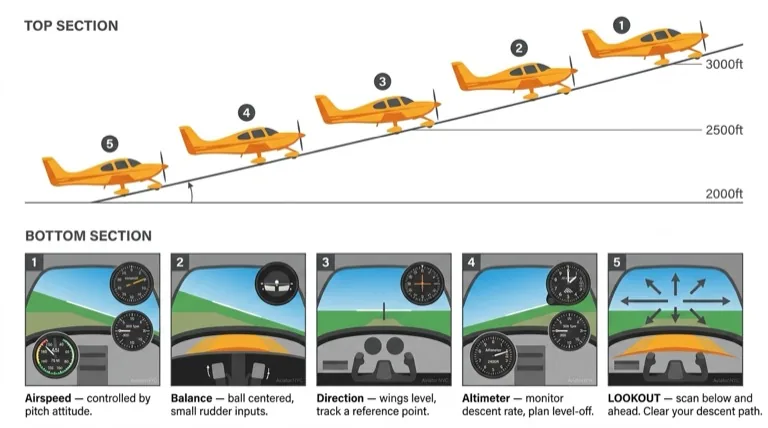
Before descending, always look below and ahead. Descending aircraft merge visually with ground features and become very difficult for other pilots to see. Clear the area beneath you before committing to a descent.
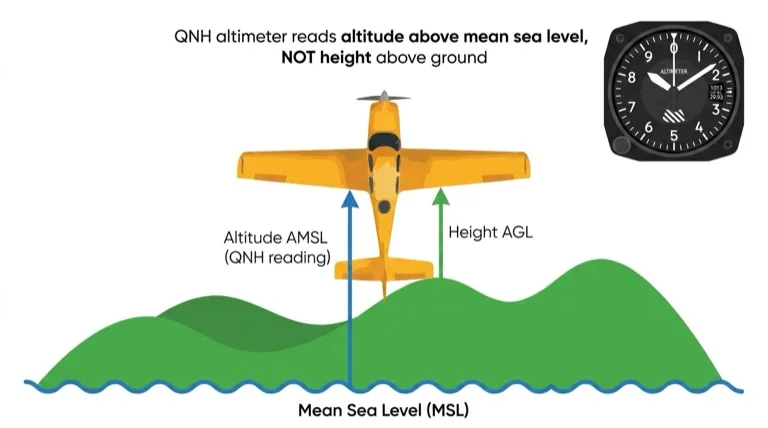
- Altimeter awareness: altimeter setting reads altitude above mean sea level (AMSL), not above ground level (AGL). Always know the terrain elevation beneath you.
- VFE awareness: Before extending flap, confirm airspeed is within the white arc (at or below VFE — maximum flap extended speed).
- Engine care: A cool engine in descent is susceptible to spark plug fouling. Warm the engine by briefly increasing power every 1,000 feet of descent. This also confirms the engine is still producing power when needed.
- Carburetor heat: Apply carb heat before closing the throttle for descent. Warm the engine at each 1,000-foot interval.
Entering the Glide
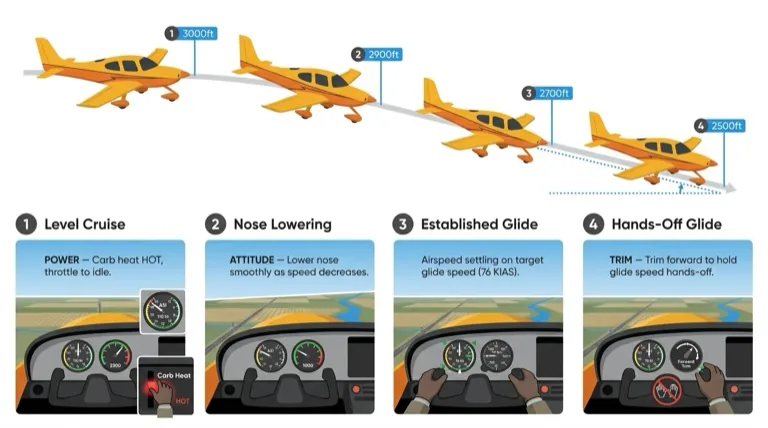
Use the standard Power-Attitude-Trim sequence:
- POWER: Carburetor heat to HOT. Smoothly close the throttle to idle.
- ATTITUDE: As the aircraft decelerates, lower the nose smoothly to the glide attitude. Allow airspeed to settle on the target glide speed.
- TRIM: Trim forward pressure off to maintain the glide speed hands-off.
Patience with Trim
Wait for the airspeed to stabilize before trimming. If you trim too early, you will need to re-trim as the aircraft settles into its new equilibrium. Give it 5-10 seconds.
Maintaining the Descent
Once established in the glide, maintain it with:
- Airspeed: Controlled by pitch attitude. If airspeed is too high, raise the nose slightly. If too low, lower the nose.
- Balance: Keep the ball centered with rudder. In a power-off glide there is minimal propeller effect, so rudder inputs are small.
- Direction: Maintain wings level and track a reference point on the horizon.
- Altimeter: Monitor descent rate and remaining altitude. Plan your level-off point.
Leveling Off
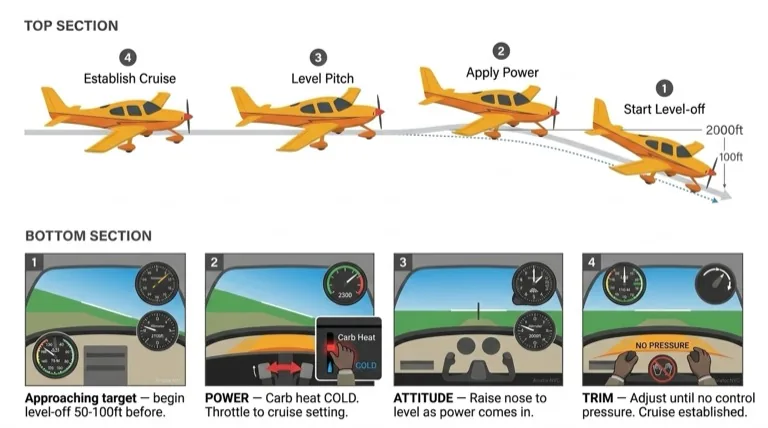
To transition smoothly from a descent back to level flight, anticipate your target altitude by 50-100 feet (approximately 10% of your descent rate). The sequence is:
- POWER: Carburetor heat to COLD. Smoothly increase power to cruise setting.
- ATTITUDE: Raise the nose to the level flight attitude as power comes in. The two actions should be coordinated — power and pitch together.
- TRIM: Once airspeed settles at cruise, trim off any residual control pressure.
Common Error
Leveling off late (go-arounding the target altitude) because the pilot waited until reaching the exact altitude before adding power. Always lead the level-off by 50-100 ft.
Effect of Flap
Extending flap in a descent produces a steeper descent path without increasing airspeed. The procedure:
- Confirm airspeed is in the white arc (at or below VFE)
- Select flap incrementally (10 degrees at a time)
- Note the steeper descent angle and lower nose attitude
- Airspeed may initially fluctuate — re-trim as needed
Each increment of flap steepens the approach. Full flap gives the steepest descent angle at a given airspeed — ideal for clearing obstacles on short final.
Effect of Power
Adding power during a descent reduces the rate of descent while maintaining the same airspeed. This is the primary technique for controlling your glidepath on approach:
- More power: Shallower descent, lower rate of descent
- Less power: Steeper descent, higher rate of descent
- Airspeed: Controlled independently by pitch attitude
This decoupling — power for path, pitch for speed — is the foundation of approach technique and will be used on every landing you make.
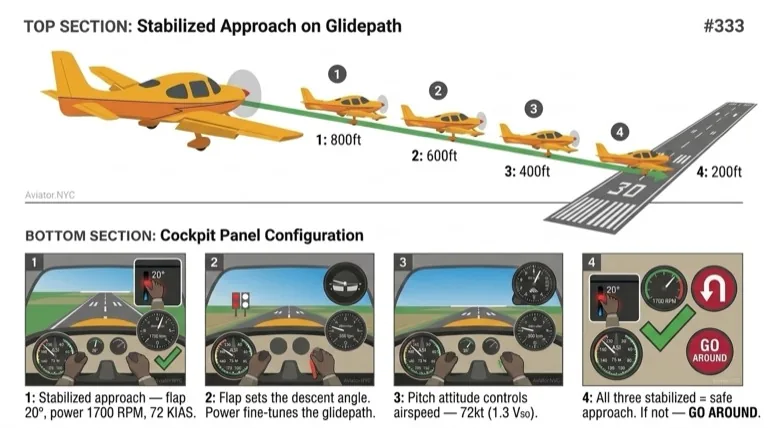
Descending with Flap and Power
On a normal approach to land, you combine flap and power to achieve a stable, controlled descent at a target airspeed along a desired glidepath. This is the standard approach configuration:
- Flap provides the steep descent angle needed to clear obstacles
- Power fine-tunes the rate of descent to hit your aim point
- Pitch attitude controls airspeed (approach speed, typically 1.3 VSO)
When all three are stabilized, you have a stabilized approach — the goal for every landing.
Simulator Practice
The stabilized approach is one of the most valuable exercises to practice in the AATD. Set up on a 3-degree glidepath at various flap settings and practice maintaining a constant airspeed and descent rate to the runway threshold.
Sideslipping
A sideslip increases descent rate without increasing airspeed. It is used when you find yourself too high on approach and need to steepen the descent quickly.
Technique
- Apply approximately 15 degrees of bank toward the lower wing
- Apply opposite (top) rudder to prevent the airplane from turning — maintain ground track
- The airplane now slips sideways through the air, presenting its fuselage to the airflow
- Note the markedly increased descent rate
- To recover: level the wings and centralize the rudder simultaneously
Limitations and Cautions
Check the POH for sideslip restrictions. Some aircraft prohibit slips with flaps extended (fuel flow concerns). The ASI may read inaccurately during a slip due to disturbed airflow over pitot/static ports. Use attitude and known pitch references rather than relying solely on indicated airspeed.
Cruise Descent
The cruise descent is the most common descent technique for transitioning from cruise altitude toward the traffic pattern. It is comfortable for passengers and gentle on the engine.
Technique
- Reduce power by 200-300 RPM from cruise setting
- Maintain cruise airspeed (the nose will lower slightly on its own)
- The airplane settles into a shallow descent of approximately 500 fpm
- Trim as needed for hands-off flight
Descent Planning Rule of Thumb
Multiply the altitude to lose (in thousands of feet) by 3 to get the distance in nautical miles at which to begin the descent. Example: need to descend 3,000 ft? Start about 9 nm out.
What You Have Learned
You can now descend the airplane appropriately, controlling both rate of descent and airspeed to achieve a precise approach path to land. You understand how to use power, flap, and sideslipping as tools to manage your descent profile in various situations — from a gentle cruise descent to a steep power-off glide.
Key takeaways from this lesson:
- Power controls rate of descent; attitude controls airspeed — this decoupling is the foundation of every approach
- Best glide speed gives maximum range; it is one specific airspeed determined by L/D ratio
- Flap steepens the descent without increasing speed — essential for obstacle clearance on approach
- Wind affects glide range (not rate of descent); weight affects glide speed (not glide angle)
- Carburetor icing is most dangerous in descent — apply carb heat proactively and warm the engine every 1,000 feet
- Sideslipping is a useful tool for losing altitude quickly, but check the POH for aircraft-specific limitations
Trimming Is Becoming Second Nature
By now, the Power-Attitude-Trim sequence should be feeling familiar. Whether entering a climb, leveling off, or establishing a descent, the framework is always the same. You are building the muscle memory that will make configuration changes smooth and precise throughout your flying career.
Stage 1 Complete
Congratulations
With the descending exercise complete, you have now covered all four basic maneuvers of flight: straight and level, climbing, descending, and turning. These are the building blocks upon which every advanced maneuver is constructed — from stalls and steep turns to traffic patterns and cross-country navigation.
You have progressed from your first familiarization flight through the fundamental handling skills that every pilot must master. The four basic maneuvers — combined with your understanding of the effects of controls, power, and trim — give you the toolkit to fly the airplane confidently in normal flight.
In the stages ahead, you will combine these basic maneuvers into more complex sequences: slow flight, stalling, pattern flying, forced landings, and eventually solo flight. Every one of those exercises is built on the skills you have developed in Stage 1.
Well done on reaching this milestone. The foundation is set — now the real fun begins.
Coming Up Next: Lesson 7 — Slow Flight
Learn to recognize the symptoms of critically slow airspeed and control the aircraft safely at minimum controllable airspeed. This exercise builds the foundation for stall recognition and pattern...
Skills You'll Work On
These are the maneuvers and procedures covered in this lesson. Your instructor tracks each one as you progress.
- Preflight Inspection
- Engine Starting
- Taxi & Before Takeoff Check
- Radio Communications
- Normal Takeoff and Climbs
- Climbing & Leveling Off With Turns
- Straight & Level Flight/Various Airspeeds
- Medium Turns
- Steep Turns
- Slow Flight (With & Without Flaps)
- Use Of Trim
- Use of Flaps, Mixture, Carb Heat
- Go Around Procedure (At Altitude)
- Descent & Leveling Off
- Introduction to Ground Ref Maneuvers
- Approach Planning & Altimeter Setting
- Normal Landing
- After Landing Parking and Securing
Grades reflect what was covered in this lesson, not a certification of pilot competency.
Lesson Plan
Where this fits: Exercise 8, "Descending," is the last of the four basic maneuvers and is paired with the climbing exercise to complete all vertical maneuvering in normal flight. It follows the climb and level-off work and sets up the slow-flight and circuit work that lead toward approach and landing. Conducted on Aviator.NYC's FAA-approved Advanced Aviation Training Device (AATD).
- Prerequisite
- Student can enter, maintain, and level off from a climb and hold straight-and-level cruise with trim.
- Materials
- C172 G1000 AATD simulator; checklist card; local VFR sectional and airport diagram; carburetor icing supplement reference.
- Objectives for this session
- Practice glide, powered, and cruise descents at specified airspeeds, leveling off at a target altitude within plus or minus 100 feet.
- Show how flap and power each change descent rate and angle, using the vertical speed tape and trend vectors to visualize the path.
- Practice a sideslip to increase descent rate without gaining airspeed, and review carburetor heat use during low-power descent.
Looking Ahead
Next is Lesson 7, Slow Flight (Exercise 10a), which carries the descent and configuration skills into flight at minimum controllable airspeed. If leveling off or descent-rate control was rough today, re-fly a couple of glide and powered descents at the start of Lesson 7 before slowing down.
These lesson plans are provided as supplementary training guidance only. They do not supersede FAA publications, aircraft manufacturer documentation, or your instructor's direction. Always refer to the FAA Instrument Flying Handbook, Airplane Flying Handbook, AIM, and applicable POH/AFM as the official sources.