Planning your PPL? Start with the step-by-step Private Pilot License guide.
How Do You Get to Morristown Airport from Manhattan?
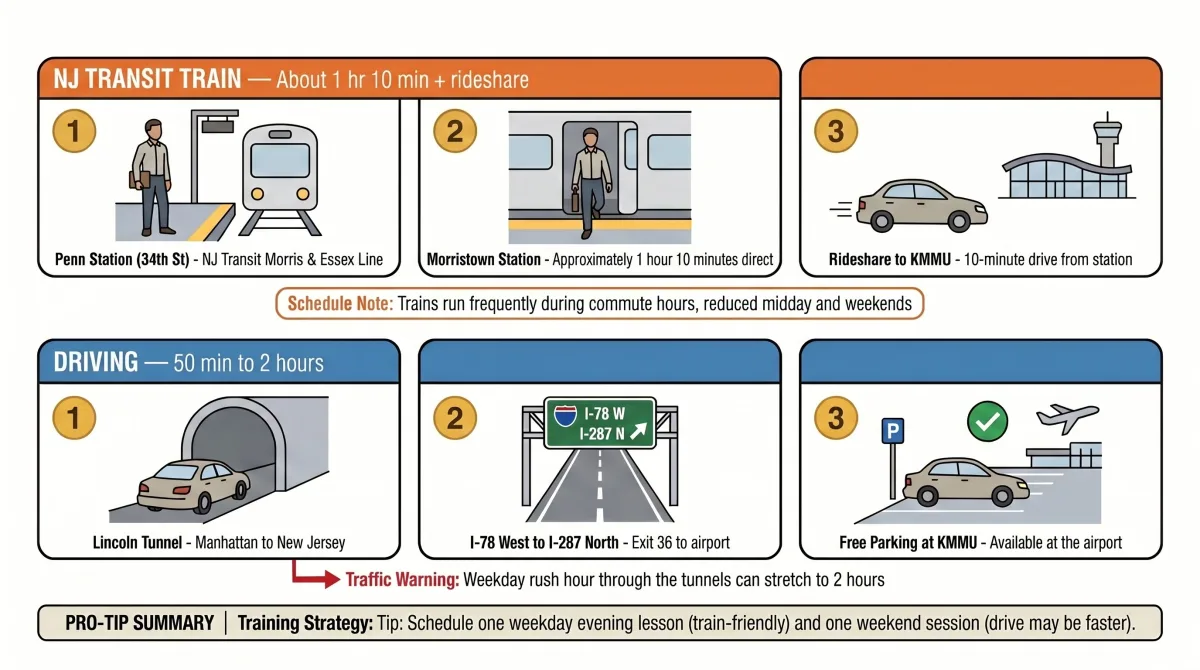
NJ Transit's Morris & Essex Line runs from Penn Station (Midtown Manhattan) to Morristown Station, making KMMU one of the few training airports accessible by public transit from NYC. The ride takes approximately 1 hour and 10 minutes on a direct train, with departures running every 30–60 minutes during peak hours. From Morristown Station, the airport is about a 10-minute drive — most students use a rideshare or have a car at the Morristown end. A one-way NJ Transit ticket costs approximately $12.50 off-peak. Morristown Municipal Airport is located at 50 Airport Road, Morristown, NJ 07960, approximately 35 miles west of Midtown Manhattan. The airport offers free surface parking for flight students, which is a significant advantage over closer airports where parking can be limited or costly.
If you're driving, KMMU is approximately 35 miles from Midtown Manhattan. Take the Lincoln Tunnel to I-78 West, then I-287 North to exit 36. Free parking is available at the airport. Flight schools at Morristown operate from their own buildings or share space with one of the airport's FBOs (Fixed Base Operators) — the facilities that provide fuel, parking, and ground services for private aircraft. Think of an FBO as the airport's front desk for general aviation. Weekend drive times average 50–60 minutes; weekday rush hour can stretch to 2 hours through the tunnels.
What Flight Schools Operate at Morristown Airport?
Five flight schools operate at Morristown Municipal Airport (KMMU) in 2026, spanning Part 61 and Part 141 training with fleet options from budget Cessna 172s to brand-new Cirrus SR22 aircraft with Garmin G7 avionics. The schools are Certified Flyers, American Flyers, ATP Flight School, P6 Aviation, and Nova Aviation. Morristown has one unique advantage over other NJ training airports: Certified Flyers operates the most diverse fleet of any single school in the NYC metro area, covering Cessna, Cirrus, Beechcraft, and Diamond aircraft under one roof. Hourly rental rates at KMMU schools range from approximately $180–$350 depending on aircraft type, with instruction fees of $65–$95 per hour on top. Only American Flyers offers both Part 61 and Part 141 certification, while ATP provides an accelerated full-time career program. Here's what each school does and who it's best for.
| School | Part | Best For | Fleet Highlight |
|---|---|---|---|
| Certified Flyers | 61 | Students wanting fleet variety, multi-engine, glass cockpit | Cessna 172SP, Cirrus SR20/SR22, Beechcraft Duchess, Diamond DA42 |
| American Flyers | 61 & 141 | Students wanting dual-path flexibility, modern aircraft | Piper Pilot 100i (modern glass cockpit) |
| ATP Flight School | 61 | Full-time career changers, accelerated timeline | Piper Archer, Piper Seminole (multi), Cessna 172 |
| P6 Aviation | 61 | Cirrus owners, transition pilots, premium training | 2024–2026 Cirrus SR20/SR22, Diamond DA42 |
| Nova Aviation | 61 | Advanced training, aircraft management clients | Aircraft management + flight training |
What Does Certified Flyers Offer at KMMU?
Certified Flyers operates the most diverse fleet of any single flight school in the NYC metro area, with aircraft spanning Cessna, Cirrus, Beechcraft, and Diamond under one roof at Morristown Airport. They are a long-established New Jersey Part 61 school specializing in glass cockpit training with accelerated programs for instrument and multi-engine ratings. Their fleet includes the Cessna 172SP with Garmin G1000 avionics, Cirrus SR20 and SR22 for advanced single-engine training, the Beechcraft Duchess for traditional multi-engine time, and the Diamond DA42 Twin Star with FADEC engines and Garmin G1000 NXi. This range means a student can progress from Private Pilot through Commercial Multi-Engine without ever switching schools or starting over with a new operation. Certified Flyers has been training pilots at KMMU for over 20 years.
What They Offer
- Certificates & ratings: Private Pilot, Instrument Rating, Commercial, Multi-Engine, CFI, CFII
- Fleet: Cessna 172SP, Cirrus SR20, Cirrus SR22, Beechcraft Duchess (multi-engine), Diamond DA42 Twin Star (multi-engine)
- Specialties: Glass cockpit training, accelerated IFR programs, accelerated multi-engine programs
- Part 61: Flexible scheduling
- Website: certifiedflyers.com
Who It's Best For
Certified Flyers is the right choice if you want the flexibility to train in different aircraft types without switching schools. Starting your Private Pilot in a Cessna 172SP, transitioning to a Cirrus SR20 for instrument training, and adding a multi-engine rating in a Beechcraft Duchess or Diamond DA42 — all with the same school and the same record-keeping. The two multi-engine options (piston twin Duchess and modern DA42) are particularly valuable for students planning an airline career.
The glass cockpit focus means you'll be learning modern avionics from the start. For students who want variety without the hassle of coordinating between multiple schools, Certified Flyers is hard to beat at KMMU. If your priority is finding the right instructor match, the larger operation means more instructor options.
What Does American Flyers Offer at KMMU?
American Flyers is a national flight training brand founded in 1939 with locations across the US, and their Morristown Airport location operates the modern Piper Pilot 100i — one of the newest purpose-built training aircraft on the market. They offer both Part 61 and Part 141 training at KMMU, making them the only school at Morristown that provides dual-path flexibility. The Piper Pilot 100i features a Garmin G3X Touch glass cockpit, fuel-injected Lycoming engine, and a contemporary airframe designed from the ground up for flight training rather than adapted from a 1950s-era design. American Flyers' standardized national curriculum means students can transfer between locations without repeating coursework — useful for students who travel or relocate during training. Their Part 141 approval also qualifies students for VA benefits and international student visa training requirements.
What They Offer
- Certificates & ratings: Private Pilot, Instrument Rating, Commercial, Multi-Engine, CFI, CFII
- Fleet: Piper Pilot 100i (modern glass cockpit single-engine trainer)
- Part 61 and Part 141: Dual-path flexibility
- National brand: Standardized curriculum across all locations; students can train at multiple locations
- Website: americanflyers.com/morristown
Who It's Best For
American Flyers suits students who value a proven national curriculum and want the option to train at other locations if they travel. The Piper Pilot 100i is a significant draw — it's a purpose-built training aircraft with a modern glass cockpit, designed from the ground up for flight schools. It's newer than the legacy Cessna 172 and Piper Archer designs that dominate most training fleets.
The dual Part 61/141 option provides real flexibility. Start under Part 61 for scheduling convenience, then switch to Part 141 if you need a structured syllabus for VA benefits or an accelerated timeline. One caveat: American Flyers' structured curriculum moves quickly. Students who don't pick up concepts fast can struggle to stay on track with the lesson plans. Complete your FAA written knowledge test before starting — it removes one variable and lets you focus entirely on flying skills. Read our Part 61 vs Part 141 comparison to understand which path makes sense for your goals.
What Does ATP Flight School Offer at KMMU?
ATP is the largest flight school in the United States with 88 training centers nationwide, and their Morristown Airport (KMMU) location offers the same Airline Career Pilot Program available at their other NJ and NY locations. The program takes students from zero flight experience to all certificates required for an airline pilot career — Private Pilot, Instrument Rating, Commercial (single and multi-engine), CFI, and CFII — in approximately 12 months of full-time training. ATP's fixed program cost starts at $90,995 (with private pilot credit) up to $123,995 (from zero time), plus $10,500–$12,000 in FAA examiner and testing fees. Their fleet at KMMU includes Piper Archers, Piper Seminoles for multi-engine, Cessna 172s, and Frasca AATD simulators. The same program runs at Essex County (KCDW) and Republic Airport (KFRG), with classes starting every Monday.
What They Offer
- Program cost: $123,995 from zero time (12 months), $100,995 with solo credit (11 months), $90,995 with private pilot (9 months). FAA examiner fees and knowledge tests ($10,500–$12,000) are additional.
- Flight hours: 284 total from zero time — 204 single-engine, 25 multi-engine, 55 simulator
- Fleet: Piper Archer, Piper Seminole (multi-engine), Cessna 172, Frasca AATD simulators
- Schedule: Full-time immersion, 8 AM–8 PM, 5–7 days/week. Classes start every Monday.
- Certificates included: Private Pilot, Instrument Rating, Commercial (single & multi-engine), Flight Instructor (CFI & CFII)
- Airline partnerships: 38 Career Tracks with American, Delta, United, Frontier, Sun Country. Tuition reimbursement through select airlines.
- After graduation: Instructor position to build hours; airline hiring minimums in 18–24 months. Total time to airline cockpit: ~2.5 years.
- Financing: Full financing through Sallie Mae. Free housing at select locations.
Who It's Best For
ATP is built for career changers going full-time. If you can commit 12 months at 5–7 days a week and invest $124K–$136K total (program + examiner fees), ATP's model eliminates the uncertainty of pay-as-you-go training. The guaranteed instructor position and 38 airline Career Tracks provide a clear pipeline from zero experience to a regional airline cockpit in approximately 2.5 years.
The tradeoff is flexibility — there is none. ATP's accelerated program doesn't accommodate part-time schedules or breaks. If you're training 2–3 times a week while working, ATP is not the right fit. Be aware: the accelerated pace demands fast learning. If you fall behind the lesson plans, catching up is extremely difficult — and ATP does not refund program fees. Complete your FAA written knowledge tests before enrolling to give yourself the best chance of keeping pace. For the full-time commitment question, read our guide on how lesson frequency affects your training.
What Does P6 Aviation Offer at KMMU?
P6 Aviation is a certified Cirrus Platinum Training Center with dual locations at both Morristown Airport (KMMU) and Essex County Airport (KCDW), offering some of the newest training aircraft in the NYC metro area. They operate a fleet of 2024–2026 model-year Cirrus SR20 and SR22 aircraft equipped with Garmin G7 Perspective Touch+ avionics — the same glass cockpit and side-stick configuration found in Cirrus aircraft worldwide. P6 also has a Diamond DA42 Twin Star for multi-engine training. As a Cirrus Platinum Training Center, P6 is authorized to deliver Cirrus Approach transition courses for new Cirrus owners. Their Part 61 operation provides flexible scheduling, and students can book at either the KMMU or KCDW location depending on convenience, weather, or which approach environment they want to practice in on a given day.
What They Offer
- Certificates & ratings: Private Pilot, Instrument Rating, Commercial, Multi-Engine (Diamond DA42), Cirrus transition courses via Cirrus Approach platform
- Fleet: Cirrus SR20 and SR22 (2024–2026 G7 Garmin Perspective Touch+), Diamond DA42 Twin Star
- Part 61: Flexible scheduling
- Two locations: Students can train at both KMMU and KCDW
- Website: p6aviation.com
Who It's Best For
P6 is the right choice if you already own or plan to own a Cirrus, or if you want to train in the most modern aircraft available. The dual-location advantage is real — you can schedule at whichever airport works better on a given day, or use KCDW for its shorter Manhattan commute and KMMU for its superior instrument approaches.
Cirrus aircraft have a side-stick, composite airframe, and Cirrus Airframe Parachute System (CAPS) that make them meaningfully different from traditional Cessna or Piper trainers. Learning in a Cirrus from day one means no transition training later. The Diamond DA42 Twin Star adds a modern multi-engine option that's increasingly common in airline interview prep.
What Does Nova Aviation Offer at KMMU?
Nova Aviation combines aircraft management services with advanced flight training at Morristown Airport (KMMU), operating under Part 61 with flexible scheduling for experienced pilots. Unlike the other four schools at KMMU that focus primarily on ab initio (zero-time) training, Nova's flight training operation is oriented toward pilots who already hold certificates and want advanced ratings, recurrency training, or type-specific instruction. Their aircraft management side means they maintain and operate owner aircraft based at Morristown, and some of those managed aircraft are available for dual instruction. Nova does not maintain a dedicated rental fleet or a standalone website — they operate primarily through referrals and their Facebook presence. For students starting from zero, one of the larger KMMU schools is a more appropriate entry point.
What They Offer
- Services: Aircraft management and advanced flight training
- Part 61: Flexible scheduling
- Contact: Available via Facebook page (no standalone website)
Who It's Best For
Nova Aviation is a smaller operation geared toward pilots who already have some experience and want advanced training, or aircraft owners looking for management services combined with instruction. For ab initio (zero-time) students, the larger schools at KMMU — Certified Flyers, American Flyers, or ATP — are more appropriate starting points with broader fleets and more instructor availability.
Should You Choose Part 61 or Part 141 at KMMU?
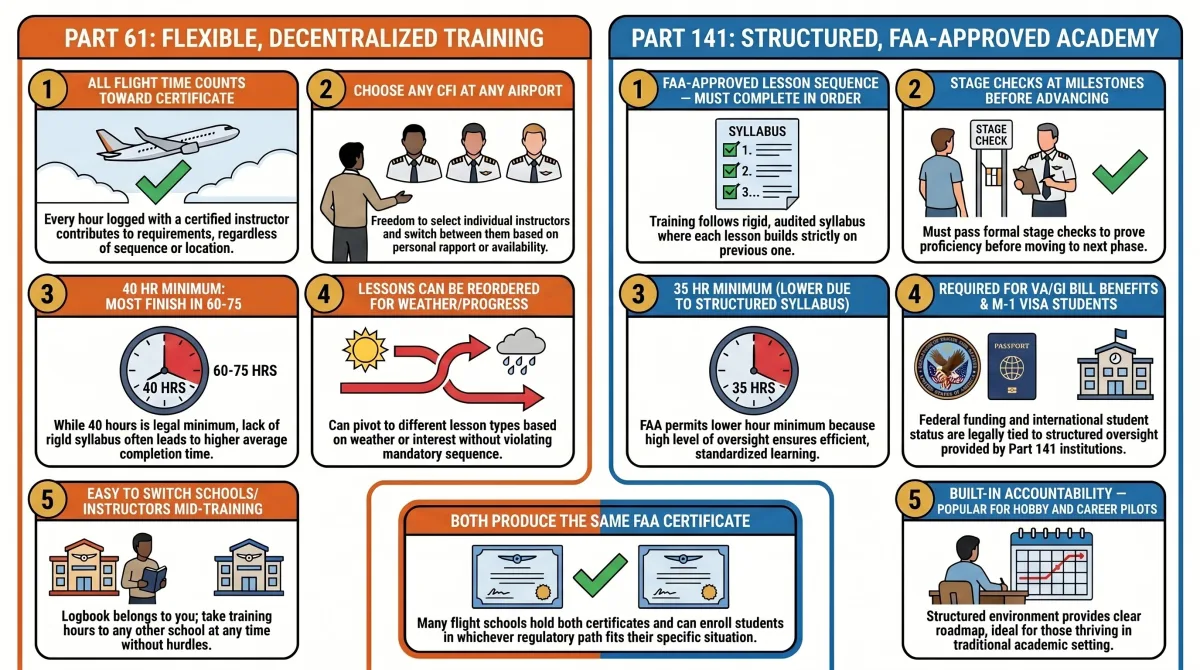
Morristown Airport (KMMU) offers both Part 61 and Part 141 flight training, with American Flyers being the only school at the airport providing both options under one roof. The remaining four schools — Certified Flyers, ATP Flight School, P6 Aviation, and Nova Aviation — all operate under Part 61 exclusively. Part 141 training follows an FAA-approved structured syllabus with stage checks and is required for VA (GI Bill) funding and most international student visa programs. Part 61 allows more flexible scheduling and is the standard choice for working professionals who train on evenings and weekends. Both paths lead to the exact same FAA pilot certificate — airlines do not differentiate between them when hiring. Here's how the options break down at KMMU:
| School | Part 61 | Part 141 | Notes |
|---|---|---|---|
| Certified Flyers | Yes | — | Most diverse fleet. Flexible scheduling. |
| American Flyers | Yes | Yes | Dual option. National curriculum. Piper Pilot 100i. |
| ATP Flight School | Yes | — | Part 61 but structured like 141. Full-time accelerated only. |
| P6 Aviation | Yes | — | Cirrus-only fleet. Also at KCDW. |
| Nova Aviation | Yes | — | Aircraft management + advanced training. |
If you're not sure which path is right for you, read our full Part 61 vs Part 141 comparison. The short version: Part 141 is required for VA benefits and international student visas. For everyone else, both paths lead to the exact same FAA certificate. Airlines don't care which one you used.
What's It Like Training at Morristown Airport?
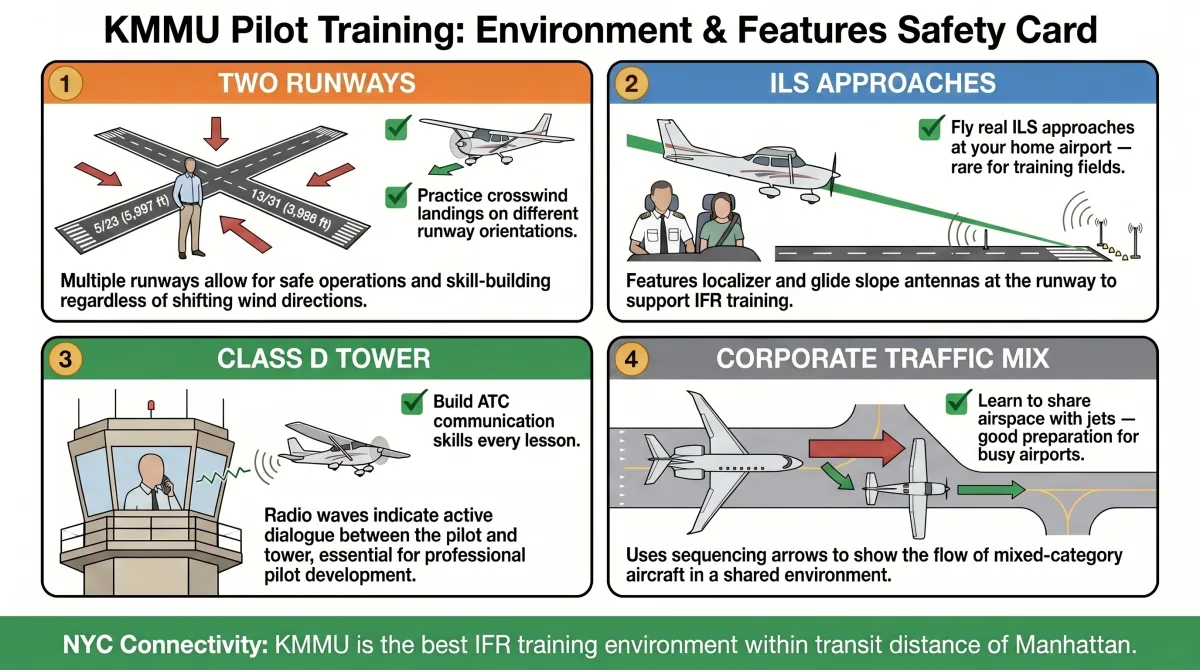
Morristown Municipal Airport (KMMU) is a Class D towered airport with two runways — the primary Runway 5/23 at 5,998 feet and Runway 13/31 at 3,597 feet — making it one of the busiest general aviation airports in northern New Jersey. KMMU handles a mix of flight training, corporate jets, turboprops, and piston aircraft, creating a more active radio and traffic environment than nearby Essex County Airport (KCDW). This is excellent preparation for flying into busier airports later in your career. The airport has ILS, RNAV (GPS), VOR, and LOC instrument approaches available, which makes it one of the strongest IFR training environments in the NYC metro area. Students at KMMU build real radio communication skills quickly because the Morristown Tower is active and the traffic volume demands clear, concise phraseology from day one.
Airspace
KMMU sits under the New York Class B airspace shelf, similar to KCDW. You'll learn to operate near complex airspace from day one. The Morristown Tower controls departures and arrivals, and the practice areas to the west provide room for maneuvers training outside the Class B. The proximity to Newark (KEWR) Class B airspace teaches students about airspace boundaries in a way that textbooks cannot replicate.
Runways
The primary runway (Runway 5/23) is 5,998 feet long — significantly longer than KCDW's 4,552-foot primary. There's also Runway 13/31 at 3,597 feet. The longer primary runway accommodates the jets and turboprops based at KMMU, and it gives training aircraft plenty of margin. Having two runways provides crosswind landing practice when winds don't favor the primary.
Instrument Approaches
KMMU's multiple instrument approaches are a major training advantage. The airport has ILS, RNAV (GPS), VOR, and LOC approaches — covering the full range of approach types an instrument student needs to learn. You can practice precision and non-precision approaches at your home airport rather than flying to a different field for each type. This saves time and money during instrument training. For a deeper look at approach procedures, read our guide on how to fly an instrument approach, or hear from a student about what getting an instrument rating is really like.
Weather Patterns
Northern New Jersey weather follows typical Northeast corridor patterns. Summer afternoons bring convective activity that can cancel lessons. Winter brings IFR conditions that are excellent for instrument training but can ground VFR students. The best training months for consistent flying are April–June and September–November. If you want to make progress year-round, supplementing flight time with simulator-based training keeps you sharp during weather cancellations.
How Does Simulator Training Complement Flight Time at KMMU?
Students who combine FAA-approved simulator (AATD) sessions with flight lessons at Morristown Airport typically spend less total time and money in the airplane to reach the same proficiency level. The FAA allows up to 2.5 hours of AATD time toward the Private Pilot certificate (out of 40 minimum total) and up to 20 hours toward the Instrument Rating (out of 40 minimum). The reason simulator time is so effective is straightforward: procedures that can be learned and repeated in a simulator — like KMMU's ILS Runway 5 approach, radio communication practice, emergency procedures, and GPS navigation — don't need to be learned at $250–$350 per hour with the engine running. Aviator.NYC in Manhattan offers FAA-approved AATD simulators with Garmin G1000 NXi avionics, with instructors who hold multiple type ratings and fly real jets for a living. Aviator is moving to a new Midtown Manhattan location in October 2026, with Cirrus SR20, SR22, and SF50 Vision Jet simulator training planned there, including type rating prep (opening date to be announced). A typical simulator session costs $100–$180 per hour, saving students $100–$200 per hour on procedural practice that transfers directly to the airplane.
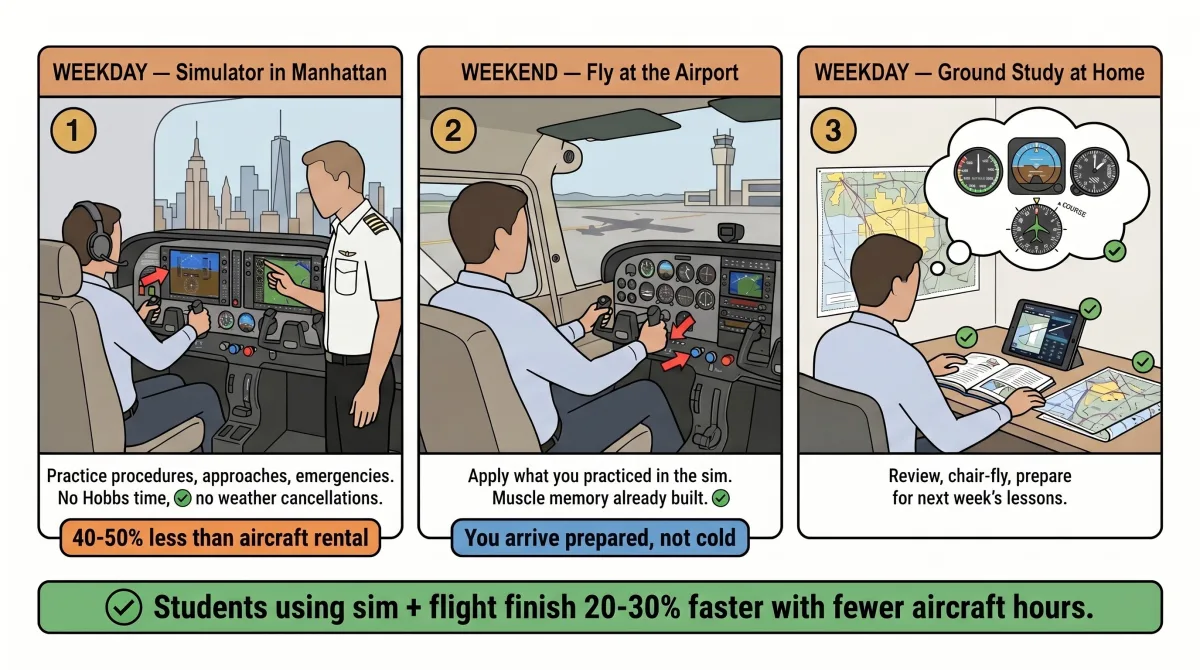
FAA regulations allow up to 2.5 hours of Advanced Aviation Training Device (AATD) time toward the Private Pilot certificate and up to 20 hours toward the Instrument Rating. These aren't "bonus" hours — they replace airplane hours that would otherwise cost significantly more.
The practical benefit for a KMMU student: you can do a 1-hour sim session in Manhattan after work on a Tuesday evening, practice the ILS Runway 5 approach at Morristown three times, and show up to your Saturday flight lesson ready to fly it for real. Your instructor spends less time explaining and more time refining your technique in the actual airplane. With KMMU's multiple approach types, there's always a new procedure to practice in the simulator before flying it for real. Learn more about how to optimize your instrument rating training with the right sim-to-flight balance.
SELECT YOUR PATH
NYC / AVIATOR.NYCNEW PILOTS: WHAT'S YOUR GOAL?
LICENSED PILOTS: SELECT TRAINING
FLY AS A HOBBY
Learn safely, step-by-step, and at your own pace.
A private pilot license in NYC typically costs $12,000–$34,000. Most students need 60–80 flight hours to reach checkride proficiency. Simulator training at $215/hr saves over 45% compared to aircraft rental at each stage — and over 60% with a $1,080 training bundle ($180/hr). Pay-as-you-go pricing with no membership fees or upfront commitment.
See the full private pilot license cost breakdown →Yes. You need at least a Third Class FAA Medical Certificate before you can fly solo. Most healthy adults pass without issues — the exam covers basic vision, hearing, and general health. Schedule your exam with an Aviation Medical Examiner (AME) early in training. Important: if you have ever been prescribed medication for anxiety, depression, or ADHD — even as a child — talk to an AME before investing heavily in training to avoid surprises.
How to get your FAA medical certificate for flight training →Yes. Aviator.NYC's FAA-certified Advanced Aviation Training Device (AATD) with Garmin G1000 NXi avionics logs hours that count directly toward your private pilot certificate. Simulator training at $215/hr saves over 45% compared to aircraft rental — and over 60% with a training bundle — with no weather cancellations or maintenance delays. Train on 20+ aircraft configurations from Cessna 172 to Beechcraft Bonanza, all in Lower Manhattan.
FAA-approved flight simulator training in NYC →Most students earn their private pilot license in 4–12 months depending on training frequency. The FAA requires a minimum of 40 flight hours, but most students need 60–80 hours to reach checkride proficiency. A typical path: Weeks 1–2 in the simulator building foundations, Weeks 3–12 flying dual and solo at a local airport, then Months 3–12 completing cross-country flights and checkride prep. You control the pace — train around your work schedule.
Private pilot training timeline and milestones →Start with a 2-hour discovery session ($430) in Aviator.NYC's Manhattan simulator. No experience needed — your airline pilot instructor walks you through takeoff, flight, and landing. After your first session, you'll know if flight training is right for you. From there, a structured path takes you from simulator foundations to your first solo flight at a local airport.
Book your first flight lesson in Manhattan →Part 61 defines requirements for pilot certification. Part 141 defines requirements for school approval. Both use the same commercially available lesson plans and lead to the same FAA certificate. The key difference: under Part 61, every flight you take counts toward your certificate requirements. Under Part 141, off-syllabus flights don't count toward the 141 program. Part 61 dominates in NYC because the off-syllabus flexibility better serves students who train infrequently and want every flight hour to always count. Aviator.NYC operates under Part 61 — by design.
Part 61 vs Part 141 flight training — which is right for you →The FAA Private Pilot Knowledge Test is a 60-question multiple-choice exam covering aerodynamics, weather, navigation, regulations, and flight planning. You need a score of 70% or higher to pass. Most students use online prep courses like Sheppard Air or Sporty's and pass within 2–4 weeks of focused study. Pass the written test early in your training — it builds confidence and lets you focus on flying skills.
Private pilot training steps and written exam prep →Instructor quality matters more than price. Look for instructors with airline or professional experience who teach part-time because they love it — not because they're building hours. Visit 1–2 schools in person. Ask about cancellation rates, aircraft availability, and whether they use FAA-approved simulators to reduce cost. For NYC-area students, the closest GA airports are Republic Airport (KFRG), Morristown Airport (KMMU), Essex County Airport (KCDW), Westchester Airport (KHPN), and Lincoln Park Airport (N07).
Best flight training airports near New York City →FLY AS A CAREER
From first lesson to professional pilot — one clear path.
The career path follows six stages: Private Pilot License → Instrument Rating → Commercial Certificate → Multi-Engine Rating → CFI Certification → Airline Transport Pilot (ATP). Each rating builds on the previous one. You need 1,500 total flight hours for an ATP certificate, which most pilots build by instructing after earning their CFI. The entire pathway from zero experience to airline-eligible typically takes 4–6 years part-time or 18–24 months full-time.
See the complete career pilot roadmap — PPL through ATP →The complete career pathway costs roughly $80,000–$150,000+ spread across multiple ratings: Private Pilot ($12,000–$34,000), Instrument Rating ($9,250–$21,000), Commercial ($15,000–$50,000), Multi-Engine ($6,000–$8,000), and CFI ($3,000–$5,000). You don't pay this all at once — each rating is a separate phase. Simulator training at $215/hr saves over 45% at every stage compared to aircraft time, and over 60% with training bundles. Once you earn your CFI, you earn $30–$60/hour while building the hours you need for airlines.
Full pilot license cost breakdown by rating →With consistent training, 18–24 months is realistic for the accelerated path. Most part-time students take 4–6 years. The bottleneck is building 1,500 total hours for an ATP certificate. After earning your CFI, instructing is the most common way to build hours while getting paid. Regional airlines are currently hiring pilots at 1,500 hours with competitive first-year pay.
Airline Transport Pilot requirements and timeline →The instrument rating is your next step. It teaches you to fly in clouds and low visibility using only your instruments — a requirement for every professional pilot path. The instrument rating requires 40 hours of instrument training (up to 20 hours can be in an FAA-approved simulator) and 50 hours of cross-country PIC time. Most working professionals complete it in 3–6 months.
Instrument rating — step 2 in the career pilot roadmap →Yes, for most career pilots. The CFI (Certified Flight Instructor) certificate lets you earn $30–$60/hour teaching other pilots while building the 1,500 hours you need for airlines. It also deepens your own flying knowledge — teaching forces mastery. Requirements: Commercial Pilot Certificate, Instrument Rating, 250+ total hours, and passing the CFI practical test. The training typically takes 20–30 additional flight hours.
CFI certification — step 5 in the career pilot roadmap →Airlines require a First Class FAA Medical Certificate. This is a more thorough exam than the Third Class medical used for private flying. It includes detailed vision, hearing, cardiovascular, and neurological screening. Most healthy adults pass. Get your First Class medical early — before investing in career training — to catch any potential issues. The exam is done by an Aviation Medical Examiner (AME) and is valid for 12 months.
FAA medical certificate requirements for career pilots →Yes, extensively. The FAA allows up to 20 hours of simulator time toward your instrument rating, up to 50 hours toward your commercial certificate, and up to 25 hours toward your ATP. Simulator training at $215/hr saves over 45% compared to aircraft at the standard rate — and over 60% with training bundles — across every stage of the career path. Aviator.NYC's AATD features the Garmin G1000 NXi and GFC 700 autopilot used in modern training aircraft, so skills transfer directly to the airplane.
How FAA-approved simulator training reduces career pilot costs →The multi-engine rating is required for most airline jobs. There is no FAA minimum flight time required, but most students need 10–15 hours of training. Cost is typically $6,000–$8,000. Training covers VMC demonstrations, single-engine operations, and asymmetric thrust management. Most pilots complete it in 1–2 weeks of intensive training.
Multi-engine rating — step 4 in the career pilot roadmap →YOUTH PROGRAM (AGES 8-17)
Safe, age-appropriate lessons that grow with your child.
Children can start simulator-based flight training at age 8. There are no medical requirements for simulator lessons. Training is structured by age: ages 8–12 focus on basic stick-and-rudder control, instrument scanning, and simple ATC calls in 1-hour sessions. Ages 13–15 progress to traffic patterns, VOR navigation, and checklist discipline in 2-hour sessions. The simulator is a zero-risk environment supervised by professional instructors.
Youth aviation program milestones by age →Under FAA regulations (FAR 61.87), a student pilot can solo a glider at age 14 and a powered airplane at age 16. At age 17, they are eligible for a full Private Pilot Certificate with 40+ hours of training. Starting simulator training at age 8–12 gives your child years of structured skill building before solo eligibility, creating a significant head start over peers who begin at 16.
FAA solo flight age requirements for young pilots →Youth training uses pay-as-you-go pricing designed for younger attention spans. 1-hour sessions at $215, 2-hour sessions at $430. A 6-hour training bundle ($1,080) saves over 30% compared to individual sessions. No membership fees or upfront commitment.
Youth flight training pricing and session options →Ages 8–12: Discovery and foundation — basic controls, instrument scanning, simple radio calls. Ages 13–15: Structured skill building — traffic patterns, navigation, checklist discipline. Age 16: Solo flight eligible (FAR 61.87) — pre-solo maneuvers, emergency procedures, student certificate. Age 17: Private Pilot Certificate eligible (FAR 61.103) — checkride, cross-country flights, instrument basics introduction.
Complete youth aviation age milestones and FAA requirements →Not for simulator training. Children ages 8–15 train exclusively in the FAA-approved simulator and do not need a medical certificate. A medical certificate is only required before solo flight in an actual aircraft, which is not permitted until age 16. When the time comes, most healthy teenagers pass the Third Class medical easily.
FAA medical requirements for student pilots under 18 →Yes. Early training creates a massive head start. A student who begins at age 8 has 8 years of structured skill building before solo eligibility at 16. Hours logged in the FAA-approved AATD simulator count toward future certificate requirements. By age 17, a dedicated student can hold a Private Pilot Certificate while peers are just starting. This is a direct path toward airline or professional aviation careers.
Career pilot roadmap starting from youth training →Instructors are active airline pilots or experienced CFIs who specialize in youth aviation training for ages 8–17. They understand age-appropriate pacing, use patient teaching methods, and make sessions engaging without sacrificing real aviation standards. Parents are welcome to observe every lesson from the instructor station.
Meet our airline pilot flight instructors →The FAA-approved AATD simulator is a zero-risk training environment. No aircraft is involved until your child reaches solo eligibility at age 16+. Children practice stalls, engine failures, and emergency procedures safely and repeatedly. The simulator uses the same Garmin G1000 NXi avionics found in real training aircraft, so skills transfer directly when they transition to flying.
FAA-approved flight simulator for youth training →INSTRUMENT RATING
Everything you need to know about earning your instrument rating:
The FAA requires 50 hours of PIC cross-country time, 40 hours of actual or simulated instrument time (up to 20 hours in an FAA-approved AATD like Aviator.NYC's simulator), and passing both a written knowledge test and a practical checkride. You must already hold a Private Pilot Certificate. The 20 simulator hours alone save over $4,400 compared to logging that time in an airplane.
FAA instrument rating requirements explained (14 CFR 61.65) →Total cost typically ranges from $9,250 to $16,800 depending on pace and how much airplane time you add. The simulator-first approach saves over $4,400 compared to airplane-only training. Dual instruction starts at $215/hr in the simulator — over 45% less than aircraft rental. Training bundles save over 60%. Pay-as-you-go with no upfront commitment.
Instrument rating cost breakdown and simulator savings →Your first lesson starts with a 20-minute briefing covering instrument scan fundamentals and the G1000 NXi layout. Then 90 minutes of hands-on simulator time: straight-and-level flight by instruments only, basic attitude control, and an introduction to the instrument scan pattern. Your instructor is an airline pilot who flies IFR professionally — not someone learning alongside you. No experience with instruments required.
What to expect in your first IFR simulator lesson →Most working professionals complete their instrument rating in 3–6 months training 1–2 sessions per week. The 10-lesson simulator curriculum covers fundamentals through mock checkride. After the simulator phase, you transition to the airplane for cross-country time and real-world IFR experience. Consistent weekly sessions are more effective than sporadic blocks — instrument skills decay fast without regular practice.
Instrument rating training timeline and milestones →A structured 10-lesson progression: Lessons 1–2 build instrument scan and basic attitude flying. Lessons 3–5 introduce VOR navigation, holding patterns, and your first approach. Lessons 6–7 cover precision approaches (ILS, GPS). Lessons 8–9 add STARs, complex arrivals, and lost communications. Lesson 10 is a full mock checkride. Each session: 20-min briefing, 90-min simulator, 10-min debrief.
See the full 10-lesson IFR training plan →After building proficiency in the simulator, you take your instrument skills to the airplane at a local airport. The G1000 NXi in the simulator matches the avionics in common training aircraft (Cessna 172S, Cessna 182T), so the cockpit layout transfers directly. Cross-country flights build the PIC time required for your rating while practicing real ATC communications, weather decision-making, and approach procedures in actual conditions.
IFR simulator-to-airplane transition guide →The instrument rating checkride has two parts: an oral exam (~1.5 hours) covering regulations, weather theory, approach procedures, and decision-making scenarios; and a flight test (~2 hours) where you fly approaches, holds, intercepting and tracking courses, and demonstrate partial panel skills. The DPE will test unusual attitudes and recovery, and at least one missed approach. Lesson 10 in the curriculum is a full mock checkride that mirrors the real exam.
Instrument rating checkride preparation →IFR CURRENCY OPTIONS
Choose your IFR currency training option:
The FAA WINGS (Pilot Proficiency Program) lets you earn safety credit while rebuilding IFR proficiency. Aviator.NYC's LOFT scenarios are structured as WINGS activities — you get IFR currency practice and FAA safety credit simultaneously. Each scenario is a realistic cross-country flight with approaches, holds, and decision-making challenges designed by active airline pilots.
IFR currency through FAA WINGS simulator scenarios →Short, focused simulator sessions built around airports you actually fly to. Practice ILS, RNAV, and LOC approaches at local airports like Teterboro Airport (KTEB), Republic Airport (KFRG), Westchester Airport (KHPN), and Morristown Airport (KMMU). Complete your 6 approaches, holding, and tracking requirements in one or two sessions. No travel to an airport, no weather delays, no Hobbs time running while you brief approaches.
IFR currency approaches at NYC-area airports →Custom sessions built around your experience level, aircraft type, and specific currency needs. If you fly a Bonanza, we configure the G1000 NXi to match. If you need RNAV (GPS) approaches specifically, we build a profile focused on those. Your airline pilot instructor tailors the session to what you actually need — not a one-size-fits-all curriculum.
Custom IFR currency training sessions →Guided IFR currency practice with an airline-experienced CFII. Includes structured approach profiles, real-time feedback on instrument scan and procedures, and FAA WINGS credit. Ideal if you've been out of the IFR system for a while and want professional guidance rebuilding precision. If your currency has lapsed beyond 6 months, you'll need an Instrument Proficiency Check (IPC) — available as part of dual sessions. Dual sessions start at $430 for 2 hours.
Dual IFR currency training with instrument proficiency check →Independent simulator access for current IFR pilots at $190 for 2 hours. No checkout required — if you're familiar with G1000 NXi operations and know how to log approaches for currency, you can practice the required 6 approaches, holding, and tracking on your own. Solo practice saves roughly 75% compared to aircraft rental time. Available in bulk bundles for even greater savings.
Solo IFR currency simulator practice →What Cross-Country Routes Can You Fly from Morristown Airport (KMMU)?
Morristown Municipal Airport (KMMU) is well-positioned in northern New Jersey for cross-country flights to Pennsylvania, Connecticut, New York, and the mid-Atlantic. The routes below meet FAA aeronautical experience requirements for Private Pilot, Instrument Rating, and Commercial Pilot certificates under both Part 61 and Part 141 regulations.
Cross-Country Routes from Morristown Municipal Airport (KMMU)
The following routes meet FAA aeronautical experience requirements for cross-country flights departing Morristown Municipal Airport in Morristown, NJ. Distances are straight-line (great circle) in nautical miles. Instrument approach data is from FAA d-TPP Cycle 2606.
Private Pilot Solo Long Cross-Country (Part 61)
FAR Reference: §61.109(a)(5)(ii)
150nm total, one leg 50nm+, full-stop landings at 3 points
Private Pilot Solo Long Cross-Country (Part 141)
FAR Reference: 141 Appendix B, 5(b)
100nm total, one leg 50nm+, full-stop landings at 3 points, TCO-approved
Instrument Rating Cross-Country (Part 61)
FAR Reference: §61.65(d)(2)(ii)(C)
250nm total along airways, instrument approach at each of 3 airports, 3 different approach types
Instrument Rating Cross-Country (Part 141)
FAR Reference: 141 Appendix C, 4(b)(2)
Landing at airport 250nm+ from departure, instrument approach at each airport, 3 different approach types, TCO-approved
Commercial Pilot Solo Long Cross-Country (Part 61)
FAR Reference: §61.129(a)(4)(i)
300nm total, one point 250nm+ from departure, full-stop landings at 3 points
Commercial Pilot Solo Long Cross-Country (Part 141)
FAR Reference: 141 Appendix D, 5(b)
300nm total, one point 250nm+ from departure, TCO-approved
Frequently Asked Questions About Training at KMMU
See Something Inaccurate?
If you're a flight school, instructor, or student with updated information, let us know. We review and correct all submissions.
Not sure KMMU is the right airport for you? Compare with all training airports near NYC, or look at Essex County Airport (KCDW) for a closer NJ alternative, or read about how much flight training actually costs in the NYC area.