What Is the FAA WINGS Program?
WINGS is the FAA's voluntary Pilot Proficiency Program, open to every U.S. pilot certificate holder at no cost. The program encourages continuous learning by combining ground knowledge with flight activities across three levels: Basic, Advanced, and Master. Each level builds on the last, and completing any phase within a 12-month period satisfies the flight review requirement under 14 CFR 61.56 — meaning you never need a separate biennial flight review if you stay active in WINGS.
The program is managed through FAASafety.gov, where you track your credits, browse available courses, and claim your rewards. There is no fee to participate, no deadline pressure beyond the 12-month completion window, and no obligation to continue once you start. You can participate at your own pace.
For instrument-rated pilots, WINGS is particularly valuable because the flight activities align directly with the skills you need to stay current and proficient: approaches, holds, tracking, and scan discipline. Learn more about how instrument currency works in our IFR currency training guide.
How Do You Earn WINGS Credits?
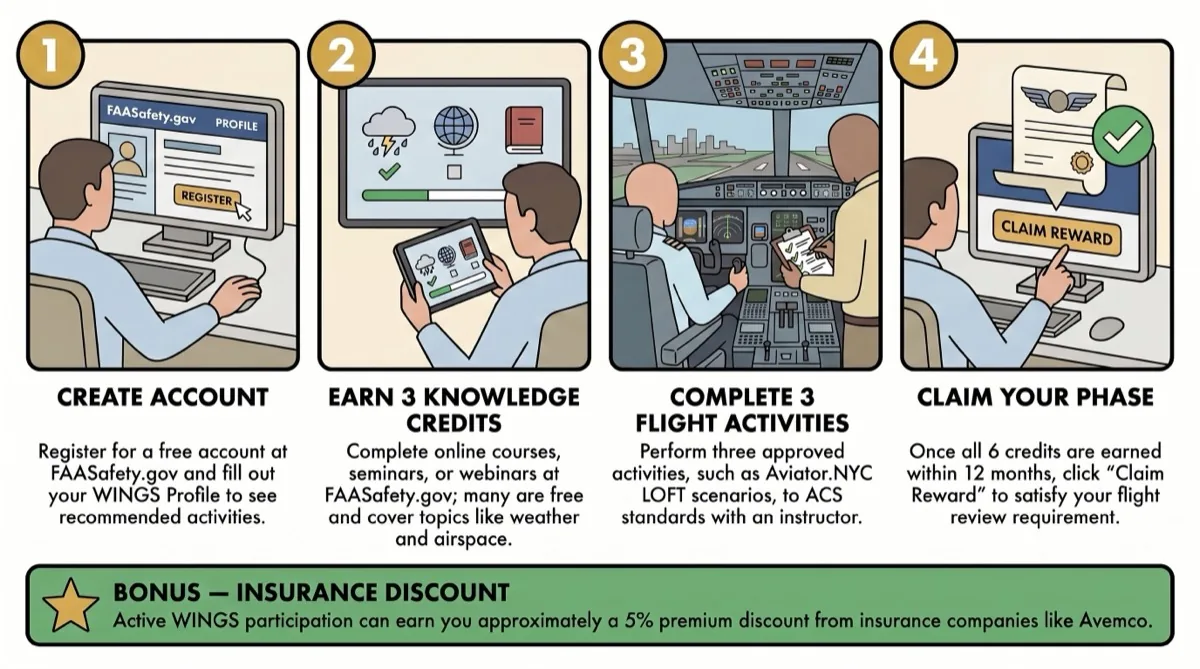
Earning a WINGS phase requires two types of credits: three Knowledge activities and three Flight activities, all completed within a rolling 12-month window. The process is straightforward, and the FAA has made it easy to track everything online. Here is the step-by-step process for the Basic level.
Complete a Basic WINGS Phase
Create Your FAASafety.gov Account
Earn 3 Knowledge Activity Credits
Complete 3 Flight Activity Credits
Track Your Progress
Claim Your Reward
SELECT YOUR PATH
NYC / AVIATOR.NYCNEW PILOTS: WHAT'S YOUR GOAL?
LICENSED PILOTS: SELECT TRAINING
FLY AS A HOBBY
Learn safely, step-by-step, and at your own pace.
A private pilot license in NYC typically costs $12,000–$18,000. Most students need 60–80 flight hours to reach checkride proficiency. Simulator training at $190/hr saves over 45% compared to aircraft rental at each stage — and over 60% with a $780 training bundle ($130/hr). Pay-as-you-go pricing with no membership fees or upfront commitment.
See the full private pilot license cost breakdown →Yes. You need at least a Third Class FAA Medical Certificate before you can fly solo. Most healthy adults pass without issues — the exam covers basic vision, hearing, and general health. Schedule your exam with an Aviation Medical Examiner (AME) early in training. Important: if you have ever been prescribed medication for anxiety, depression, or ADHD — even as a child — talk to an AME before investing heavily in training to avoid surprises.
How to get your FAA medical certificate for flight training →Yes. Aviator.NYC's FAA-certified Advanced Aviation Training Device (AATD) with Garmin G1000 NXi avionics logs hours that count directly toward your private pilot certificate. Simulator training at $190/hr saves over 45% compared to aircraft rental — and over 60% with a training bundle — with no weather cancellations or maintenance delays. Train on 20+ aircraft configurations from Cessna 172 to Beechcraft Bonanza, all in Lower Manhattan.
FAA-approved flight simulator training in NYC →Most students earn their private pilot license in 4–12 months depending on training frequency. The FAA requires a minimum of 40 flight hours, but most students need 60–80 hours to reach checkride proficiency. A typical path: Weeks 1–2 in the simulator building foundations, Weeks 3–12 flying dual and solo at a local airport, then Months 3–12 completing cross-country flights and checkride prep. You control the pace — train around your work schedule.
Private pilot training timeline and milestones →Start with a 2-hour discovery session ($380) in Aviator.NYC's Manhattan simulator. No experience needed — your airline pilot instructor walks you through takeoff, flight, and landing. After your first session, you'll know if flight training is right for you. From there, a structured path takes you from simulator foundations to your first solo flight at a local airport.
Book your first flight lesson in Manhattan →Part 61 defines requirements for pilot certification. Part 141 defines requirements for school approval. Both use the same commercially available lesson plans and lead to the same FAA certificate. The key difference: under Part 61, every flight you take counts toward your certificate requirements. Under Part 141, off-syllabus flights don't count toward the 141 program. Part 61 dominates in NYC because the off-syllabus flexibility better serves students who train infrequently and want every flight hour to always count. Aviator.NYC operates under Part 61 — by design.
Part 61 vs Part 141 flight training — which is right for you →The FAA Private Pilot Knowledge Test is a 60-question multiple-choice exam covering aerodynamics, weather, navigation, regulations, and flight planning. You need a score of 70% or higher to pass. Most students use online prep courses like Sheppard Air or Sporty's and pass within 2–4 weeks of focused study. Pass the written test early in your training — it builds confidence and lets you focus on flying skills.
Private pilot training steps and written exam prep →Instructor quality matters more than price. Look for instructors with airline or professional experience who teach part-time because they love it — not because they're building hours. Visit 1–2 schools in person. Ask about cancellation rates, aircraft availability, and whether they use FAA-approved simulators to reduce cost. For NYC-area students, the closest GA airports are Republic Airport (KFRG), Morristown Airport (KMMU), Essex County Airport (KCDW), Westchester Airport (KHPN), and Lincoln Park Airport (N07).
Best flight training airports near New York City →FLY AS A CAREER
From first lesson to professional pilot — one clear path.
The career path follows six stages: Private Pilot License → Instrument Rating → Commercial Certificate → Multi-Engine Rating → CFI Certification → Airline Transport Pilot (ATP). Each rating builds on the previous one. You need 1,500 total flight hours for an ATP certificate, which most pilots build by instructing after earning their CFI. The entire pathway from zero experience to airline-eligible typically takes 4–6 years part-time or 18–24 months full-time.
See the complete career pilot roadmap — PPL through ATP →The complete career pathway costs roughly $80,000–$150,000+ spread across multiple ratings: Private Pilot ($22,250–$32,250), Instrument Rating ($9,250–$21,000), Commercial ($15,000–$50,000), Multi-Engine ($6,000–$8,000), and CFI ($3,000–$5,000). You don't pay this all at once — each rating is a separate phase. Simulator training at $190/hr saves over 45% at every stage compared to aircraft time, and over 60% with training bundles. Once you earn your CFI, you earn $30–$60/hour while building the hours you need for airlines.
Full pilot license cost breakdown by rating →With consistent training, 18–24 months is realistic for the accelerated path. Most part-time students take 4–6 years. The bottleneck is building 1,500 total hours for an ATP certificate. After earning your CFI, instructing is the most common way to build hours while getting paid. Regional airlines are currently hiring pilots at 1,500 hours with competitive first-year pay.
Airline Transport Pilot requirements and timeline →The instrument rating is your next step. It teaches you to fly in clouds and low visibility using only your instruments — a requirement for every professional pilot path. The instrument rating requires 40 hours of instrument training (up to 20 hours can be in an FAA-approved simulator) and 50 hours of cross-country PIC time. Most working professionals complete it in 3–6 months.
Instrument rating — step 2 in the career pilot roadmap →Yes, for most career pilots. The CFI (Certified Flight Instructor) certificate lets you earn $30–$60/hour teaching other pilots while building the 1,500 hours you need for airlines. It also deepens your own flying knowledge — teaching forces mastery. Requirements: Commercial Pilot Certificate, Instrument Rating, 250+ total hours, and passing the CFI practical test. The training typically takes 20–30 additional flight hours.
CFI certification — step 5 in the career pilot roadmap →Airlines require a First Class FAA Medical Certificate. This is a more thorough exam than the Third Class medical used for private flying. It includes detailed vision, hearing, cardiovascular, and neurological screening. Most healthy adults pass. Get your First Class medical early — before investing in career training — to catch any potential issues. The exam is done by an Aviation Medical Examiner (AME) and is valid for 12 months.
FAA medical certificate requirements for career pilots →Yes, extensively. The FAA allows up to 20 hours of simulator time toward your instrument rating, up to 50 hours toward your commercial certificate, and up to 25 hours toward your ATP. Simulator training at $190/hr saves over 45% compared to aircraft at the standard rate — and over 60% with training bundles — across every stage of the career path. Aviator.NYC's AATD features the Garmin G1000 NXi and GFC 700 autopilot used in modern training aircraft, so skills transfer directly to the airplane.
How FAA-approved simulator training reduces career pilot costs →The multi-engine rating is required for most airline jobs. There is no FAA minimum flight time required, but most students need 10–15 hours of training. Cost is typically $6,000–$8,000. Training covers VMC demonstrations, single-engine operations, and asymmetric thrust management. Most pilots complete it in 1–2 weeks of intensive training.
Multi-engine rating — step 4 in the career pilot roadmap →YOUTH PROGRAM (AGES 8-17)
Safe, age-appropriate lessons that grow with your child.
Children can start simulator-based flight training at age 8. There are no medical requirements for simulator lessons. Training is structured by age: ages 8–12 focus on basic stick-and-rudder control, instrument scanning, and simple ATC calls in 1-hour sessions. Ages 13–15 progress to traffic patterns, VOR navigation, and checklist discipline in 2-hour sessions. The simulator is a zero-risk environment supervised by professional instructors.
Youth aviation program milestones by age →Under FAA regulations (FAR 61.87), a student pilot can solo a glider at age 14 and a powered airplane at age 16. At age 17, they are eligible for a full Private Pilot Certificate with 40+ hours of training. Starting simulator training at age 8–12 gives your child years of structured skill building before solo eligibility, creating a significant head start over peers who begin at 16.
FAA solo flight age requirements for young pilots →Youth training uses pay-as-you-go pricing designed for younger attention spans. 1-hour sessions at $190, 2-hour sessions at $380. A 6-hour training bundle ($780) saves over 30% compared to individual sessions. No membership fees or upfront commitment.
Youth flight training pricing and session options →Ages 8–12: Discovery and foundation — basic controls, instrument scanning, simple radio calls. Ages 13–15: Structured skill building — traffic patterns, navigation, checklist discipline. Age 16: Solo flight eligible (FAR 61.87) — pre-solo maneuvers, emergency procedures, student certificate. Age 17: Private Pilot Certificate eligible (FAR 61.103) — checkride, cross-country flights, instrument basics introduction.
Complete youth aviation age milestones and FAA requirements →Not for simulator training. Children ages 8–15 train exclusively in the FAA-approved simulator and do not need a medical certificate. A medical certificate is only required before solo flight in an actual aircraft, which is not permitted until age 16. When the time comes, most healthy teenagers pass the Third Class medical easily.
FAA medical requirements for student pilots under 18 →Yes. Early training creates a massive head start. A student who begins at age 8 has 8 years of structured skill building before solo eligibility at 16. Hours logged in the FAA-approved AATD simulator count toward future certificate requirements. By age 17, a dedicated student can hold a Private Pilot Certificate while peers are just starting. This is a direct path toward airline or professional aviation careers.
Career pilot roadmap starting from youth training →Instructors are active airline pilots or experienced CFIs who specialize in youth aviation training for ages 8–17. They understand age-appropriate pacing, use patient teaching methods, and make sessions engaging without sacrificing real aviation standards. Parents are welcome to observe every lesson from the instructor station.
Meet our airline pilot flight instructors →The FAA-approved AATD simulator is a zero-risk training environment. No aircraft is involved until your child reaches solo eligibility at age 16+. Children practice stalls, engine failures, and emergency procedures safely and repeatedly. The simulator uses the same Garmin G1000 NXi avionics found in real training aircraft, so skills transfer directly when they transition to flying.
FAA-approved flight simulator for youth training →INSTRUMENT RATING
Everything you need to know about earning your instrument rating:
The FAA requires 50 hours of PIC cross-country time, 40 hours of actual or simulated instrument time (up to 20 hours in an FAA-approved AATD like Aviator.NYC's simulator), and passing both a written knowledge test and a practical checkride. You must already hold a Private Pilot Certificate. The 20 simulator hours alone save over $4,400 compared to logging that time in an airplane.
FAA instrument rating requirements explained (14 CFR 61.65) →Total cost typically ranges from $9,250 to $16,800 depending on pace and how much airplane time you add. The simulator-first approach saves over $4,400 compared to airplane-only training. Dual instruction starts at $190/hr in the simulator — over 45% less than aircraft rental. Training bundles save over 60%. Pay-as-you-go with no upfront commitment.
Instrument rating cost breakdown and simulator savings →Your first lesson starts with a 20-minute briefing covering instrument scan fundamentals and the G1000 NXi layout. Then 90 minutes of hands-on simulator time: straight-and-level flight by instruments only, basic attitude control, and an introduction to the instrument scan pattern. Your instructor is an airline pilot who flies IFR professionally — not someone learning alongside you. No experience with instruments required.
What to expect in your first IFR simulator lesson →Most working professionals complete their instrument rating in 3–6 months training 1–2 sessions per week. The 10-lesson simulator curriculum covers fundamentals through mock checkride. After the simulator phase, you transition to the airplane for cross-country time and real-world IFR experience. Consistent weekly sessions are more effective than sporadic blocks — instrument skills decay fast without regular practice.
Instrument rating training timeline and milestones →A structured 10-lesson progression: Lessons 1–2 build instrument scan and basic attitude flying. Lessons 3–5 introduce VOR navigation, holding patterns, and your first approach. Lessons 6–7 cover precision approaches (ILS, GPS). Lessons 8–9 add STARs, complex arrivals, and lost communications. Lesson 10 is a full mock checkride. Each session: 20-min briefing, 90-min simulator, 10-min debrief.
See the full 10-lesson IFR training plan →After building proficiency in the simulator, you take your instrument skills to the airplane at a local airport. The G1000 NXi in the simulator matches the avionics in common training aircraft (Cessna 172S, Cessna 182T), so the cockpit layout transfers directly. Cross-country flights build the PIC time required for your rating while practicing real ATC communications, weather decision-making, and approach procedures in actual conditions.
IFR simulator-to-airplane transition guide →The instrument rating checkride has two parts: an oral exam (~1.5 hours) covering regulations, weather theory, approach procedures, and decision-making scenarios; and a flight test (~2 hours) where you fly approaches, holds, intercepting and tracking courses, and demonstrate partial panel skills. The DPE will test unusual attitudes and recovery, and at least one missed approach. Lesson 10 in the curriculum is a full mock checkride that mirrors the real exam.
Instrument rating checkride preparation →IFR CURRENCY OPTIONS
Choose your IFR currency training option:
The FAA WINGS (Pilot Proficiency Program) lets you earn safety credit while rebuilding IFR proficiency. Aviator.NYC's LOFT scenarios are structured as WINGS activities — you get IFR currency practice and FAA safety credit simultaneously. Each scenario is a realistic cross-country flight with approaches, holds, and decision-making challenges designed by active airline pilots.
IFR currency through FAA WINGS simulator scenarios →Short, focused simulator sessions built around airports you actually fly to. Practice ILS, RNAV, and LOC approaches at local airports like Teterboro Airport (KTEB), Republic Airport (KFRG), Westchester Airport (KHPN), and Morristown Airport (KMMU). Complete your 6 approaches, holding, and tracking requirements in one or two sessions. No travel to an airport, no weather delays, no Hobbs time running while you brief approaches.
IFR currency approaches at NYC-area airports →Custom sessions built around your experience level, aircraft type, and specific currency needs. If you fly a Bonanza, we configure the G1000 NXi to match. If you need RNAV (GPS) approaches specifically, we build a profile focused on those. Your airline pilot instructor tailors the session to what you actually need — not a one-size-fits-all curriculum.
Custom IFR currency training sessions →Guided IFR currency practice with an airline-experienced CFII. Includes structured approach profiles, real-time feedback on instrument scan and procedures, and FAA WINGS credit. Ideal if you've been out of the IFR system for a while and want professional guidance rebuilding precision. If your currency has lapsed beyond 6 months, you'll need an Instrument Proficiency Check (IPC) — available as part of dual sessions. Dual sessions start at $380 for 2 hours.
Dual IFR currency training with instrument proficiency check →Independent simulator access for current IFR pilots at $170 for 2 hours. No checkout required — if you're familiar with G1000 NXi operations and know how to log approaches for currency, you can practice the required 6 approaches, holding, and tracking on your own. Solo practice saves roughly 75% compared to aircraft rental time. Available in bulk bundles for even greater savings.
Solo IFR currency simulator practice →Can You Earn WINGS Credits in a Flight Simulator?
Yes. Aviator.NYC's LOFT (Line Oriented Flight Training) scenarios are registered FAA Safety WINGS activities, which means every qualifying simulator session earns Flight activity credits toward your WINGS phase. You do not need to fly an actual aircraft to earn WINGS flight credits — the FAA recognizes approved simulator-based training as equivalent.
Specifically, our Instrument Currency Mastery Program (ICMP) scenarios are designed to meet WINGS requirements. Each scenario includes three instrument approaches flown to Instrument-Airplane ACS (Airman Certification Standards) standards, plus holds, procedure turns, and missed approach procedures. When you meet those standards, your instructor logs the session as a WINGS flight activity.
The simulator environment is ideal for WINGS training because you can practice approaches at airports you would not normally visit, fly in weather conditions that would ground you in an aircraft, and repeat procedures until they are solid — all in a controlled, risk-free setting. See our instrument training optimization guide for strategies that help you get the most from each session.
Earn WINGS Credits in the Simulator
Book an Instrument Currency Mastery Program session. Every qualifying scenario counts as an approved WINGS flight activity.
What Happens If You Don't Meet ACS Standards?
If you fly a LOFT scenario but do not meet Instrument-Airplane ACS standards on your approaches, you do not earn WINGS flight activity credit for that session. However, the approaches still count toward your instrument currency requirements under 14 CFR 61.57. You still logged approaches, holds, and tracking — the training value is real, and your currency clock keeps ticking.
Think of it this way: WINGS credit requires a higher standard than basic currency. Currency means you flew the approaches. WINGS means you flew them to checkride-level precision. If you fall short on WINGS standards, your instructor will debrief what to work on and you can try again at your next session.
For a detailed walkthrough of what ACS-standard approaches look like, see our guide on how to brief an instrument approach — proper briefing technique is often the difference between meeting and missing ACS standards.
Does WINGS Replace the Flight Review?
Yes. Completing any phase of WINGS (Basic, Advanced, or Master) within a 12-month period satisfies the flight review requirement under 14 CFR 61.56. This is not a workaround or a loophole — the FAA specifically designed WINGS as an alternative to the traditional biennial flight review because continuous training is more effective than a single review flight every two years.
For active instrument pilots who train regularly, this is a significant benefit. If you fly three ICMP scenarios and complete three online knowledge courses within 12 months, you have satisfied your flight review and maintained your instrument currency simultaneously. That is two regulatory requirements handled through training you were already doing.
Can WINGS Save You Money on Insurance?
Yes. Several aviation insurance companies — most notably Avemco — offer approximately 5% discounts on annual premiums for pilots who actively participate in the WINGS program. The exact discount varies by insurer and policy type, but for aircraft owners or renters carrying their own insurance, the savings are real and recurring.
A 5% discount on an annual premium of $2,000-$5,000 translates to $100-$250 per year. Over a decade of flying, that adds up to $1,000-$2,500 in savings — more than enough to cover several simulator sessions. The insurance company benefits because WINGS participants are statistically safer pilots, and you benefit from lower premiums while maintaining sharper skills.
Contact your insurance provider or broker to ask whether they offer WINGS participation discounts. Even if your current insurer does not, it is worth mentioning WINGS activity when shopping for coverage — underwriters view ongoing proficiency training favorably.
What Knowledge Activities Count for WINGS?
The FAA offers hundreds of approved Knowledge activities through FAASafety.gov, and new ones are added regularly. These are the three main formats, all of which count toward your three required Knowledge credits per WINGS phase.
- Online courses: Self-paced courses on FAASafety.gov covering topics like weather decision-making, airspace regulations, aeronautical decision-making, and human factors. Most take 30-60 minutes to complete, and many are free.
- In-person seminars: FAA Safety Team (FAAST) seminars held at local airports, flight schools, and aviation events. These are typically 1-2 hours and often feature presentations from local DPEs, FSDO inspectors, or experienced pilots.
- Webinars: Live online presentations hosted through FAASafety.gov. These cover the same topics as in-person seminars but can be attended from anywhere. Recordings are sometimes available for credit afterward.
The easiest approach is to complete all three Knowledge activities online between your flight sessions. Browse the course catalog on FAASafety.gov filtered by your certificate level and ratings. Choose topics that complement your flight training — if you are working on approaches, take courses on weather minimums or approach plate interpretation.
What WINGS Activities Does Aviator.NYC Offer?
Aviator.NYC offers three types of approved FAA Safety WINGS activities, covering both IFR and VFR proficiency. Each is designed to earn WINGS flight activity credits while providing real training value.
- Instrument Currency Mastery Program (ICMP) scenarios: Our core WINGS offering. Each LOFT scenario includes three instrument approaches at real-world airports, plus holds, procedure turns, and missed approach procedures. Must meet Instrument-Airplane ACS standards for WINGS credit. Flown in our FAA-certified AATD simulator in Lower Manhattan.
- Hudson Corridor simulator training: A VFR WINGS activity focused on the Hudson River Exclusion and East River Special Flight Rules Area. Practice the corridor procedures, radio calls, and navigation in the simulator before flying the real thing. Available to all rated pilots.
- VFR and IFR flight plan review: Conducted via Zoom using your own Electronic Flight Bag (EFB). Review real-world flight planning, weather analysis, NOTAMs, and route selection with a CFII. Counts as a Knowledge or Flight activity depending on the content covered.
Most instrument-rated pilots start with the ICMP scenarios because they simultaneously address currency, proficiency, and WINGS credits in a single session. If you are looking for a structured way to stay current, book an IFR currency session and tell your instructor you want to work toward WINGS credit.
SELECT YOUR PATH
NYC / AVIATOR.NYCNEW PILOTS: WHAT'S YOUR GOAL?
LICENSED PILOTS: SELECT TRAINING
FLY AS A HOBBY
Learn safely, step-by-step, and at your own pace.
A private pilot license in NYC typically costs $12,000–$18,000. Most students need 60–80 flight hours to reach checkride proficiency. Simulator training at $190/hr saves over 45% compared to aircraft rental at each stage — and over 60% with a $780 training bundle ($130/hr). Pay-as-you-go pricing with no membership fees or upfront commitment.
See the full private pilot license cost breakdown →Yes. You need at least a Third Class FAA Medical Certificate before you can fly solo. Most healthy adults pass without issues — the exam covers basic vision, hearing, and general health. Schedule your exam with an Aviation Medical Examiner (AME) early in training. Important: if you have ever been prescribed medication for anxiety, depression, or ADHD — even as a child — talk to an AME before investing heavily in training to avoid surprises.
How to get your FAA medical certificate for flight training →Yes. Aviator.NYC's FAA-certified Advanced Aviation Training Device (AATD) with Garmin G1000 NXi avionics logs hours that count directly toward your private pilot certificate. Simulator training at $190/hr saves over 45% compared to aircraft rental — and over 60% with a training bundle — with no weather cancellations or maintenance delays. Train on 20+ aircraft configurations from Cessna 172 to Beechcraft Bonanza, all in Lower Manhattan.
FAA-approved flight simulator training in NYC →Most students earn their private pilot license in 4–12 months depending on training frequency. The FAA requires a minimum of 40 flight hours, but most students need 60–80 hours to reach checkride proficiency. A typical path: Weeks 1–2 in the simulator building foundations, Weeks 3–12 flying dual and solo at a local airport, then Months 3–12 completing cross-country flights and checkride prep. You control the pace — train around your work schedule.
Private pilot training timeline and milestones →Start with a 2-hour discovery session ($380) in Aviator.NYC's Manhattan simulator. No experience needed — your airline pilot instructor walks you through takeoff, flight, and landing. After your first session, you'll know if flight training is right for you. From there, a structured path takes you from simulator foundations to your first solo flight at a local airport.
Book your first flight lesson in Manhattan →Part 61 defines requirements for pilot certification. Part 141 defines requirements for school approval. Both use the same commercially available lesson plans and lead to the same FAA certificate. The key difference: under Part 61, every flight you take counts toward your certificate requirements. Under Part 141, off-syllabus flights don't count toward the 141 program. Part 61 dominates in NYC because the off-syllabus flexibility better serves students who train infrequently and want every flight hour to always count. Aviator.NYC operates under Part 61 — by design.
Part 61 vs Part 141 flight training — which is right for you →The FAA Private Pilot Knowledge Test is a 60-question multiple-choice exam covering aerodynamics, weather, navigation, regulations, and flight planning. You need a score of 70% or higher to pass. Most students use online prep courses like Sheppard Air or Sporty's and pass within 2–4 weeks of focused study. Pass the written test early in your training — it builds confidence and lets you focus on flying skills.
Private pilot training steps and written exam prep →Instructor quality matters more than price. Look for instructors with airline or professional experience who teach part-time because they love it — not because they're building hours. Visit 1–2 schools in person. Ask about cancellation rates, aircraft availability, and whether they use FAA-approved simulators to reduce cost. For NYC-area students, the closest GA airports are Republic Airport (KFRG), Morristown Airport (KMMU), Essex County Airport (KCDW), Westchester Airport (KHPN), and Lincoln Park Airport (N07).
Best flight training airports near New York City →FLY AS A CAREER
From first lesson to professional pilot — one clear path.
The career path follows six stages: Private Pilot License → Instrument Rating → Commercial Certificate → Multi-Engine Rating → CFI Certification → Airline Transport Pilot (ATP). Each rating builds on the previous one. You need 1,500 total flight hours for an ATP certificate, which most pilots build by instructing after earning their CFI. The entire pathway from zero experience to airline-eligible typically takes 4–6 years part-time or 18–24 months full-time.
See the complete career pilot roadmap — PPL through ATP →The complete career pathway costs roughly $80,000–$150,000+ spread across multiple ratings: Private Pilot ($22,250–$32,250), Instrument Rating ($9,250–$21,000), Commercial ($15,000–$50,000), Multi-Engine ($6,000–$8,000), and CFI ($3,000–$5,000). You don't pay this all at once — each rating is a separate phase. Simulator training at $190/hr saves over 45% at every stage compared to aircraft time, and over 60% with training bundles. Once you earn your CFI, you earn $30–$60/hour while building the hours you need for airlines.
Full pilot license cost breakdown by rating →With consistent training, 18–24 months is realistic for the accelerated path. Most part-time students take 4–6 years. The bottleneck is building 1,500 total hours for an ATP certificate. After earning your CFI, instructing is the most common way to build hours while getting paid. Regional airlines are currently hiring pilots at 1,500 hours with competitive first-year pay.
Airline Transport Pilot requirements and timeline →The instrument rating is your next step. It teaches you to fly in clouds and low visibility using only your instruments — a requirement for every professional pilot path. The instrument rating requires 40 hours of instrument training (up to 20 hours can be in an FAA-approved simulator) and 50 hours of cross-country PIC time. Most working professionals complete it in 3–6 months.
Instrument rating — step 2 in the career pilot roadmap →Yes, for most career pilots. The CFI (Certified Flight Instructor) certificate lets you earn $30–$60/hour teaching other pilots while building the 1,500 hours you need for airlines. It also deepens your own flying knowledge — teaching forces mastery. Requirements: Commercial Pilot Certificate, Instrument Rating, 250+ total hours, and passing the CFI practical test. The training typically takes 20–30 additional flight hours.
CFI certification — step 5 in the career pilot roadmap →Airlines require a First Class FAA Medical Certificate. This is a more thorough exam than the Third Class medical used for private flying. It includes detailed vision, hearing, cardiovascular, and neurological screening. Most healthy adults pass. Get your First Class medical early — before investing in career training — to catch any potential issues. The exam is done by an Aviation Medical Examiner (AME) and is valid for 12 months.
FAA medical certificate requirements for career pilots →Yes, extensively. The FAA allows up to 20 hours of simulator time toward your instrument rating, up to 50 hours toward your commercial certificate, and up to 25 hours toward your ATP. Simulator training at $190/hr saves over 45% compared to aircraft at the standard rate — and over 60% with training bundles — across every stage of the career path. Aviator.NYC's AATD features the Garmin G1000 NXi and GFC 700 autopilot used in modern training aircraft, so skills transfer directly to the airplane.
How FAA-approved simulator training reduces career pilot costs →The multi-engine rating is required for most airline jobs. There is no FAA minimum flight time required, but most students need 10–15 hours of training. Cost is typically $6,000–$8,000. Training covers VMC demonstrations, single-engine operations, and asymmetric thrust management. Most pilots complete it in 1–2 weeks of intensive training.
Multi-engine rating — step 4 in the career pilot roadmap →YOUTH PROGRAM (AGES 8-17)
Safe, age-appropriate lessons that grow with your child.
Children can start simulator-based flight training at age 8. There are no medical requirements for simulator lessons. Training is structured by age: ages 8–12 focus on basic stick-and-rudder control, instrument scanning, and simple ATC calls in 1-hour sessions. Ages 13–15 progress to traffic patterns, VOR navigation, and checklist discipline in 2-hour sessions. The simulator is a zero-risk environment supervised by professional instructors.
Youth aviation program milestones by age →Under FAA regulations (FAR 61.87), a student pilot can solo a glider at age 14 and a powered airplane at age 16. At age 17, they are eligible for a full Private Pilot Certificate with 40+ hours of training. Starting simulator training at age 8–12 gives your child years of structured skill building before solo eligibility, creating a significant head start over peers who begin at 16.
FAA solo flight age requirements for young pilots →Youth training uses pay-as-you-go pricing designed for younger attention spans. 1-hour sessions at $190, 2-hour sessions at $380. A 6-hour training bundle ($780) saves over 30% compared to individual sessions. No membership fees or upfront commitment.
Youth flight training pricing and session options →Ages 8–12: Discovery and foundation — basic controls, instrument scanning, simple radio calls. Ages 13–15: Structured skill building — traffic patterns, navigation, checklist discipline. Age 16: Solo flight eligible (FAR 61.87) — pre-solo maneuvers, emergency procedures, student certificate. Age 17: Private Pilot Certificate eligible (FAR 61.103) — checkride, cross-country flights, instrument basics introduction.
Complete youth aviation age milestones and FAA requirements →Not for simulator training. Children ages 8–15 train exclusively in the FAA-approved simulator and do not need a medical certificate. A medical certificate is only required before solo flight in an actual aircraft, which is not permitted until age 16. When the time comes, most healthy teenagers pass the Third Class medical easily.
FAA medical requirements for student pilots under 18 →Yes. Early training creates a massive head start. A student who begins at age 8 has 8 years of structured skill building before solo eligibility at 16. Hours logged in the FAA-approved AATD simulator count toward future certificate requirements. By age 17, a dedicated student can hold a Private Pilot Certificate while peers are just starting. This is a direct path toward airline or professional aviation careers.
Career pilot roadmap starting from youth training →Instructors are active airline pilots or experienced CFIs who specialize in youth aviation training for ages 8–17. They understand age-appropriate pacing, use patient teaching methods, and make sessions engaging without sacrificing real aviation standards. Parents are welcome to observe every lesson from the instructor station.
Meet our airline pilot flight instructors →The FAA-approved AATD simulator is a zero-risk training environment. No aircraft is involved until your child reaches solo eligibility at age 16+. Children practice stalls, engine failures, and emergency procedures safely and repeatedly. The simulator uses the same Garmin G1000 NXi avionics found in real training aircraft, so skills transfer directly when they transition to flying.
FAA-approved flight simulator for youth training →INSTRUMENT RATING
Everything you need to know about earning your instrument rating:
The FAA requires 50 hours of PIC cross-country time, 40 hours of actual or simulated instrument time (up to 20 hours in an FAA-approved AATD like Aviator.NYC's simulator), and passing both a written knowledge test and a practical checkride. You must already hold a Private Pilot Certificate. The 20 simulator hours alone save over $4,400 compared to logging that time in an airplane.
FAA instrument rating requirements explained (14 CFR 61.65) →Total cost typically ranges from $9,250 to $16,800 depending on pace and how much airplane time you add. The simulator-first approach saves over $4,400 compared to airplane-only training. Dual instruction starts at $190/hr in the simulator — over 45% less than aircraft rental. Training bundles save over 60%. Pay-as-you-go with no upfront commitment.
Instrument rating cost breakdown and simulator savings →Your first lesson starts with a 20-minute briefing covering instrument scan fundamentals and the G1000 NXi layout. Then 90 minutes of hands-on simulator time: straight-and-level flight by instruments only, basic attitude control, and an introduction to the instrument scan pattern. Your instructor is an airline pilot who flies IFR professionally — not someone learning alongside you. No experience with instruments required.
What to expect in your first IFR simulator lesson →Most working professionals complete their instrument rating in 3–6 months training 1–2 sessions per week. The 10-lesson simulator curriculum covers fundamentals through mock checkride. After the simulator phase, you transition to the airplane for cross-country time and real-world IFR experience. Consistent weekly sessions are more effective than sporadic blocks — instrument skills decay fast without regular practice.
Instrument rating training timeline and milestones →A structured 10-lesson progression: Lessons 1–2 build instrument scan and basic attitude flying. Lessons 3–5 introduce VOR navigation, holding patterns, and your first approach. Lessons 6–7 cover precision approaches (ILS, GPS). Lessons 8–9 add STARs, complex arrivals, and lost communications. Lesson 10 is a full mock checkride. Each session: 20-min briefing, 90-min simulator, 10-min debrief.
See the full 10-lesson IFR training plan →After building proficiency in the simulator, you take your instrument skills to the airplane at a local airport. The G1000 NXi in the simulator matches the avionics in common training aircraft (Cessna 172S, Cessna 182T), so the cockpit layout transfers directly. Cross-country flights build the PIC time required for your rating while practicing real ATC communications, weather decision-making, and approach procedures in actual conditions.
IFR simulator-to-airplane transition guide →The instrument rating checkride has two parts: an oral exam (~1.5 hours) covering regulations, weather theory, approach procedures, and decision-making scenarios; and a flight test (~2 hours) where you fly approaches, holds, intercepting and tracking courses, and demonstrate partial panel skills. The DPE will test unusual attitudes and recovery, and at least one missed approach. Lesson 10 in the curriculum is a full mock checkride that mirrors the real exam.
Instrument rating checkride preparation →IFR CURRENCY OPTIONS
Choose your IFR currency training option:
The FAA WINGS (Pilot Proficiency Program) lets you earn safety credit while rebuilding IFR proficiency. Aviator.NYC's LOFT scenarios are structured as WINGS activities — you get IFR currency practice and FAA safety credit simultaneously. Each scenario is a realistic cross-country flight with approaches, holds, and decision-making challenges designed by active airline pilots.
IFR currency through FAA WINGS simulator scenarios →Short, focused simulator sessions built around airports you actually fly to. Practice ILS, RNAV, and LOC approaches at local airports like Teterboro Airport (KTEB), Republic Airport (KFRG), Westchester Airport (KHPN), and Morristown Airport (KMMU). Complete your 6 approaches, holding, and tracking requirements in one or two sessions. No travel to an airport, no weather delays, no Hobbs time running while you brief approaches.
IFR currency approaches at NYC-area airports →Custom sessions built around your experience level, aircraft type, and specific currency needs. If you fly a Bonanza, we configure the G1000 NXi to match. If you need RNAV (GPS) approaches specifically, we build a profile focused on those. Your airline pilot instructor tailors the session to what you actually need — not a one-size-fits-all curriculum.
Custom IFR currency training sessions →Guided IFR currency practice with an airline-experienced CFII. Includes structured approach profiles, real-time feedback on instrument scan and procedures, and FAA WINGS credit. Ideal if you've been out of the IFR system for a while and want professional guidance rebuilding precision. If your currency has lapsed beyond 6 months, you'll need an Instrument Proficiency Check (IPC) — available as part of dual sessions. Dual sessions start at $380 for 2 hours.
Dual IFR currency training with instrument proficiency check →Independent simulator access for current IFR pilots at $170 for 2 hours. No checkout required — if you're familiar with G1000 NXi operations and know how to log approaches for currency, you can practice the required 6 approaches, holding, and tracking on your own. Solo practice saves roughly 75% compared to aircraft rental time. Available in bulk bundles for even greater savings.
Solo IFR currency simulator practice →Frequently Asked Questions
Is the FAA WINGS program free?
Yes. There is no fee to create a FAASafety.gov account, no enrollment charge, and no cost for online Knowledge courses. The only expense is the flight training itself, which you would be doing anyway for currency and proficiency. WINGS adds structure and recognition to training you are already investing in.
How long do WINGS credits last?
Individual credits do not expire, but all six credits (3 Knowledge + 3 Flight) must be completed within a rolling 12-month window to earn a phase completion. If you earn two flight credits but do not finish the third within 12 months of the first, you need to start over. The easiest way to stay on track is to combine WINGS with your regular currency training schedule.
Can I earn WINGS credits in a flight simulator?
Yes, if the simulator session is a registered FAA Safety WINGS activity. At Aviator.NYC, our ICMP scenarios are approved WINGS flight activities. You must meet Instrument-Airplane ACS standards with three approaches per scenario to earn the credit. The simulator must be an FAA-certified training device (our G1000 AATD qualifies).
Do I need an instrument rating to participate in WINGS?
No. WINGS is open to all U.S. pilot certificate holders, including VFR-only pilots. The program offers activities for every certificate level. However, many of the flight activities — especially at the Basic level — focus on instrument proficiency because the FAA considers IFR skills critical to safety even for VFR pilots.
Do insurance companies give discounts for WINGS?
Some do. Avemco is the most well-known insurer offering approximately 5% off annual premiums for active WINGS participants. Other insurers may offer similar discounts or view WINGS participation favorably during underwriting. Ask your broker or insurer directly — the savings compound over years of flying.