How much does flight training actually cost?
Nationally, the three pieces of flight training run about $108/hr for a flight instructor (CFI), $70–225/hr for a simulator depending on how sophisticated the device is, and ~$190/hr for a single-engine airplane rental(wet, meaning fuel included). Those are median market rates — half of operators charge more, half less. The range is wide because "flight training" bundles together very different products in very different places. The rest of this guide breaks each piece apart so the numbers make sense.
| What you're paying for | Typical national rate | What drives it |
|---|---|---|
| Flight instructor (CFI) | ~$108/hr (median) | The instructor's ratings and local demand |
| Simulator | $70–225/hr | Basic training device vs. full glass-cockpit sim |
| Airplane rental (single-engine, wet) | ~$190/hr (median) | Aircraft type, age, and avionics |
How much does a flight simulator cost per hour?
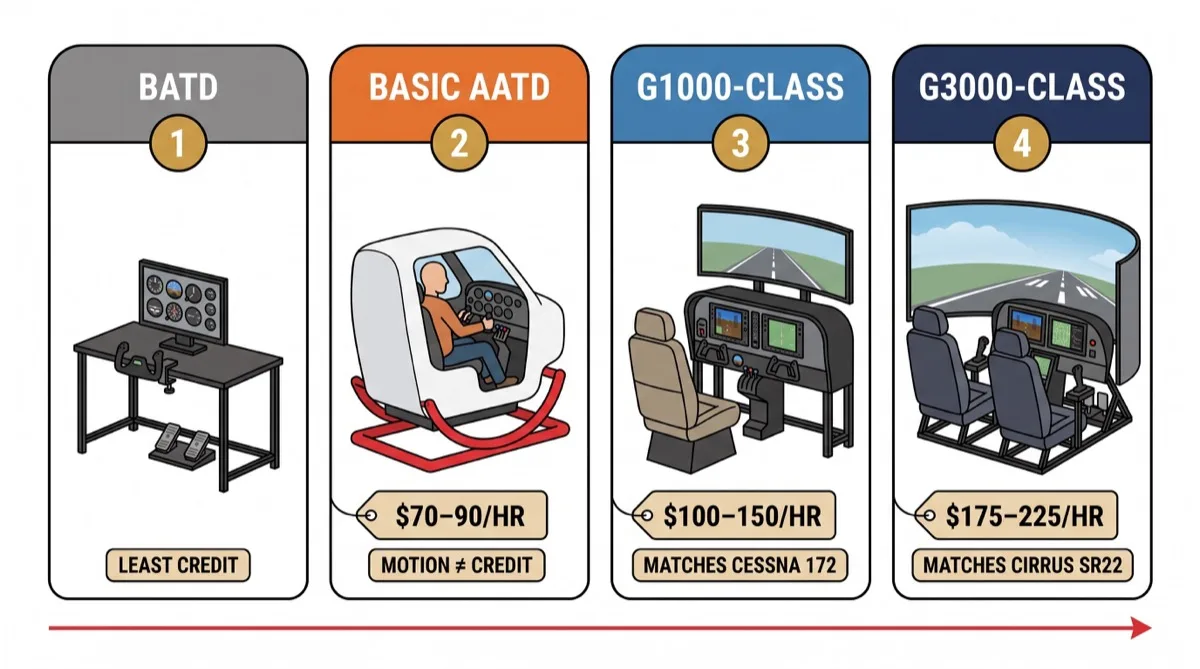
A flight simulator costs anywhere from $70 to $225 an hour, and the spread tracks the class of device and the fidelity of its panel — "simulator" covers a ladder of very different products. At the bottom are tabletop Basic Aviation Training Devices (BATDs) — a single monitor and a yoke clamped to a desk — the cheapest line on a rate sheet, but the class that logs the least creditable time. Next are basic Advanced Aviation Training Devices (AATDs), including the full-motion cabs, at about $70–90/hr — and know that motion earns no extra FAA credit; AATD certification doesn't require it. Above those sit G1000-class AATDs at about $100–150/hr (median ~$125), which reproduce the glass panel of a modern Cessna 172 or Bonanza. And at the top, Cirrus / G3000-class devices — touchscreen Perspective-style cockpits like the one in an SR-series — run about $175–225/hr. When you compare simulator quotes, the first question to ask is which rung of this ladder you're actually renting.
| Device class | Typical rate | What it is |
|---|---|---|
| BATD (tabletop) | Lowest tier | Desk-mounted trainer — logs half the instrument-rating credit of an AATD (10 vs 20 hours) |
| Basic AATD (incl. motion) | $70–90/hr | Generic panel (Redbird, ELITE); motion cabs look impressive but earn no extra FAA credit |
| G1000-class AATD | $100–150/hr (median ~$125) | Matches a G1000 Cessna 172 / Bonanza panel — the airplane class it pairs with on price |
| Cirrus / G3000-class | $175–225/hr | Touchscreen Perspective-style Cirrus cockpit — the tier that pairs with an SR-series |
One more fidelity question separates two devices with the same "G1000" label: whose software is drawing the screens? Many trainers run a manufacturer-built recreation of the G1000 that's missing features the real unit has. The best devices run Garmin's own G1000 trainer software — 1:1 with the airplane, down to the worldwide navigation database — so every knob and page works exactly as it will in flight. The Cirrus / G3000-class tier is still rare on rate sheets; if you're curious what one looks like, see the Cirrus G3000 simulator page.
Is training in a simulator cheaper than renting a real plane?
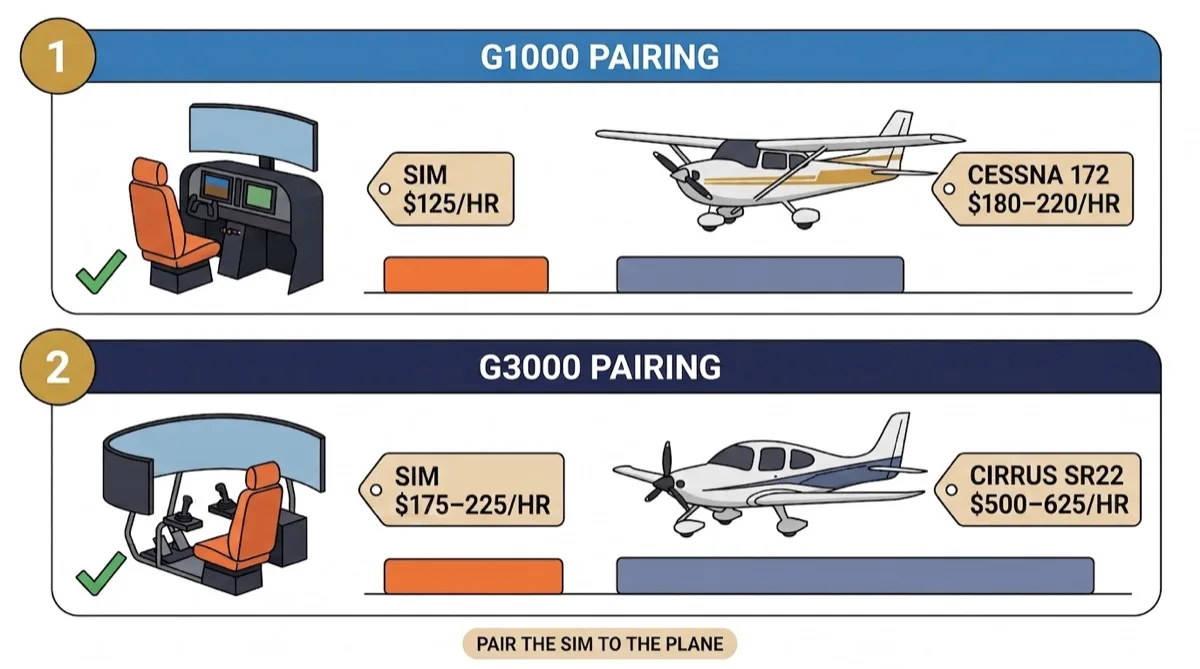
Yes — but only if you compare like for like, pairing each simulator class with the airplane it actually reproduces. A G1000-class simulator hour (~$125) pairs with a G1000 Cessna 172 that rents for about $180–220/hr — roughly a third off, before the airplane's fuel surcharge. A Cirrus / G3000-class simulator ($175–225/hr) pairs with a real Cirrus SR22 at $500–625/hr — about one-third the price for the same Perspective-style cockpit (see what a Cirrus G3000 simulator is). Don't let a quote mix the tiers: a $125 device is not the Cirrus comparison, and a Cirrus-class device won't price like a $125 one. The savings come from what a simulator doesn't need — no fuel, no engine or airframe wear, no insurance on a moving aircraft — and it lets you pause, reset, and repeat a maneuver instantly, impossible in flight. This is an industry-wide fact, not a pitch: the pairings hold across the market.
What does a flight instructor (CFI) cost per hour?
A flight instructor costs about $108/hr nationally at the median, but the rate you actually pay depends heavily on the instructor's ratings and experience. Basic primary instruction — a Certificated Flight Instructor (CFI) teaching toward a private certificate — clusters around $60–85/hr. Instrument and commercial instruction (a CFII) runs $75–110/hr. And specialist instructors — for example a Cirrus Standardized Instructor Pilot (CSIP), or an active airline pilot — command $113–200/hr. That top tier reflects genuinely different expertise, and in instructor-shortage markets it climbs further. When you compare schools, make sure you're comparing instructors of similar qualification.
| Instructor tier | Typical rate | What it covers |
|---|---|---|
| Primary / Private CFI | $60–85/hr | Private-pilot instruction — the volume rate most schools post |
| Instrument / Commercial (CFII) | $75–110/hr | Instrument, commercial, multi-engine, high-performance |
| Specialist / airline-pilot / CSIP | $113–200/hr | Type-specific expertise; the premium tier |
The instructor is often the part of training that matters most, and it's worth choosing deliberately rather than by price alone — our guide to choosing the right flight instructor walks through what to look for.
SELECT YOUR PATH
NYC / AVIATOR.NYCNEW PILOTS: WHAT'S YOUR GOAL?
LICENSED PILOTS: SELECT TRAINING
FLY AS A HOBBY
Learn safely, step-by-step, and at your own pace.
A private pilot license in NYC typically costs $12,000–$18,000. Most students need 60–80 flight hours to reach checkride proficiency. Simulator training at $190/hr saves over 45% compared to aircraft rental at each stage — and over 60% with a $780 training bundle ($130/hr). Pay-as-you-go pricing with no membership fees or upfront commitment.
See the full private pilot license cost breakdown →Yes. You need at least a Third Class FAA Medical Certificate before you can fly solo. Most healthy adults pass without issues — the exam covers basic vision, hearing, and general health. Schedule your exam with an Aviation Medical Examiner (AME) early in training. Important: if you have ever been prescribed medication for anxiety, depression, or ADHD — even as a child — talk to an AME before investing heavily in training to avoid surprises.
How to get your FAA medical certificate for flight training →Yes. Aviator.NYC's FAA-certified Advanced Aviation Training Device (AATD) with Garmin G1000 NXi avionics logs hours that count directly toward your private pilot certificate. Simulator training at $190/hr saves over 45% compared to aircraft rental — and over 60% with a training bundle — with no weather cancellations or maintenance delays. Train on 20+ aircraft configurations from Cessna 172 to Beechcraft Bonanza, all in Lower Manhattan.
FAA-approved flight simulator training in NYC →Most students earn their private pilot license in 4–12 months depending on training frequency. The FAA requires a minimum of 40 flight hours, but most students need 60–80 hours to reach checkride proficiency. A typical path: Weeks 1–2 in the simulator building foundations, Weeks 3–12 flying dual and solo at a local airport, then Months 3–12 completing cross-country flights and checkride prep. You control the pace — train around your work schedule.
Private pilot training timeline and milestones →Start with a 2-hour discovery session ($380) in Aviator.NYC's Manhattan simulator. No experience needed — your airline pilot instructor walks you through takeoff, flight, and landing. After your first session, you'll know if flight training is right for you. From there, a structured path takes you from simulator foundations to your first solo flight at a local airport.
Book your first flight lesson in Manhattan →Part 61 defines requirements for pilot certification. Part 141 defines requirements for school approval. Both use the same commercially available lesson plans and lead to the same FAA certificate. The key difference: under Part 61, every flight you take counts toward your certificate requirements. Under Part 141, off-syllabus flights don't count toward the 141 program. Part 61 dominates in NYC because the off-syllabus flexibility better serves students who train infrequently and want every flight hour to always count. Aviator.NYC operates under Part 61 — by design.
Part 61 vs Part 141 flight training — which is right for you →The FAA Private Pilot Knowledge Test is a 60-question multiple-choice exam covering aerodynamics, weather, navigation, regulations, and flight planning. You need a score of 70% or higher to pass. Most students use online prep courses like Sheppard Air or Sporty's and pass within 2–4 weeks of focused study. Pass the written test early in your training — it builds confidence and lets you focus on flying skills.
Private pilot training steps and written exam prep →Instructor quality matters more than price. Look for instructors with airline or professional experience who teach part-time because they love it — not because they're building hours. Visit 1–2 schools in person. Ask about cancellation rates, aircraft availability, and whether they use FAA-approved simulators to reduce cost. For NYC-area students, the closest GA airports are Republic Airport (KFRG), Morristown Airport (KMMU), Essex County Airport (KCDW), Westchester Airport (KHPN), and Lincoln Park Airport (N07).
Best flight training airports near New York City →FLY AS A CAREER
From first lesson to professional pilot — one clear path.
The career path follows six stages: Private Pilot License → Instrument Rating → Commercial Certificate → Multi-Engine Rating → CFI Certification → Airline Transport Pilot (ATP). Each rating builds on the previous one. You need 1,500 total flight hours for an ATP certificate, which most pilots build by instructing after earning their CFI. The entire pathway from zero experience to airline-eligible typically takes 4–6 years part-time or 18–24 months full-time.
See the complete career pilot roadmap — PPL through ATP →The complete career pathway costs roughly $80,000–$150,000+ spread across multiple ratings: Private Pilot ($22,250–$32,250), Instrument Rating ($9,250–$21,000), Commercial ($15,000–$50,000), Multi-Engine ($6,000–$8,000), and CFI ($3,000–$5,000). You don't pay this all at once — each rating is a separate phase. Simulator training at $190/hr saves over 45% at every stage compared to aircraft time, and over 60% with training bundles. Once you earn your CFI, you earn $30–$60/hour while building the hours you need for airlines.
Full pilot license cost breakdown by rating →With consistent training, 18–24 months is realistic for the accelerated path. Most part-time students take 4–6 years. The bottleneck is building 1,500 total hours for an ATP certificate. After earning your CFI, instructing is the most common way to build hours while getting paid. Regional airlines are currently hiring pilots at 1,500 hours with competitive first-year pay.
Airline Transport Pilot requirements and timeline →The instrument rating is your next step. It teaches you to fly in clouds and low visibility using only your instruments — a requirement for every professional pilot path. The instrument rating requires 40 hours of instrument training (up to 20 hours can be in an FAA-approved simulator) and 50 hours of cross-country PIC time. Most working professionals complete it in 3–6 months.
Instrument rating — step 2 in the career pilot roadmap →Yes, for most career pilots. The CFI (Certified Flight Instructor) certificate lets you earn $30–$60/hour teaching other pilots while building the 1,500 hours you need for airlines. It also deepens your own flying knowledge — teaching forces mastery. Requirements: Commercial Pilot Certificate, Instrument Rating, 250+ total hours, and passing the CFI practical test. The training typically takes 20–30 additional flight hours.
CFI certification — step 5 in the career pilot roadmap →Airlines require a First Class FAA Medical Certificate. This is a more thorough exam than the Third Class medical used for private flying. It includes detailed vision, hearing, cardiovascular, and neurological screening. Most healthy adults pass. Get your First Class medical early — before investing in career training — to catch any potential issues. The exam is done by an Aviation Medical Examiner (AME) and is valid for 12 months.
FAA medical certificate requirements for career pilots →Yes, extensively. The FAA allows up to 20 hours of simulator time toward your instrument rating, up to 50 hours toward your commercial certificate, and up to 25 hours toward your ATP. Simulator training at $190/hr saves over 45% compared to aircraft at the standard rate — and over 60% with training bundles — across every stage of the career path. Aviator.NYC's AATD features the Garmin G1000 NXi and GFC 700 autopilot used in modern training aircraft, so skills transfer directly to the airplane.
How FAA-approved simulator training reduces career pilot costs →The multi-engine rating is required for most airline jobs. There is no FAA minimum flight time required, but most students need 10–15 hours of training. Cost is typically $6,000–$8,000. Training covers VMC demonstrations, single-engine operations, and asymmetric thrust management. Most pilots complete it in 1–2 weeks of intensive training.
Multi-engine rating — step 4 in the career pilot roadmap →YOUTH PROGRAM (AGES 8-17)
Safe, age-appropriate lessons that grow with your child.
Children can start simulator-based flight training at age 8. There are no medical requirements for simulator lessons. Training is structured by age: ages 8–12 focus on basic stick-and-rudder control, instrument scanning, and simple ATC calls in 1-hour sessions. Ages 13–15 progress to traffic patterns, VOR navigation, and checklist discipline in 2-hour sessions. The simulator is a zero-risk environment supervised by professional instructors.
Youth aviation program milestones by age →Under FAA regulations (FAR 61.87), a student pilot can solo a glider at age 14 and a powered airplane at age 16. At age 17, they are eligible for a full Private Pilot Certificate with 40+ hours of training. Starting simulator training at age 8–12 gives your child years of structured skill building before solo eligibility, creating a significant head start over peers who begin at 16.
FAA solo flight age requirements for young pilots →Youth training uses pay-as-you-go pricing designed for younger attention spans. 1-hour sessions at $190, 2-hour sessions at $380. A 6-hour training bundle ($780) saves over 30% compared to individual sessions. No membership fees or upfront commitment.
Youth flight training pricing and session options →Ages 8–12: Discovery and foundation — basic controls, instrument scanning, simple radio calls. Ages 13–15: Structured skill building — traffic patterns, navigation, checklist discipline. Age 16: Solo flight eligible (FAR 61.87) — pre-solo maneuvers, emergency procedures, student certificate. Age 17: Private Pilot Certificate eligible (FAR 61.103) — checkride, cross-country flights, instrument basics introduction.
Complete youth aviation age milestones and FAA requirements →Not for simulator training. Children ages 8–15 train exclusively in the FAA-approved simulator and do not need a medical certificate. A medical certificate is only required before solo flight in an actual aircraft, which is not permitted until age 16. When the time comes, most healthy teenagers pass the Third Class medical easily.
FAA medical requirements for student pilots under 18 →Yes. Early training creates a massive head start. A student who begins at age 8 has 8 years of structured skill building before solo eligibility at 16. Hours logged in the FAA-approved AATD simulator count toward future certificate requirements. By age 17, a dedicated student can hold a Private Pilot Certificate while peers are just starting. This is a direct path toward airline or professional aviation careers.
Career pilot roadmap starting from youth training →Instructors are active airline pilots or experienced CFIs who specialize in youth aviation training for ages 8–17. They understand age-appropriate pacing, use patient teaching methods, and make sessions engaging without sacrificing real aviation standards. Parents are welcome to observe every lesson from the instructor station.
Meet our airline pilot flight instructors →The FAA-approved AATD simulator is a zero-risk training environment. No aircraft is involved until your child reaches solo eligibility at age 16+. Children practice stalls, engine failures, and emergency procedures safely and repeatedly. The simulator uses the same Garmin G1000 NXi avionics found in real training aircraft, so skills transfer directly when they transition to flying.
FAA-approved flight simulator for youth training →INSTRUMENT RATING
Everything you need to know about earning your instrument rating:
The FAA requires 50 hours of PIC cross-country time, 40 hours of actual or simulated instrument time (up to 20 hours in an FAA-approved AATD like Aviator.NYC's simulator), and passing both a written knowledge test and a practical checkride. You must already hold a Private Pilot Certificate. The 20 simulator hours alone save over $4,400 compared to logging that time in an airplane.
FAA instrument rating requirements explained (14 CFR 61.65) →Total cost typically ranges from $9,250 to $16,800 depending on pace and how much airplane time you add. The simulator-first approach saves over $4,400 compared to airplane-only training. Dual instruction starts at $190/hr in the simulator — over 45% less than aircraft rental. Training bundles save over 60%. Pay-as-you-go with no upfront commitment.
Instrument rating cost breakdown and simulator savings →Your first lesson starts with a 20-minute briefing covering instrument scan fundamentals and the G1000 NXi layout. Then 90 minutes of hands-on simulator time: straight-and-level flight by instruments only, basic attitude control, and an introduction to the instrument scan pattern. Your instructor is an airline pilot who flies IFR professionally — not someone learning alongside you. No experience with instruments required.
What to expect in your first IFR simulator lesson →Most working professionals complete their instrument rating in 3–6 months training 1–2 sessions per week. The 10-lesson simulator curriculum covers fundamentals through mock checkride. After the simulator phase, you transition to the airplane for cross-country time and real-world IFR experience. Consistent weekly sessions are more effective than sporadic blocks — instrument skills decay fast without regular practice.
Instrument rating training timeline and milestones →A structured 10-lesson progression: Lessons 1–2 build instrument scan and basic attitude flying. Lessons 3–5 introduce VOR navigation, holding patterns, and your first approach. Lessons 6–7 cover precision approaches (ILS, GPS). Lessons 8–9 add STARs, complex arrivals, and lost communications. Lesson 10 is a full mock checkride. Each session: 20-min briefing, 90-min simulator, 10-min debrief.
See the full 10-lesson IFR training plan →After building proficiency in the simulator, you take your instrument skills to the airplane at a local airport. The G1000 NXi in the simulator matches the avionics in common training aircraft (Cessna 172S, Cessna 182T), so the cockpit layout transfers directly. Cross-country flights build the PIC time required for your rating while practicing real ATC communications, weather decision-making, and approach procedures in actual conditions.
IFR simulator-to-airplane transition guide →The instrument rating checkride has two parts: an oral exam (~1.5 hours) covering regulations, weather theory, approach procedures, and decision-making scenarios; and a flight test (~2 hours) where you fly approaches, holds, intercepting and tracking courses, and demonstrate partial panel skills. The DPE will test unusual attitudes and recovery, and at least one missed approach. Lesson 10 in the curriculum is a full mock checkride that mirrors the real exam.
Instrument rating checkride preparation →IFR CURRENCY OPTIONS
Choose your IFR currency training option:
The FAA WINGS (Pilot Proficiency Program) lets you earn safety credit while rebuilding IFR proficiency. Aviator.NYC's LOFT scenarios are structured as WINGS activities — you get IFR currency practice and FAA safety credit simultaneously. Each scenario is a realistic cross-country flight with approaches, holds, and decision-making challenges designed by active airline pilots.
IFR currency through FAA WINGS simulator scenarios →Short, focused simulator sessions built around airports you actually fly to. Practice ILS, RNAV, and LOC approaches at local airports like Teterboro Airport (KTEB), Republic Airport (KFRG), Westchester Airport (KHPN), and Morristown Airport (KMMU). Complete your 6 approaches, holding, and tracking requirements in one or two sessions. No travel to an airport, no weather delays, no Hobbs time running while you brief approaches.
IFR currency approaches at NYC-area airports →Custom sessions built around your experience level, aircraft type, and specific currency needs. If you fly a Bonanza, we configure the G1000 NXi to match. If you need RNAV (GPS) approaches specifically, we build a profile focused on those. Your airline pilot instructor tailors the session to what you actually need — not a one-size-fits-all curriculum.
Custom IFR currency training sessions →Guided IFR currency practice with an airline-experienced CFII. Includes structured approach profiles, real-time feedback on instrument scan and procedures, and FAA WINGS credit. Ideal if you've been out of the IFR system for a while and want professional guidance rebuilding precision. If your currency has lapsed beyond 6 months, you'll need an Instrument Proficiency Check (IPC) — available as part of dual sessions. Dual sessions start at $380 for 2 hours.
Dual IFR currency training with instrument proficiency check →Independent simulator access for current IFR pilots at $170 for 2 hours. No checkout required — if you're familiar with G1000 NXi operations and know how to log approaches for currency, you can practice the required 6 approaches, holding, and tracking on your own. Solo practice saves roughly 75% compared to aircraft rental time. Available in bulk bundles for even greater savings.
Solo IFR currency simulator practice →Why does flight training cost more in some regions?
Flight training costs more in some regions because of a handful of forces a buyer can actually reason about: instructor supply (shortage markets pay more), cost of living, weather (year-round-flyable regions pack in more training), and airspace congestion. Coastal metros like the San Francisco Bay Area and Southern California sit at the top of the national band — instructor rates there run meaningfully above the rest of the country. Use the map below to explore simulator, instructor, and aircraft rates by region, then read the honest caveats that follow. The full numbers are in the table underneath.
National · all US
Simulator · typical $81–240 · 38 operators
- Simulator$132/hr
- Instructor$108/hr
- Aircraft$190/hr
lower higher median for the selected metric. Orange dots are destination-training states. * / hatched = few published rates (indicative). Regions coloured one shade each — full numbers are in the table below.
| Region | Simulator /hr | Instructor /hr | Aircraft /hr (single-engine, wet) |
|---|---|---|---|
| Northeast | $164 ($105–260) | $99 ($72–150) | $180 ($137–222) |
| West | $72 ($59–156) | $116 ($90–181) | $190 ($152–277) |
| Midwest * | $80 (~$80) | $142 ($85–200) | $260 ($159–360) |
| South * | $80 ($75–85) | $72 ($70–75) | $140 (~$140) |
| National (all regions) | $132 ($81–240) | $108 ($80–175) | $190 ($150–252) |
| Florida (destination) | $90 (~$90) | $103 ($70–195) | $172 ($91–500) |
| Arizona (destination) | $123 ($80–166) | $84 ($40–253) | $222 ($75–750) |
| Texas (destination) | no published data | $70 ($60–100) | $188 ($139–450) |
* Read these honestly. The Midwest and South rows rest on very few published rates, so treat them as indicative, not precise. Texas had no publicly posted simulator rate we could verify, so it shows "no published data" rather than a guess. And notice that destination states aren't uniformly cheaper by the hour — Arizona aircraft actually run high. Their real advantage is weather and program pricing, which the next two sections cover.
Should you stay local or travel to train?
Whether to train locally or travel to another state comes down to more than a cheaper hourly rate — and honestly, the hourly rate is often the smallest factor. Pilots travel to train for four practical reasons: proximity, speed, real savings, and sometimes simply access to a specific device or instructor. Here's how to weigh them.
Proximity and convenience
Sometimes the destination is the convenient option, not the exotic one. A pilot with a second home in Florida might have the airport 15 minutes away, versus an hour each way to a training field around New York. Across dozens of lessons, that commute is real time, fuel, and fatigue — and it quietly makes training harder to finish than the sticker price suggests.
Speed — finishing in the shortest time possible
The best training is compressed: skills and money both leak when lessons are spread thin over months. Destination-training states like Florida and Arizona are built for this. Florida offers 300–350+ flyable days a year, and Phoenix over 300 VFR (Visual Flight Rules) days — so weather cancellations don't stretch a three-week plan into six months. Many academies there sell training as a flat program price rather than an open-ended hourly meter (more on that below). Arizona has a catch worth knowing: July–September monsoon season and summer heat push flying to the early morning.
The honest savings math
Here the data forces an honest answer: destination states are not reliably cheaper by the hour. Arizona aircraft run about $222/hr — above the national median. The real lever is program price, speed, and weather, not the hourly rate. So do the full sum: a destination program total plus travel and lodging, versus your home-market total. Often the true gap is smaller than the hourly rates imply — and sometimes the win is time, not money.
Traveling in — to a major metro
Travel runs the other way, too. Some pilots come to a city like New York for a specific glass-cockpit simulator, an airline-pilot instructor, or a concentrated instrument block — where the goal isn't the cheapest hour at all. If you're weighing a move around the New York area specifically, our roundup of the best training airports near NYC and the individual airport guides (Republic (KFRG), Westchester (KHPN), Morristown (KMMU)) break down the local options. The Bay Area flight-training crunch is a good example of when leaving an expensive market makes sense.
SELECT YOUR PATH
NYC / AVIATOR.NYCNEW PILOTS: WHAT'S YOUR GOAL?
LICENSED PILOTS: SELECT TRAINING
FLY AS A HOBBY
Learn safely, step-by-step, and at your own pace.
A private pilot license in NYC typically costs $12,000–$18,000. Most students need 60–80 flight hours to reach checkride proficiency. Simulator training at $190/hr saves over 45% compared to aircraft rental at each stage — and over 60% with a $780 training bundle ($130/hr). Pay-as-you-go pricing with no membership fees or upfront commitment.
See the full private pilot license cost breakdown →Yes. You need at least a Third Class FAA Medical Certificate before you can fly solo. Most healthy adults pass without issues — the exam covers basic vision, hearing, and general health. Schedule your exam with an Aviation Medical Examiner (AME) early in training. Important: if you have ever been prescribed medication for anxiety, depression, or ADHD — even as a child — talk to an AME before investing heavily in training to avoid surprises.
How to get your FAA medical certificate for flight training →Yes. Aviator.NYC's FAA-certified Advanced Aviation Training Device (AATD) with Garmin G1000 NXi avionics logs hours that count directly toward your private pilot certificate. Simulator training at $190/hr saves over 45% compared to aircraft rental — and over 60% with a training bundle — with no weather cancellations or maintenance delays. Train on 20+ aircraft configurations from Cessna 172 to Beechcraft Bonanza, all in Lower Manhattan.
FAA-approved flight simulator training in NYC →Most students earn their private pilot license in 4–12 months depending on training frequency. The FAA requires a minimum of 40 flight hours, but most students need 60–80 hours to reach checkride proficiency. A typical path: Weeks 1–2 in the simulator building foundations, Weeks 3–12 flying dual and solo at a local airport, then Months 3–12 completing cross-country flights and checkride prep. You control the pace — train around your work schedule.
Private pilot training timeline and milestones →Start with a 2-hour discovery session ($380) in Aviator.NYC's Manhattan simulator. No experience needed — your airline pilot instructor walks you through takeoff, flight, and landing. After your first session, you'll know if flight training is right for you. From there, a structured path takes you from simulator foundations to your first solo flight at a local airport.
Book your first flight lesson in Manhattan →Part 61 defines requirements for pilot certification. Part 141 defines requirements for school approval. Both use the same commercially available lesson plans and lead to the same FAA certificate. The key difference: under Part 61, every flight you take counts toward your certificate requirements. Under Part 141, off-syllabus flights don't count toward the 141 program. Part 61 dominates in NYC because the off-syllabus flexibility better serves students who train infrequently and want every flight hour to always count. Aviator.NYC operates under Part 61 — by design.
Part 61 vs Part 141 flight training — which is right for you →The FAA Private Pilot Knowledge Test is a 60-question multiple-choice exam covering aerodynamics, weather, navigation, regulations, and flight planning. You need a score of 70% or higher to pass. Most students use online prep courses like Sheppard Air or Sporty's and pass within 2–4 weeks of focused study. Pass the written test early in your training — it builds confidence and lets you focus on flying skills.
Private pilot training steps and written exam prep →Instructor quality matters more than price. Look for instructors with airline or professional experience who teach part-time because they love it — not because they're building hours. Visit 1–2 schools in person. Ask about cancellation rates, aircraft availability, and whether they use FAA-approved simulators to reduce cost. For NYC-area students, the closest GA airports are Republic Airport (KFRG), Morristown Airport (KMMU), Essex County Airport (KCDW), Westchester Airport (KHPN), and Lincoln Park Airport (N07).
Best flight training airports near New York City →FLY AS A CAREER
From first lesson to professional pilot — one clear path.
The career path follows six stages: Private Pilot License → Instrument Rating → Commercial Certificate → Multi-Engine Rating → CFI Certification → Airline Transport Pilot (ATP). Each rating builds on the previous one. You need 1,500 total flight hours for an ATP certificate, which most pilots build by instructing after earning their CFI. The entire pathway from zero experience to airline-eligible typically takes 4–6 years part-time or 18–24 months full-time.
See the complete career pilot roadmap — PPL through ATP →The complete career pathway costs roughly $80,000–$150,000+ spread across multiple ratings: Private Pilot ($22,250–$32,250), Instrument Rating ($9,250–$21,000), Commercial ($15,000–$50,000), Multi-Engine ($6,000–$8,000), and CFI ($3,000–$5,000). You don't pay this all at once — each rating is a separate phase. Simulator training at $190/hr saves over 45% at every stage compared to aircraft time, and over 60% with training bundles. Once you earn your CFI, you earn $30–$60/hour while building the hours you need for airlines.
Full pilot license cost breakdown by rating →With consistent training, 18–24 months is realistic for the accelerated path. Most part-time students take 4–6 years. The bottleneck is building 1,500 total hours for an ATP certificate. After earning your CFI, instructing is the most common way to build hours while getting paid. Regional airlines are currently hiring pilots at 1,500 hours with competitive first-year pay.
Airline Transport Pilot requirements and timeline →The instrument rating is your next step. It teaches you to fly in clouds and low visibility using only your instruments — a requirement for every professional pilot path. The instrument rating requires 40 hours of instrument training (up to 20 hours can be in an FAA-approved simulator) and 50 hours of cross-country PIC time. Most working professionals complete it in 3–6 months.
Instrument rating — step 2 in the career pilot roadmap →Yes, for most career pilots. The CFI (Certified Flight Instructor) certificate lets you earn $30–$60/hour teaching other pilots while building the 1,500 hours you need for airlines. It also deepens your own flying knowledge — teaching forces mastery. Requirements: Commercial Pilot Certificate, Instrument Rating, 250+ total hours, and passing the CFI practical test. The training typically takes 20–30 additional flight hours.
CFI certification — step 5 in the career pilot roadmap →Airlines require a First Class FAA Medical Certificate. This is a more thorough exam than the Third Class medical used for private flying. It includes detailed vision, hearing, cardiovascular, and neurological screening. Most healthy adults pass. Get your First Class medical early — before investing in career training — to catch any potential issues. The exam is done by an Aviation Medical Examiner (AME) and is valid for 12 months.
FAA medical certificate requirements for career pilots →Yes, extensively. The FAA allows up to 20 hours of simulator time toward your instrument rating, up to 50 hours toward your commercial certificate, and up to 25 hours toward your ATP. Simulator training at $190/hr saves over 45% compared to aircraft at the standard rate — and over 60% with training bundles — across every stage of the career path. Aviator.NYC's AATD features the Garmin G1000 NXi and GFC 700 autopilot used in modern training aircraft, so skills transfer directly to the airplane.
How FAA-approved simulator training reduces career pilot costs →The multi-engine rating is required for most airline jobs. There is no FAA minimum flight time required, but most students need 10–15 hours of training. Cost is typically $6,000–$8,000. Training covers VMC demonstrations, single-engine operations, and asymmetric thrust management. Most pilots complete it in 1–2 weeks of intensive training.
Multi-engine rating — step 4 in the career pilot roadmap →YOUTH PROGRAM (AGES 8-17)
Safe, age-appropriate lessons that grow with your child.
Children can start simulator-based flight training at age 8. There are no medical requirements for simulator lessons. Training is structured by age: ages 8–12 focus on basic stick-and-rudder control, instrument scanning, and simple ATC calls in 1-hour sessions. Ages 13–15 progress to traffic patterns, VOR navigation, and checklist discipline in 2-hour sessions. The simulator is a zero-risk environment supervised by professional instructors.
Youth aviation program milestones by age →Under FAA regulations (FAR 61.87), a student pilot can solo a glider at age 14 and a powered airplane at age 16. At age 17, they are eligible for a full Private Pilot Certificate with 40+ hours of training. Starting simulator training at age 8–12 gives your child years of structured skill building before solo eligibility, creating a significant head start over peers who begin at 16.
FAA solo flight age requirements for young pilots →Youth training uses pay-as-you-go pricing designed for younger attention spans. 1-hour sessions at $190, 2-hour sessions at $380. A 6-hour training bundle ($780) saves over 30% compared to individual sessions. No membership fees or upfront commitment.
Youth flight training pricing and session options →Ages 8–12: Discovery and foundation — basic controls, instrument scanning, simple radio calls. Ages 13–15: Structured skill building — traffic patterns, navigation, checklist discipline. Age 16: Solo flight eligible (FAR 61.87) — pre-solo maneuvers, emergency procedures, student certificate. Age 17: Private Pilot Certificate eligible (FAR 61.103) — checkride, cross-country flights, instrument basics introduction.
Complete youth aviation age milestones and FAA requirements →Not for simulator training. Children ages 8–15 train exclusively in the FAA-approved simulator and do not need a medical certificate. A medical certificate is only required before solo flight in an actual aircraft, which is not permitted until age 16. When the time comes, most healthy teenagers pass the Third Class medical easily.
FAA medical requirements for student pilots under 18 →Yes. Early training creates a massive head start. A student who begins at age 8 has 8 years of structured skill building before solo eligibility at 16. Hours logged in the FAA-approved AATD simulator count toward future certificate requirements. By age 17, a dedicated student can hold a Private Pilot Certificate while peers are just starting. This is a direct path toward airline or professional aviation careers.
Career pilot roadmap starting from youth training →Instructors are active airline pilots or experienced CFIs who specialize in youth aviation training for ages 8–17. They understand age-appropriate pacing, use patient teaching methods, and make sessions engaging without sacrificing real aviation standards. Parents are welcome to observe every lesson from the instructor station.
Meet our airline pilot flight instructors →The FAA-approved AATD simulator is a zero-risk training environment. No aircraft is involved until your child reaches solo eligibility at age 16+. Children practice stalls, engine failures, and emergency procedures safely and repeatedly. The simulator uses the same Garmin G1000 NXi avionics found in real training aircraft, so skills transfer directly when they transition to flying.
FAA-approved flight simulator for youth training →INSTRUMENT RATING
Everything you need to know about earning your instrument rating:
The FAA requires 50 hours of PIC cross-country time, 40 hours of actual or simulated instrument time (up to 20 hours in an FAA-approved AATD like Aviator.NYC's simulator), and passing both a written knowledge test and a practical checkride. You must already hold a Private Pilot Certificate. The 20 simulator hours alone save over $4,400 compared to logging that time in an airplane.
FAA instrument rating requirements explained (14 CFR 61.65) →Total cost typically ranges from $9,250 to $16,800 depending on pace and how much airplane time you add. The simulator-first approach saves over $4,400 compared to airplane-only training. Dual instruction starts at $190/hr in the simulator — over 45% less than aircraft rental. Training bundles save over 60%. Pay-as-you-go with no upfront commitment.
Instrument rating cost breakdown and simulator savings →Your first lesson starts with a 20-minute briefing covering instrument scan fundamentals and the G1000 NXi layout. Then 90 minutes of hands-on simulator time: straight-and-level flight by instruments only, basic attitude control, and an introduction to the instrument scan pattern. Your instructor is an airline pilot who flies IFR professionally — not someone learning alongside you. No experience with instruments required.
What to expect in your first IFR simulator lesson →Most working professionals complete their instrument rating in 3–6 months training 1–2 sessions per week. The 10-lesson simulator curriculum covers fundamentals through mock checkride. After the simulator phase, you transition to the airplane for cross-country time and real-world IFR experience. Consistent weekly sessions are more effective than sporadic blocks — instrument skills decay fast without regular practice.
Instrument rating training timeline and milestones →A structured 10-lesson progression: Lessons 1–2 build instrument scan and basic attitude flying. Lessons 3–5 introduce VOR navigation, holding patterns, and your first approach. Lessons 6–7 cover precision approaches (ILS, GPS). Lessons 8–9 add STARs, complex arrivals, and lost communications. Lesson 10 is a full mock checkride. Each session: 20-min briefing, 90-min simulator, 10-min debrief.
See the full 10-lesson IFR training plan →After building proficiency in the simulator, you take your instrument skills to the airplane at a local airport. The G1000 NXi in the simulator matches the avionics in common training aircraft (Cessna 172S, Cessna 182T), so the cockpit layout transfers directly. Cross-country flights build the PIC time required for your rating while practicing real ATC communications, weather decision-making, and approach procedures in actual conditions.
IFR simulator-to-airplane transition guide →The instrument rating checkride has two parts: an oral exam (~1.5 hours) covering regulations, weather theory, approach procedures, and decision-making scenarios; and a flight test (~2 hours) where you fly approaches, holds, intercepting and tracking courses, and demonstrate partial panel skills. The DPE will test unusual attitudes and recovery, and at least one missed approach. Lesson 10 in the curriculum is a full mock checkride that mirrors the real exam.
Instrument rating checkride preparation →IFR CURRENCY OPTIONS
Choose your IFR currency training option:
The FAA WINGS (Pilot Proficiency Program) lets you earn safety credit while rebuilding IFR proficiency. Aviator.NYC's LOFT scenarios are structured as WINGS activities — you get IFR currency practice and FAA safety credit simultaneously. Each scenario is a realistic cross-country flight with approaches, holds, and decision-making challenges designed by active airline pilots.
IFR currency through FAA WINGS simulator scenarios →Short, focused simulator sessions built around airports you actually fly to. Practice ILS, RNAV, and LOC approaches at local airports like Teterboro Airport (KTEB), Republic Airport (KFRG), Westchester Airport (KHPN), and Morristown Airport (KMMU). Complete your 6 approaches, holding, and tracking requirements in one or two sessions. No travel to an airport, no weather delays, no Hobbs time running while you brief approaches.
IFR currency approaches at NYC-area airports →Custom sessions built around your experience level, aircraft type, and specific currency needs. If you fly a Bonanza, we configure the G1000 NXi to match. If you need RNAV (GPS) approaches specifically, we build a profile focused on those. Your airline pilot instructor tailors the session to what you actually need — not a one-size-fits-all curriculum.
Custom IFR currency training sessions →Guided IFR currency practice with an airline-experienced CFII. Includes structured approach profiles, real-time feedback on instrument scan and procedures, and FAA WINGS credit. Ideal if you've been out of the IFR system for a while and want professional guidance rebuilding precision. If your currency has lapsed beyond 6 months, you'll need an Instrument Proficiency Check (IPC) — available as part of dual sessions. Dual sessions start at $380 for 2 hours.
Dual IFR currency training with instrument proficiency check →Independent simulator access for current IFR pilots at $170 for 2 hours. No checkout required — if you're familiar with G1000 NXi operations and know how to log approaches for currency, you can practice the required 6 approaches, holding, and tracking on your own. Solo practice saves roughly 75% compared to aircraft rental time. Available in bulk bundles for even greater savings.
Solo IFR currency simulator practice →How much does it cost to become a pilot?
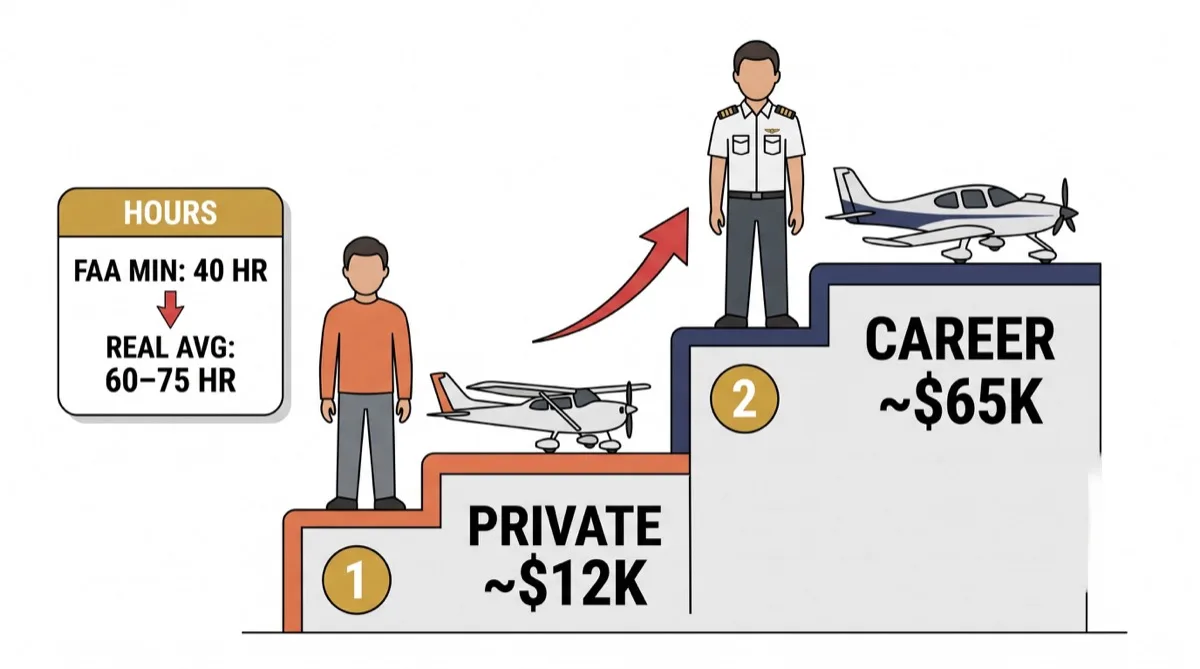
A private pilot certificate (PPL) costs a median of about $12,000, though real programs range from roughly $4,900 to $34,000. A full commercial or "zero-to-hero" career path — private through commercial and instructor ratings — runs a median around $65,000. Why such a huge spread? The low numbers usually quote the FAA minimum of about 40 hours, but the national average to a private certificate is closer to 60–75 hours. The extra flight hours, plus checkride retakes, exam fees, and (at destination academies) housing, all stack on top of the advertised "flat" number. Budget for the average, not the minimum.
| Program | Typical price | Note |
|---|---|---|
| Private Pilot (PPL) | ~$12,000 (median) | Range $4,900–$34,000; the low end quotes FAA-minimum hours |
| Commercial / zero-to-hero | ~$65,000 (median) | Private through commercial + instructor ratings |
For a metro-specific breakdown of how these dollars add up, see our cost of a private pilot certificate guide, and if you're a veteran, the GI Bill flight-training guide.
Thinking about a flat-rate program? What to check before you prepay
Accelerated academies often sell training as one reassuring flat price, sometimes financed with a big up-front loan. Before you sign, understand the risk you're taking on — because there's almost no regulation protecting prepaid tuition. As the Aircraft Owners and Pilots Association (AOPA) puts it: the FAA oversees safety and certification, but does not regulate how flight schools handle prepaid tuition or financial agreements. If a school fails, prepaid students are usually unsecured creditors — last in line.
None of this means accelerated programs are bad — many are excellent. It means you should treat a large prepayment like any other big financial commitment. AOPA's neutral advice to students is worth following: prefer pay-as-you-go where you can, never prepay more than you can afford to lose, read the refund clause (look for time limits and closure carve-outs), and talk to current students, not just the marketing. The safest way to buy training is in increments you control, from an operator you can verify.
Does multi-engine or turbine training cost more?
For real aircraft, yes — a multi-engine airplane rents for roughly 55% more than a single (about $295/hr versus $190/hr), because a twin genuinely burns more fuel and costs more to maintain. For simulators, though, the picture is different: the market prices a simulator by how sophisticated the device is, not by how many engines it's pretending to have. There's no clean "twin surcharge" or "turbine surcharge" on simulator time. That makes a simulator an especially good value at the complex end — practicing engine-out procedures or turbine systems on a device instead of in a $500+/hr real twin. For a look at how aircraft themselves compare, see our training aircraft comparison.
How is flight training usually priced — reading a rate sheet
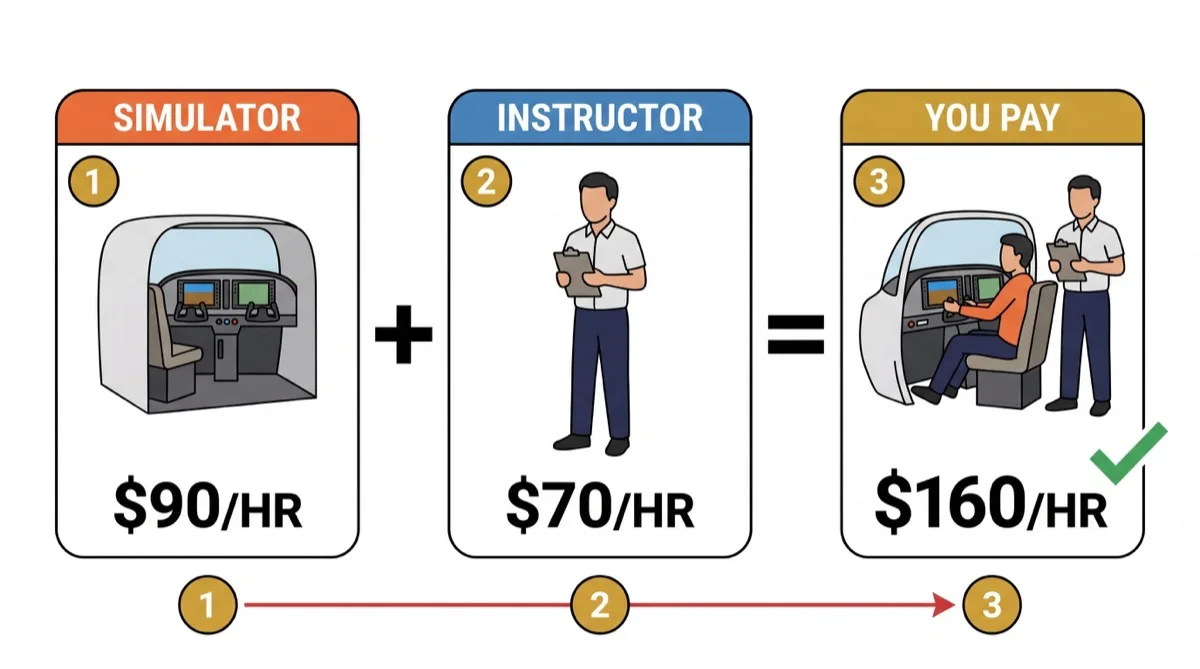
Most flight schools quote training as a simulator or aircraft rate plus a separate instructor rate, not a single all-in number. So a "$90/hr" simulator and a "$70/hr" instructor is really $160/hr when you fly them together. This matters when you compare schools: always add the two pieces, and check whether a posted rate is "wet" (fuel included) or "dry." A school that quotes one clear all-in number is doing you a favor — it's the honest way to compare. For a deeper look at how the training path itself affects cost, our Part 61 vs Part 141 guide and the student pilot certificate guide are good next reads.
One more line to hunt for on an aircraft rate sheet: a fuel surcharge. The posted rate is often a floor, not the out-the-door price. A dry rate looks cheaper but you buy fuel on top — roughly $50–70/hr on a single-engine trainer. And even many wet schools add a surcharge when avgas climbs above a set trigger (around $4–6/gallon), typically +$10–20/hr on a trainer and +$20–35/hr on a Cirrus-class airplane. It's not universal — after the last fuel spike, roughly half of schools used a surcharge and half simply raised the base rate — so always ask how fuel is billed before you compare two quotes.
How we gathered these numbers
These figures come from published rates at roughly 890 flight-training operators across 41 U.S. metros, gathered in two research passes in 2026 — a national sweep plus a focused look at destination-training states. We normalized about 505 posted rates, with a hand-verified backbone we opened and confirmed on each operator's own page. A few honest caveats: the Midwest and South rest on thin samples (few operators publish rates publicly there), "simulator" blends basic and glass-cockpit devices, and Texas had no publicly posted simulator rate we could verify. We show ranges and medians rather than single points, and we flag thin data rather than smoothing over it — a price guide is only useful if it's honest about what it doesn't know.