Spin Avoidance
Understand how spins develop from stalls and learn to recover at the incipient stage.
Lesson Objectives
- Explain how a spin develops from an uncoordinated stall
- Recognize the incipient phase of a spin and recover immediately
- Understand the role of rudder in spin entry and recovery
- Apply spin avoidance techniques during all phases of flight
The purpose of this exercise is to understand how spins develop from stalls and to learn to recover at the incipient stage — before a full spin develops. Spin avoidance is a critical safety skill for all pilots, particularly during the traffic pattern where altitude is limited and the consequences of an inadvertent spin are severe.
A spin can only occur when the aircraft is stalled. However, a stall alone does not cause a spin — the aircraft must also be in uncoordinated flight (yawing) at the moment of the stall. Understanding this relationship is the key to spin avoidance.
Simulator Practice
At Aviator.NYC, you will practice spin recognition and incipient spin recovery in our FAA-approved AATD simulator. The simulator allows you to safely experience the onset of a spin and practice correct recovery inputs without the risks associated with practicing in an aircraft at altitude.
Background Briefing Topics
- Causes of a Spin — the stall and yaw combination
- Autorotation mechanics
- Recognition of the incipient spin
- Recovery from an incipient spin
- Accidental spinning in the traffic pattern
Read the full Background Briefing →
Flight Exercise Topics
- HASELL checks and altitude requirements
- Spin entry from a full stall with deliberate yaw
- Recognition of incipient spin
- Standard spin recovery procedure
Causes of a Spin
A spin requires two conditions to be met simultaneously:
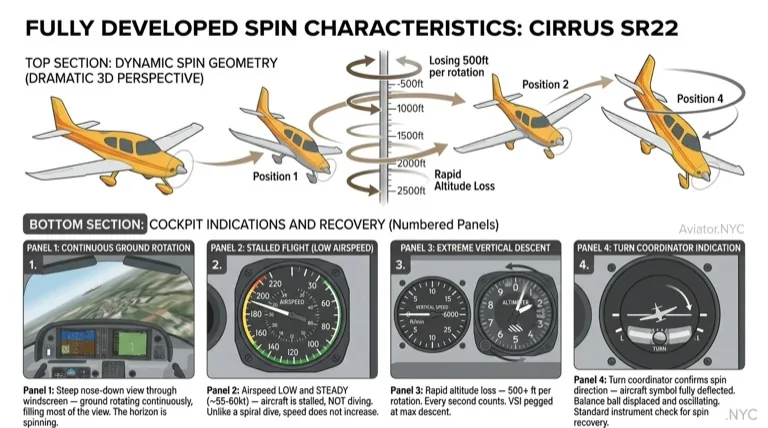
- The aircraft must be stalled — the wing must exceed its critical angle of attack.
- The aircraft must be yawing — the flight must be uncoordinated at the moment of the stall.
A stall alone does not produce a spin. If the aircraft stalls in coordinated flight, both wings stall symmetrically and the aircraft pitches nose-down without rolling or yawing into a spin. It is the yaw — caused by rudder misuse, a skidding or slipping turn, or adverse yaw from aileron input — that causes one wing to stall more deeply than the other.
Key Concept
No yaw at the stall = no spin. Maintain coordinated flight (ball centered) at all times, especially at low speeds, and you will not enter a spin.
The Role of Rudder
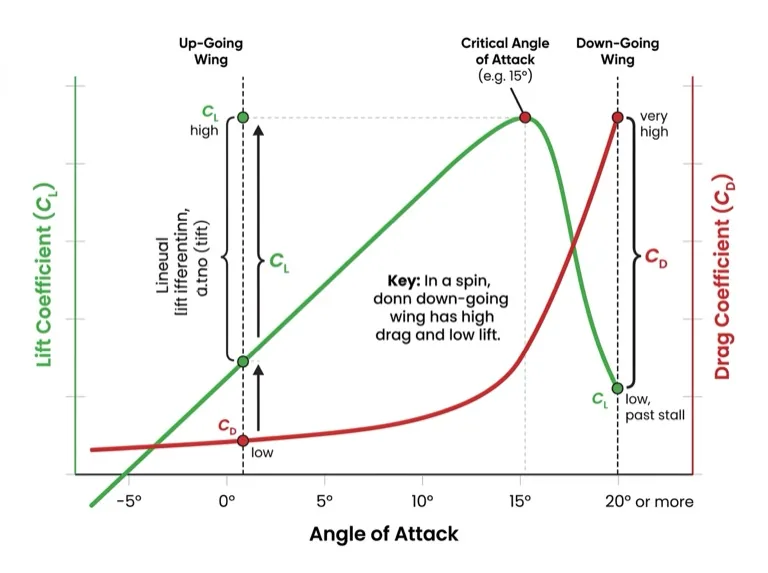
When the aircraft yaws at or near the stall, the down-going wing (the wing moving in the direction of yaw) experiences a higher effective angle of attack and stalls more deeply. The up-going wing (opposite to the yaw direction) has a lower effective angle of attack and may not fully stall. This asymmetry creates an imbalance in lift and drag that initiates autorotation.
The Role of Ailerons
Attempting to raise a dropping wing with aileron at or near the stall can worsen the situation. The aileron on the down-going wing deflects downward, increasing the local angle of attack on a wing that is already at or beyond the critical angle. This deepens the stall on that wing and can trigger a spin. The correct response to a wing drop at the stall is to use rudder to prevent further yaw — not aileron.
Autorotation
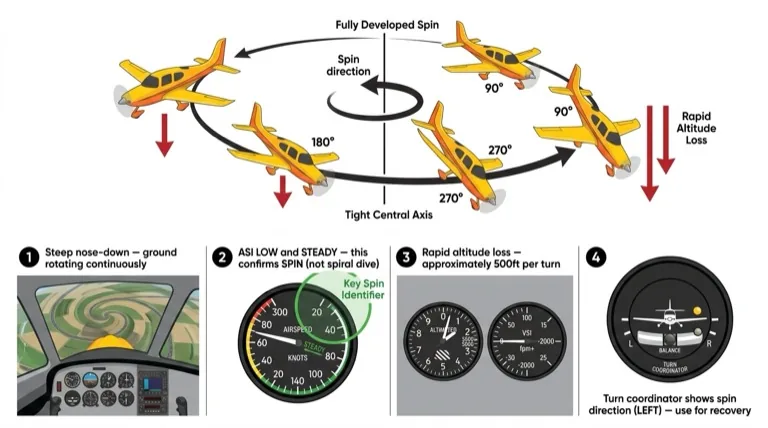
Once the spin begins, it is sustained by autorotation — a self-sustaining rolling and yawing motion driven by the differing aerodynamic forces on the two wings:
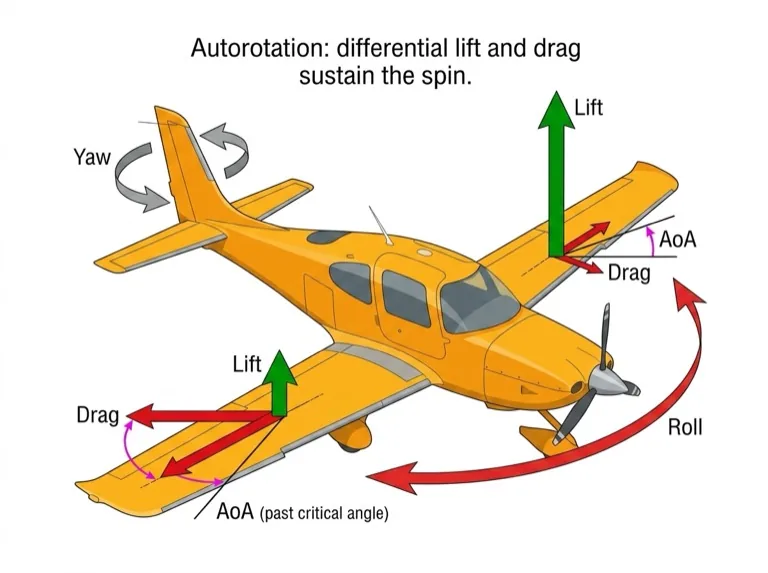
- Down-going wing: Higher effective angle of attack (deeper stall), greatly reduced lift, and increased drag. This wing drops further.
- Up-going wing: Lower effective angle of attack (less stalled or unstalled), relatively more lift and less drag. This wing rises.
The difference in drag between the two wings creates a yawing moment that sustains the rotation. The difference in lift sustains the roll. Together, these forces perpetuate the spin without any pilot input — the spin is self-sustaining once established.
Note
Autorotation will continue as long as at least one wing remains stalled. Breaking the stall (reducing the angle of attack) is essential to stopping the autorotation.
Recovery from an Incipient Spin
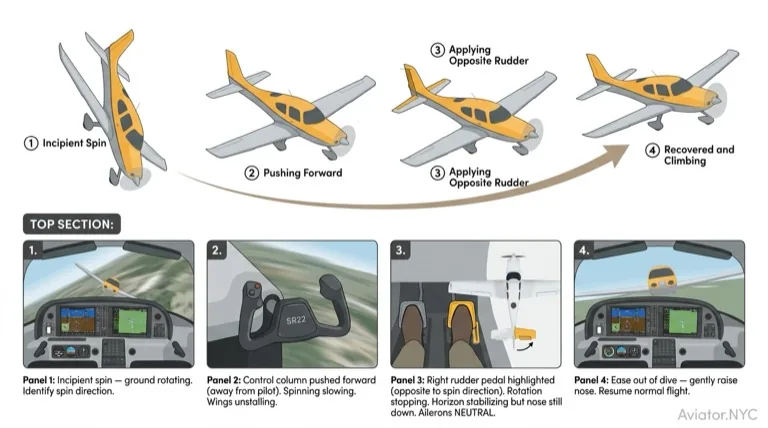
The incipient spin is the transition phase between a wing-drop stall and a fully developed spin. During this phase — typically lasting 1 to 2 turns — the aircraft has not yet settled into a stable spin. Recovery during this phase is faster, requires less altitude loss, and is more straightforward than recovery from a fully developed spin.
Recognizing the Incipient Spin
The incipient spin is recognized when:
- A wing drops sharply at the stall (beyond a normal wing-drop stall)
- The nose drops below the horizon with a simultaneous roll
- The aircraft begins to rotate — but has not yet rolled past approximately 90 degrees of bank
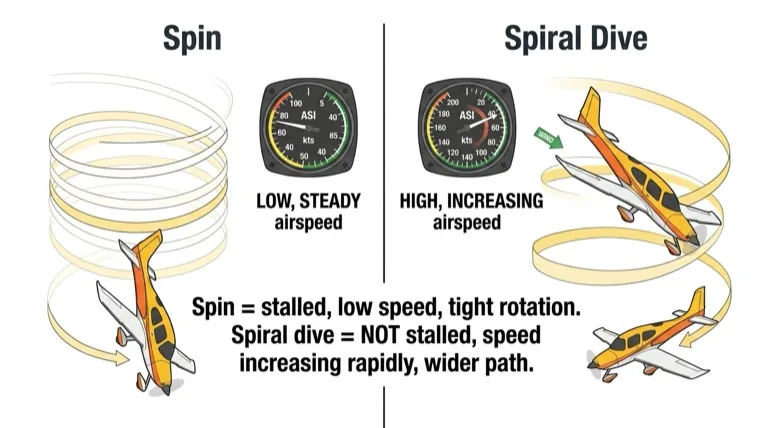
- Airspeed is low and relatively constant (not increasing as in a spiral dive)
Standard Recovery Procedure
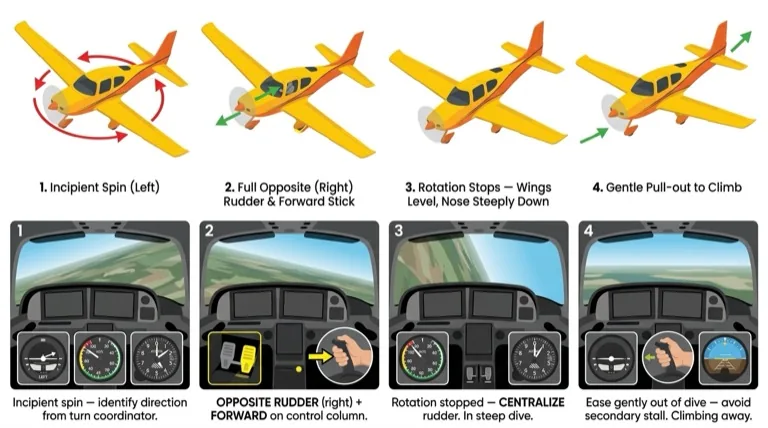
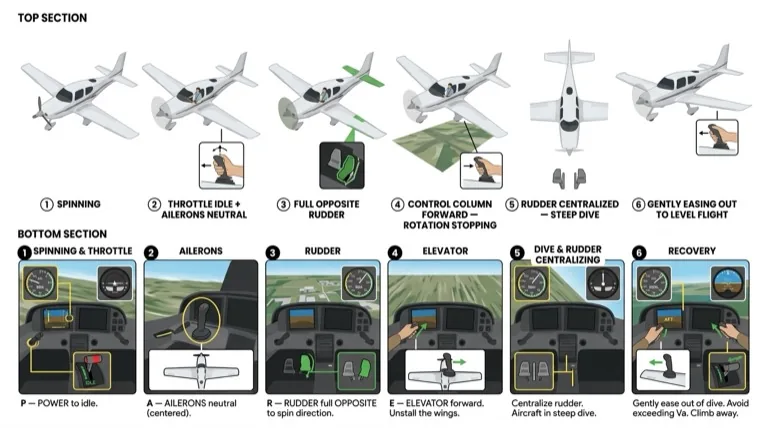
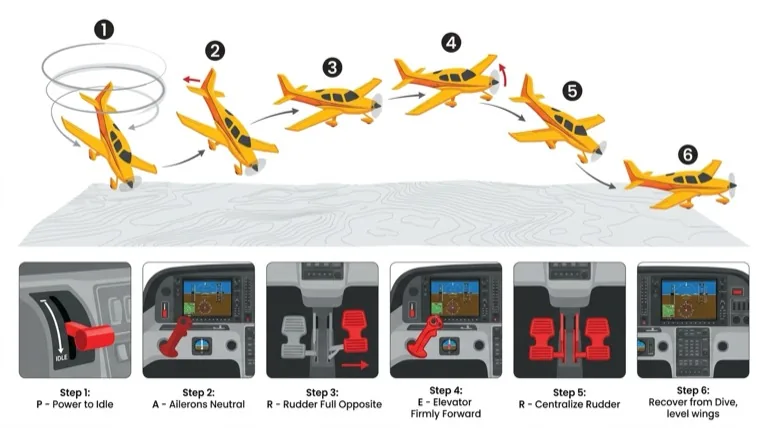
The recovery from an incipient spin follows these steps:
- Full opposite rudder — apply full rudder in the direction opposite to the spin rotation to stop the yaw.
- Control column forward — move the elevator control forward to reduce the angle of attack and break the stall. This is the critical step that stops autorotation.
- Level the wings — once the rotation stops and the stall is broken, use coordinated controls to level the wings.
- Recover from the dive — smoothly apply back pressure to return to level flight, being careful not to exceed VA or induce a secondary stall.
Critical Point
Do NOT attempt to raise the dropping wing with aileron during the incipient spin. This will deepen the stall on the lower wing and accelerate the spin entry. Use rudder first to stop the yaw, then forward elevator to break the stall.
Accidental Spinning
The most common scenario for an accidental spin is in the traffic pattern, particularly during the base-to-final turn. This situation combines all the elements needed for a spin:
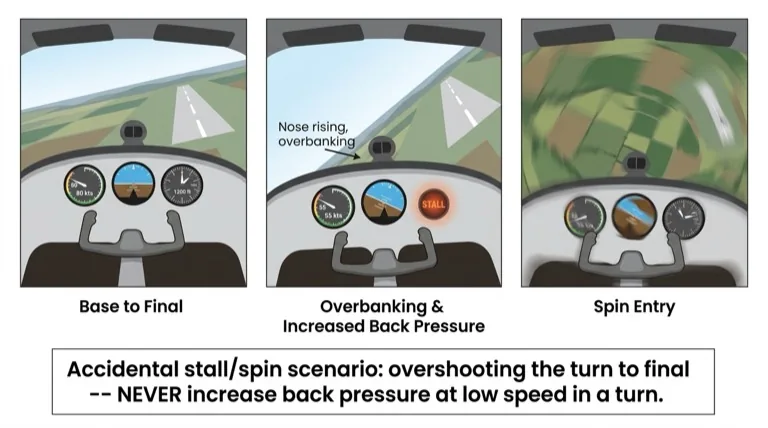
- Low airspeed: The aircraft is configured for approach, flying near the stall speed.
- Skidding turn: The pilot go-arounds the runway centerline and applies excessive bottom rudder to increase the turn rate rather than increasing bank angle.
- Distraction: The pilot is focused on aligning with the runway rather than monitoring airspeed and coordination.
The combination of slow speed plus a skidding turn (uncoordinated yaw) creates the exact conditions for a spin entry. At traffic pattern altitude (typically 800-1,000 feet AGL), there is insufficient altitude to recover from a fully developed spin.
Safety
If you go-around the turn onto final approach, do NOT use excessive rudder to force the aircraft around. Instead, either increase bank angle (up to 30 degrees maximum) or go around. A go-around is always the safest option when the approach is not stabilized.
Purpose
To recognize the transition from a stall to an incipient spin and to practice recovery before the spin becomes fully developed.
Airmanship
HASELL Checks
Before any spin-related exercise, complete the full HASELL check. Height is critical for this exercise — you must have sufficient altitude to complete the recovery and return to straight-and-level flight with adequate margin above the ground.
| Letter | Check | Action |
|---|---|---|
| H | Height | Sufficient to recover by at least 3,000 feet AGL (minimum). Your instructor will specify the required altitude. |
| A | Airframe | Flaps up, landing gear up (if retractable), aircraft in clean configuration. |
| S | Security | Harnesses tight, loose articles secured, hatches and doors locked. |
| E | Engine | Temperatures and pressures in the green, fuel sufficient, mixture set, carburetor heat check. |
| L | Location | Away from built-up areas, airports, and controlled airspace. Over a suitable forced-landing area. |
| L | Lookout | Complete a thorough clearing turn (180 degrees or more) to check for other traffic above, below, and at your altitude. |
Height is Critical
A spin can lose 500 feet or more per turn. Always begin spin exercises with sufficient altitude for full recovery plus a generous safety margin. Never practice spin maneuvers below your instructor's specified minimum altitude.
Spin Entry
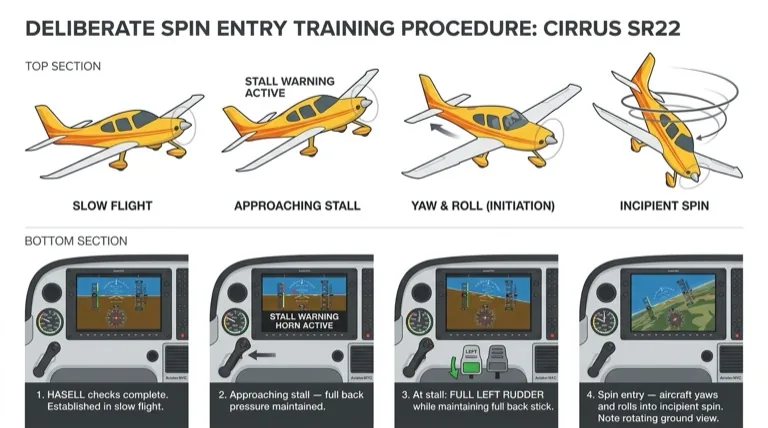
The spin is entered from a full stall with deliberate yaw:
- Establish straight-and-level flight at a safe altitude.
- Reduce power to idle and raise the nose to maintain altitude as speed decreases.
- As the aircraft approaches the stall (buffet onset, decreasing control effectiveness), apply full rudder in the desired spin direction.
- Continue holding the control column fully back to ensure the wing remains stalled.
- The aircraft will yaw and roll in the direction of the applied rudder, entering the incipient spin.
Note
Your instructor will demonstrate this maneuver first. Do not attempt spin entries without instructor supervision and in an aircraft approved for the maneuver.
Spin Recovery
Once the incipient spin is recognized, apply the standard recovery procedure immediately:
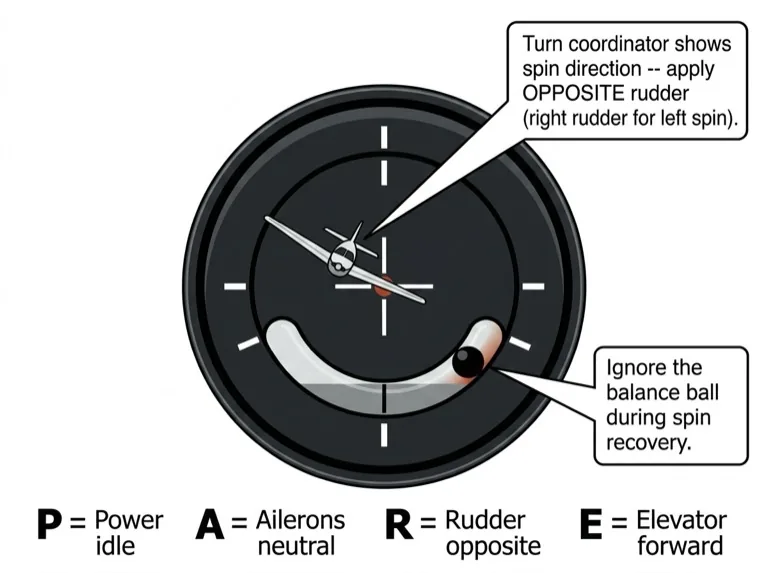
- Identify the direction of spin — look at the direction of rotation. The turn coordinator or the visual rotation will confirm the spin direction.
- Full opposite rudder — apply full rudder opposite to the direction of rotation to stop the yaw.
- Forward elevator — move the control column positively forward to break the stall (reduce the angle of attack below the critical angle).
- Centralize controls — when rotation stops, centralize the rudder and level the wings with coordinated aileron and rudder.
- Recover from the dive — smoothly apply back pressure to raise the nose to the horizon. Apply power as the nose reaches the horizon.
Recovery Priorities
The key actions are: stop the yaw (rudder), then break the stall (elevator forward). Do not pull back on the elevator until the rotation has stopped and the stall is broken — pulling back will maintain the stall and prolong the spin.
Common Errors
- Applying aileron to stop the roll instead of rudder — this deepens the stall on the lower wing
- Failing to move the elevator sufficiently forward — the stall is not broken and autorotation continues
- Pulling back on the elevator too early during recovery — causing a secondary stall
- Exceeding VA during the dive recovery — risking structural overload
- Failing to apply power smoothly during the pull-out from the dive
Key Takeaways
Spin Avoidance is the Primary Goal
The most important lesson from this exercise is that spin avoidance — not spin recovery — is the primary defense. A spin cannot occur without both a stall and uncoordinated flight. Maintain coordination (ball centered) and fly above the stall speed, and a spin is aerodynamically impossible.
Two Conditions Required for a Spin
| Condition | Prevention |
|---|---|
| Stall | Maintain adequate airspeed; do not exceed the critical angle of attack |
| Yaw (uncoordinated flight) | Keep the ball centered; use rudder and aileron in coordination |
Incipient Spin Recovery
| Step | Action | Purpose |
|---|---|---|
| 1 | Full opposite rudder | Stop the yaw |
| 2 | Control column forward | Break the stall |
| 3 | Level wings | Stop the roll |
| 4 | Recover from dive | Return to level flight |
Critical Points to Remember
- Never attempt spins at low altitude — spin recovery requires significant height (500+ feet per turn).
- The traffic pattern is the danger zone — low speed, turns, and distractions create the conditions for accidental spin entry.
- Do not use aileron to correct a wing drop at the stall — use rudder to prevent yaw.
- Recognition is time-critical — the sooner you recognize the incipient spin, the less altitude is lost in recovery.
- If in doubt, go around — never force a turn in the traffic pattern with excessive rudder at low speed.
Remember
An inadvertent spin in the traffic pattern is almost always fatal because there is insufficient altitude for recovery. The best defense is prevention: maintain airspeed, maintain coordination, and never hesitate to go around.
What's Next
In the next lesson — Fully Developed Spin (Exercise 11b) — you will learn about the phases of a fully developed spin, the aerodynamics of sustained autorotation, and the standard recovery procedure (PARE) from a developed spin.
Simulator Tip
Schedule a follow-up AATD session at Aviator.NYC to practice incipient spin recognition and recovery. The simulator allows unlimited repetition in a safe environment, building the muscle memory needed to respond correctly if a spin is ever encountered inadvertently.
Coming Up Next: Lesson 10 — Fully Developed Spin
Understand the phases of a fully developed spin, autorotation mechanics, and the standard PARE recovery procedure.
Skills You'll Work On
These are the maneuvers and procedures covered in this lesson. Your instructor tracks each one as you progress.
- Preflight Inspection
- Engine Starting
- Taxi & Before Takeoff Check
- Radio Communications
- Normal Takeoff and Climbs
- Climbing & Leveling Off With Turns
- Straight & Level Flight/Various Airspeeds
- Steep Turns
- General Handling
- Use of Trim Flaps Mixture Carb Heat
- Clean Stall- Standard Recovery
- Power On Stall
- Stalling with Flaps
- Stalling in a Turn
- Spin Avoidance Techniques
- Go Around Procedure (At Altitude)
- Approach Planning & Altimeter Setting
- Normal Landing
- After Landing Parking and Securing
Grades reflect what was covered in this lesson, not a certification of pilot competency.
Lesson Plan
Where this fits: Exercise 11a, "Spin Avoidance," follows the stalling exercise and precedes the fully developed spin. It teaches how a spin develops from an uncoordinated stall and how to recover before a full spin forms. Conducted on Aviator.NYC's FAA-approved Advanced Aviation Training Device (AATD).
- Prerequisite
- Student can recognize and recover from stalls in clean, power-on, and flapped configurations with correct wing-drop technique.
- Materials
- C172 G1000 AATD simulator; checklist card; HASELL check reference; local VFR sectional and airport diagram.
- Objectives for this session
- Complete a HASELL check with adequate altitude, then explain how a spin develops only from a stall combined with uncoordinated (yawing) flight.
- Recognize the incipient phase of a spin and recover immediately, applying the role of rudder in spin entry and recovery.
- Apply spin-avoidance techniques, with emphasis on coordination during the slow, low-altitude conditions of the traffic pattern.
Looking Ahead
Next is Lesson 10, Fully Developed Spin (Exercise 11b), which lets a spin develop fully and uses the PARE recovery. If recognizing the incipient spin or applying prompt rudder recovery was slow today, repeat a couple of incipient entries at the start of Lesson 10 before letting a spin develop.
These lesson plans are provided as supplementary training guidance only. They do not supersede FAA publications, aircraft manufacturer documentation, or your instructor's direction. Always refer to the FAA Instrument Flying Handbook, Airplane Flying Handbook, AIM, and applicable POH/AFM as the official sources.